“Which overdue jobs need attention before the next schedule is agreed?”
The planner opens the report. There are 4 overdue work orders. A table underneath shows the equipment, the target date and the status. You can filter by discipline. Someone's added a trend as well.
Then the questions start.
Does that include jobs waiting for materials? Why is that completed job still there? Is the equipment reference right? And which of these can someone actually do something about this week?
You could spend the whole meeting working out what the report means. The schedule still needs agreeing.
I'd start with that conversation when building the reporting system. The person using it needs a number they can check, enough detail to understand the work behind it, and a way to take an agreed action back into the working process. There's quite a bit to join up (and most of it happens before anyone chooses a chart).
Here's a fictional example to work through. The site, records, people, dates and decisions are invented. The report designs and AI responses are illustrative proposals, not a working integration or a tested AI trial. The small dataset is deliberately limited so you can follow each order through the system.
Give the report a decision to support
At the fictional Northbank site, a maintenance supervisor and planner are preparing for the weekly schedule discussion. They want to identify overdue corrective jobs that need a preparation check or a decision before the schedule is agreed.
They aren't asking the report to approve a deferral, certify readiness or choose a safe execution sequence. Those decisions stay with the people authorised under the site's work-management arrangements.
That leaves the report with a useful job: show the relevant orders, make the gaps visible and help the reviewer find the evidence they need to ask the next question.
I'd write down who will use it and when. Here, the planner checks the pack on Monday morning. The supervisor uses it in Monday's preparation review. Actions need an owner and a due time before Thursday's schedule discussion. Next Monday, they check what happened.
That timing affects the design. A Sunday snapshot can support Monday's review, provided everyone knows when it was taken. By Thursday, someone needs current preparation information. A historical picture of Sunday's backlog won't tell you that a spare arrived on Wednesday.
So the report needs two dates in plain view: when the source information applies and when the reporting process last loaded it. If they differ, the person reading it should be able to see that without asking the analyst.
The same applies to success. I'd ask whether the planner can find an order, explain why it appears, identify the missing evidence and take an accepted action into the next review. That gives you something practical to test alongside the arithmetic.
For the wider reasoning behind this approach, From maintenance data to decisions follows the path from a measure to diagnosis and follow-up. This guide concentrates on the system that makes that path usable.
Agree what “overdue” means before counting anything
Northbank uses a simple rule for this example. At Sunday 18 October 2026, 23:59 site time, count each distinct corrective work order at Northbank whose agreed target finish date is before 19 October and whose status at that cut-off is Approved, Waiting materials or Ready. Exclude Cancelled and Complete. A missing target date goes into a separate exception list.
Here, those three included statuses all mean the work remains open. “Ready” is the recorded status, which the planner still needs to check before scheduling. The target finish is a date, so an open job due on Sunday becomes overdue at the end of that Sunday. This is an invented counting convention, not a recommended site standard.
The agreed date matters. Creation date, planned start, scheduled finish and required completion can each answer a different question. If your export calls a column “finish date”, ask someone who owns the process which finish it means.
There's another trap in the phrase “agreed target”. If someone moves the target date, the job can disappear from overdue reporting without any work being done. I'd want the date-change process and history understood before presenting a fall as progress.
The supervisor accepts the counting rule; the analyst records its version and implements it. Later changes need an identified approver and an explanation of how earlier results will be treated. Otherwise, two perfectly competent analysts can produce different answers and spend Friday explaining each other's work.
Defining a maintenance KPI people can defend goes further into dates, populations and exceptions. For this build, the definition becomes a short agreement the source owner, analyst and supervisor can all read.
Open the records that will feed it
The fictional extract contains 6 distinct Northbank work orders. All are corrective. These are their checked positions at the Sunday cut-off:
| Order | Equipment reference | Target finish | Status at cut-off | Included as overdue? |
|---|---|---|---|---|
| WO-1101 | P-41A | 15 Oct | Waiting materials | Yes |
| WO-1102 | P-41B | 16 Oct | Ready | Yes |
| WO-1103 | P-41A | 14 Oct | Complete | No |
| WO-1104 | P-42 | 17 Oct | Cancelled | No |
| WO-1105 | P-42 | 18 Oct | Approved | Yes |
| WO-1106 | P-4I | 15 Oct | Waiting materials | Yes; equipment unresolved |
You can count those by hand: 4 overdue orders out of 6 extracted orders. The 6 is a reconciliation total, not a KPI denominator. Two orders are waiting for materials, one is Ready and one is Approved. No target dates are missing in this sample.
WO-1106 has an awkward equipment reference. The last character in P-4I is a capital letter I. The checked equipment list contains P-41A, P-41B and P-42. It doesn't contain P-4I.
I'd keep that order in the site total. Its site, type, target and status meet the rule. I'd show its equipment as unresolved and ask the source owner to establish the right reference. Silently dropping it would make the total 3. Guessing P-41A would make the equipment analysis look more certain than it is.
This is where someone who knows the work earns their place in the build. They can tell you which references identify an installed asset, which identify a location, and whether the order can legitimately refer to more than one item. The miniature model here assumes one primary equipment reference per order. A site with multi-equipment jobs needs a separate, agreed way to represent and count them.
The source system owner also needs to confirm that the extract covers the intended site and records. A reporting tool can process every row it receives correctly while half the site's work is missing from the extract.
Access can change the answer too. Suppose the analyst can see all 6 orders and a planner can see only the 3 assigned to their discipline. Both people might open a page headed “Northbank overdue work” and reasonably assume they're looking at the site total. I'd make the scope explicit and test the report using the intended reader's access, including the detail view and any exported pack.
Agree who may see the records, commentary and actions. A meeting pack shared beyond the original audience can carry information the source system would have restricted. The source owner and the organisation's data-access owner need to accept that distribution. A report author shouldn't have to invent the policy while trying to finish the page.
Can your maintenance data answer the question? explores that fitness check. I'd do it with a few real records in the organisation's approved environment before making promises about the finished report.
Keep the original extract and make the changes explainable
For this example, the raw work-order extract is retained as received. The preparation steps create a separate reporting table. They standardise the agreed status labels, read the dates as dates, check unique order identifiers and compare equipment references with the checked equipment list.
Each step should have a reason you can explain to the planner. Removing stray spaces from a status label can be sensible. Converting an unknown status to Complete because it won't fit the existing categories needs a very different conversation.
I'd put unrecognised values into an exception list. The data owner decides their meaning. The analyst can then change the mapping, record the decision and rerun the checks. A correction to a reporting mapping and a correction to a CMMS record are separate changes, with their own owners.
The same discipline applies to duplicates. The sample has 6 orders, but the accompanying status-history extract contains 7 rows. WO-1101 has two events: Approved on 12 October and Waiting materials on 16 October. Each other order has one supplied event. For this fictional cut-off, those events are sufficient to establish the statuses shown above.
Here are the supplied events. All times are fictional Northbank site time in October 2026. The event IDs identify records, rather than extra jobs.
| Event | Order | Effective date and time | Recorded status |
|---|---|---|---|
| E-01 | WO-1101 | 12 Oct, 09:00 | Approved |
| E-02 | WO-1101 | 16 Oct, 10:00 | Waiting materials |
| E-03 | WO-1102 | 17 Oct, 11:00 | Ready |
| E-04 | WO-1103 | 17 Oct, 14:00 | Complete |
| E-05 | WO-1104 | 17 Oct, 15:00 | Cancelled |
| E-06 | WO-1105 | 16 Oct, 08:00 | Approved |
| E-07 | WO-1106 | 17 Oct, 09:00 | Waiting materials |
For this supplied test, choose the latest effective event at or before the cut-off for each order. WO-1101 therefore takes E-02. Keep E-01 in the source history so the earlier position remains traceable. These are selected events sufficient for this one cut-off, not a complete lifetime history from which to promise a trend.
If you join the history rows onto the orders and count rows after applying the overdue rule, WO-1101 can appear twice. The result becomes 5 rather than 4. Both of its supplied statuses are open, so a row count won't rescue you.
I'd want the analyst to show this exact case during testing. Someone should be able to point at the extra row and explain how the calculation avoids counting the same order twice.
Automation can help repeat these steps. It can also repeat a mistaken rule every morning. My draft handbook discusses automating measures to reduce repeated manual work; I'd pair that with explicit checks of the definition, inputs and result. A successful refresh tells you that the process ran. You still need to know what it produced.
 Open full-size image (opens in a new tab)
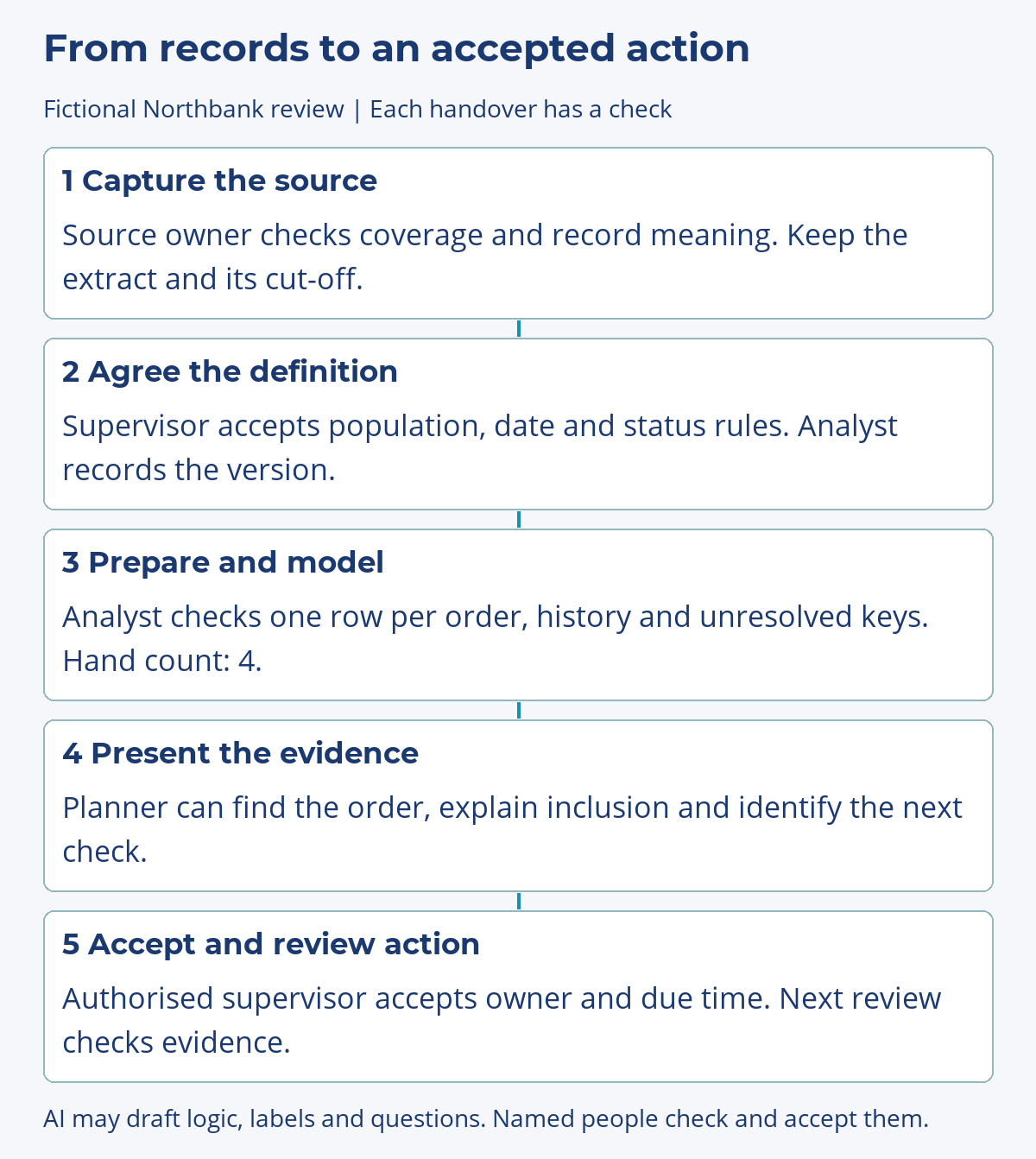
Original MDP diagram, developing the equipment, measure and performance-management themes in my draft handbook and MDP planning notes. These are proposed responsibilities for the fictional example. Passing information along the route includes a check at each handover.
Give each table one clear job
You don't need to become a database designer to ask a useful question of a model: what does one row mean here?
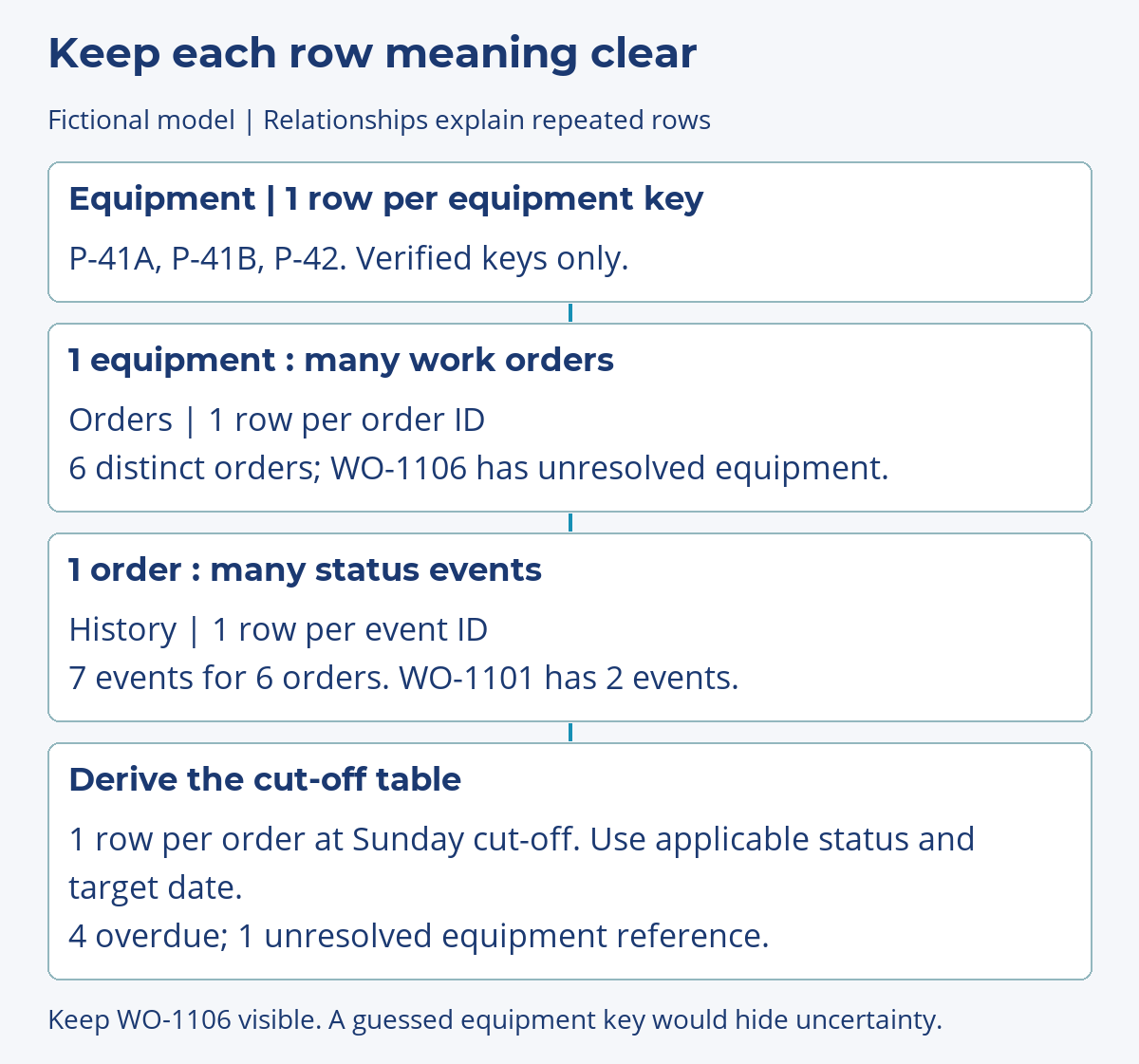
In Northbank's equipment table, one row means one checked equipment record. In the work-order table, one row means one order. In the history table, one row means one recorded status event for an order, with an event identifier and effective time.
Those are different things. Putting them into one wide table without thinking about the relationships can multiply orders, costs or hours. Counting distinct order identifiers may fix one measure while leaving another doubled.
The equipment table links to the orders using the agreed equipment key. One equipment record can have several orders. Each order can have several history events. An unresolved reference remains visible through an explicit unresolved category; it doesn't vanish when the report groups work by equipment.
For the Sunday count, a prepared cut-off table contains one row per order, with the status and target date that applied then. The raw event history remains available for tracing. If two events have the same effective time, the rule needs a reliable sequence or an exception for someone to resolve. “Take whichever row comes first” would worry me.
A report for several weeks needs more thought again. Daily or weekly snapshots can preserve each reporting position. An event-based reconstruction can work when the relevant changes and their timing are available. Either approach needs a stated rule for late corrections, retention and reruns.
Today's status and today's target date alone can't establish last Sunday's position. If target dates can change, status history by itself won't be enough either. Northbank's tiny example assumes the listed target dates were verified as applicable at the cut-off. That assumption needs evidence in a real build.
I'd keep the first model small enough to inspect. Equipment, orders and history are enough to explain this question. Labour, costs, materials and downtime may be valuable later. They need their own row meanings and links when the decision actually requires them.
 Open full-size image (opens in a new tab)
Original, system-neutral model sketch. The 1-to-many links explain the fictional sample; this isn't a deployed Power BI model. The prepared cut-off table is derived from the checked records and applicable history, rather than added to the order count.
Build the page around the next useful question
Now I'd sketch the report with the planner.
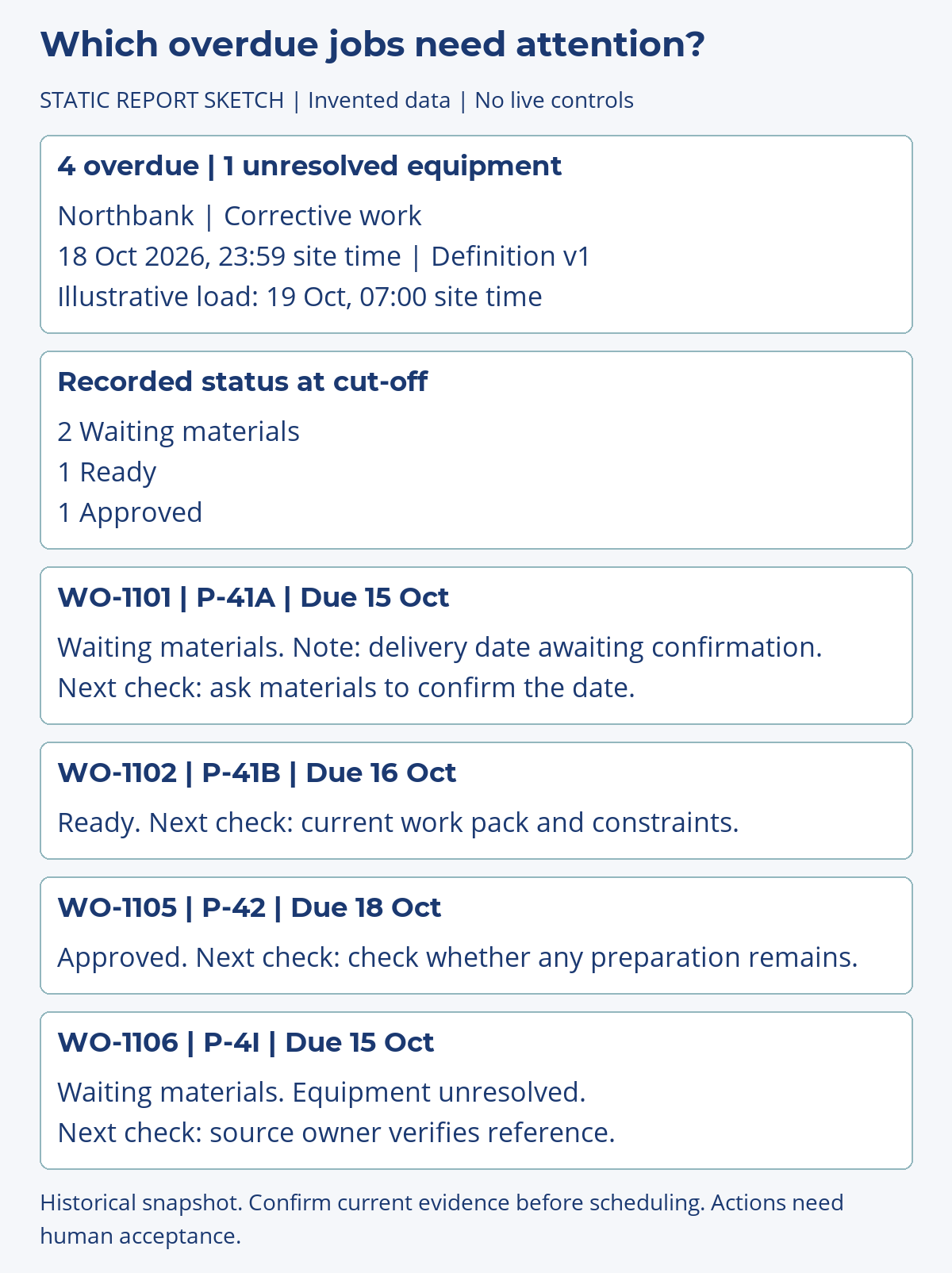
At the top: the question, the site, the cut-off and the definition version. Then the 4 overdue orders and the 1 unresolved equipment reference. The exception needs a label someone can understand. A small warning symbol with no explanation leaves the reader to guess whether anything matters.
Below that, a simple breakdown: 2 Waiting materials, 1 Ready, 1 Approved. Those categories suggest different conversations. They don't establish why the work is late. An order waiting for materials might have had several earlier delays, and the current status may itself need updating.
The order list should include identifiers, target dates, recorded statuses and the next evidence to check. For WO-1101, the supplied preparation note says “delivery date awaiting confirmation”. That gives the planner a specific question for materials. For WO-1102, the Ready status directs the planner to check the work pack and current constraints. Neither label authorises scheduling by itself.
Selecting an order should expose the relevant source reference and history in a real implementation. The reviewer needs to know where the information came from and how current it is. Whether that is a permitted link back to the CMMS or a checked detail view depends on the site's access arrangements.
I'd avoid putting a trend onto this particular mock-up. There's one cut-off in the sample. A line joining invented weekly totals would add an appearance of evidence the dataset doesn't contain. When comparable snapshots exist, a trend can be useful, with definition changes and corrections visible.
The visual below is a proposed layout, using only the fictional count and notes described here. It shows the information to put together, rather than the controls of a finished application.
 Open full-size image (opens in a new tab)
Original static report sketch. No buttons, links, refresh or write-back are demonstrated. WO-1101's delivery note is supplied fictional context; the other prompts identify checks still needed. The layout gives the reader a route from the total to a specific question.
On a smaller screen, I'd want the same meaning preserved in a different arrangement. The order identifier, status, date and evidence prompt need to stay together. Shrinking the whole desktop page until the text is tiny would make the planner's job harder.
I'd also ask the actual users where they read the report. A screen in a meeting room, a laptop and a phone on a site connection are different conditions. Test with the people and equipment involved before calling the page usable.
Give AI a bounded task and the evidence to do it
There's useful work for AI throughout this build. I'd make each request small enough that someone can check the result.
Early on, an analyst could provide the agreed overdue definition, a field dictionary and these 6 fictional orders. Ask an assistant to identify ambiguous fields and propose test cases. It might notice the Sunday boundary or ask whether the target date can change. The supervisor still accepts the definition, and the source owner confirms what the fields mean.
During preparation, the analyst could supply the same definition, a sanitised schema, the equipment list and the 7 status events. Ask for draft transformation logic and an explanation of how one row per order is preserved. The analyst reviews that proposal in a test environment and checks its output against the hand count. A convincing explanation alongside incorrect logic still fails the test.
At the report stage, an assistant could propose labels or group supplied review notes into questions. Give it the record identifiers and require it to distinguish a recorded fact from a proposed check. The planner checks that distinction before the text enters the review pack.
For example, imagine this request:
Using only the supplied cut-off table, checked equipment list and WO-1101 delivery note, draft questions for Monday's planner review. Cite the order identifier for each question. Keep unknown equipment unresolved. Don't infer causes of delay or recommend deferrals.
The following is a hypothetical bad response written for this explanation, not an output from a separate model test:
Material shortages caused half the overdue work. P-4I is probably P-41A. Expedite both orders and defer WO-1105 to protect the schedule.
You can see how much has slipped in. Two of 4 orders are recorded as Waiting materials. That doesn't establish that material shortages caused their overdue position. The equipment guess has no accepted basis. Expediting and deferral require context and authority the assistant wasn't given.
A bounded draft could instead say:
WO-1101: the supplied note says delivery date awaiting confirmation. Who will confirm the date? WO-1106: equipment reference P-4I is absent from the checked equipment list. Who can verify it? WO-1102: status is Ready at the cut-off. What current evidence supports including it in Thursday's schedule discussion? WO-1105: status is Approved. What preparation remains?
That's also illustrative teaching text. Its usefulness would need checking with the planner. It preserves what the evidence supports and turns missing context into questions.
For real work, data access comes first. The organisation needs to approve the AI environment and the specific information it may receive. A tool's ability to accept an upload doesn't grant permission to share a work-order export. Use the minimum necessary fields; names, commercial details and sensitive plant information may be unnecessary for the task.
If an assistant has a connector, establish which records it can read, under whose access, at what time and with which filters. If it has no access, give it a controlled extract and say so. Asking it to “check the CMMS” won't create a connection.
I would keep read-only preparation separate from any ability to change records. In this proposed workflow, AI drafts questions and candidate logic. The analyst accepts technical changes after testing. The planner checks preparation facts. The authorised supervisor accepts actions. Any CMMS updates follow the site's existing permissions and review process.
That division makes mistakes easier to catch while the work is still a proposal.
Test the number and the conversation
I'd sit the analyst and planner down with the sample before extending the report. First, reconcile the result: 6 distinct extracted orders, 4 included, 2 excluded. Confirm the status split totals 4. Confirm the unresolved equipment group contributes 1, so equipment group totals also add to 4.
Then try the cases most likely to expose a mistaken assumption. An open job due on 19 October shouldn't count at the Sunday cut-off. A missing date should enter the exception list. A duplicated event shouldn't create another order. An event recorded after the cut-off needs the agreed effective-time and late-correction rule.
A reopened order is particularly useful. Can the model tell whether it was open at the reporting cut-off? Can it distinguish that position from today's status? The expected result needs agreement from the process owner before the analyst implements the test.
Those checks establish whether the calculation follows the rule. I'd then give the planner a different task: “Find WO-1106 and tell me what you'd do next.”
Record the expected behaviour before the test. Here, the planner should find the order under the unresolved equipment group, confirm its inclusion from the target date and status, then ask the equipment-data owner to verify the reference. If the planner assigns it to P-41A from the spelling alone, the test has revealed a problem to discuss. Time taken to find it can be useful feedback; choosing the right next check matters more than an impressive click count.
Can they see that the equipment reference is unresolved? Can they find the source reference? Do they know whom to ask? Does anything on the page encourage them to treat the guessed equipment or recorded status as accepted fact?
For WO-1101, ask them to explain what the delivery note establishes. For WO-1102, ask whether Ready at Sunday makes it ready for Thursday. A correct answer includes the need to check current conditions. If the page suggests otherwise, the design needs changing even if every total is right.
I'd record where the reader hesitates and change the page accordingly. Another chart may help. A clearer label, source link or conversation with the data owner may do more.
Failure-code reporting needs the same care: The failure code is filled in. Can you use it? shows how a completed field can encourage an unsupported interpretation. AI-written commentary deserves that check too.
Make the agreed action easy to find next time
Monday's fictional review agrees a small set of actions. Mara, the planner, will ask materials to confirm WO-1101's delivery position by Wednesday noon. Ellis, the equipment-data owner, will verify WO-1106's reference by Tuesday noon. The supervisor accepts those actions and their due times.
Record the order reference, the question, the owner, the due time and the evidence expected back. Record who accepted the action. An approved local action log can do that for a pilot. An application may help later, particularly with permissions and reminders, once the process is clear.
The report needs a visible route to that log. A proposed action written in AI commentary shouldn't quietly become an assigned commitment. Someone accepts it, and the named owner knows what they're being asked to do.
At Thursday's discussion, the team checks current preparation evidence. At the following Monday review, they check whether the actions were completed and what the evidence now supports. A confirmed delivery date may help planning. It doesn't mean the material has arrived, the order is ready or the maintenance has been carried out.
If Ellis corrects the equipment reference, preserve the original reporting position and record the correction. The organisation should decide whether a historical report is restated or carries a correction note. Either way, someone needs to be able to explain why the equipment grouping changed.
I'd also take feedback to the person maintaining the source record. Did they understand which reference to use? Could they find it? Was the correct equipment available in the system? That conversation gives the reporting team a chance to improve the next record, rather than fixing the same problem in another extract.
What happens after a KPI turns red? concentrates on that follow-through. Here, the technical build needs to preserve the links that let it happen.
Leave a system someone else can run
Before handing this over, I'd want a named owner for the source extract, the definition, the preparation/model and the report. The review chair owns the meeting and accepted actions. One person may hold several roles in a small team; the responsibilities still need naming.
Write down how the data arrives, how often it should arrive and what to do when it doesn't. If Monday's load fails, the page should show the last successful cut-off and an explicit stale-data notice. The team then decides whether to use a checked older pack, prepare a controlled replacement or postpone that part of the review.
Keep the previous accepted version available. Changes to a mapping, relationship or calculation need the relevant checks before they replace it. If the new version fails, the person supporting the report needs a way back and a record of which reviews used which version.
Decide how long to retain the source extracts and accepted review packs, too. Keeping enough evidence to reconstruct a decision is useful; retaining every copy indefinitely can create another support and access problem. Use the organisation's retention requirements and name the person responsible. If the history needed for a promised trend won't be available, change the promise before handing the system over.
For AI-assisted steps, retain the task brief, input references, draft and acceptance record to the extent the organisation permits and needs. Someone investigating an error should be able to establish what evidence the assistant actually received. Sensitive source data doesn't need copying into every log to achieve that.
I'd start with one question, one site and one review. The companion reporting-system acceptance sheet gives the analyst, planner and supervisor a place to record the rule, hand count, exceptions, next question and acceptance evidence. It's a static worksheet with an invented example and blank fields. It hasn't been trialled operationally.
Take a handful of orders through the whole route. Check the original records. Check the number. Ask the planner to use the page, then come back to the accepted action at the next review.
You'll learn quite a lot from the first job that doesn't fit. Keep it visible. Agree who needs to resolve it. Then make the next version easier for someone else to use.