The schedule-attainment card is red. Sixty per cent.
Someone asks why. The planner opens the list. There are 10 jobs on it, 6 marked complete and 4 that missed the week. Two mention materials. One says “operations”. The last has no explanation.
“So the problem's spare parts?”
Perhaps. I'd want to open the orders before putting that in the minutes.
What does complete mean? Was that the schedule agreed at the start of the week? Did someone change it on Wednesday? And does “materials” mean the supplier was late, the part was wrong, or nobody had checked it before the job went into the schedule?
Those questions take you from a coloured card into the work people are trying to do. That's where I'd want the report to take you.
I'll use a fictional site and a small weekly schedule throughout this guide. All its records, people, figures, conversations and later outcomes are invented. The AI preparation is a proposed use, with illustrative text written for the example. There hasn't been a live integration or a trial on a maintenance site.
The question is practical: what would let the team use that 60% to decide what happens next, and return next week with something worth checking?
Start with the decision someone needs to make
“Improve schedule attainment” could keep a team busy for quite a while. It leaves a lot for everyone else to work out.
For this fictional review, the maintenance supervisor, Mara, wants to decide which changes to job preparation or schedule agreement deserve attention before the next schedule is frozen. The scheduler, planner, materials coordinator and operations representative each hold part of the answer.
Mara has delegated authority over the preparation improvement being discussed. Decisions about operating equipment, changing maintenance requirements or authorising physical work stay with the site's designated people and processes.
That's enough to give the reporting work a purpose. The team needs to see the jobs that missed, what was known when they were accepted into the schedule, what changed afterwards, and who can resolve each unanswered question.
An analyst could spend the morning adding a trend chart. A useful chart, probably. I'd also ask whether the person in the meeting can open the 4 orders behind the number and find the notes that explain them.
Start there. What decision is coming? Who can make it? What would they need to know?
The answers help you choose what to capture and what to put on the report. They also give you a reason to leave things out. A report for this review doesn't need every field the CMMS can export.
My unfinished handbook on reliability culture approaches decision support through the data model, inputs, the conditions around capture, quality and use. I find those useful places to look when a perfectly respectable report leaves someone unable to answer “what happens next?”
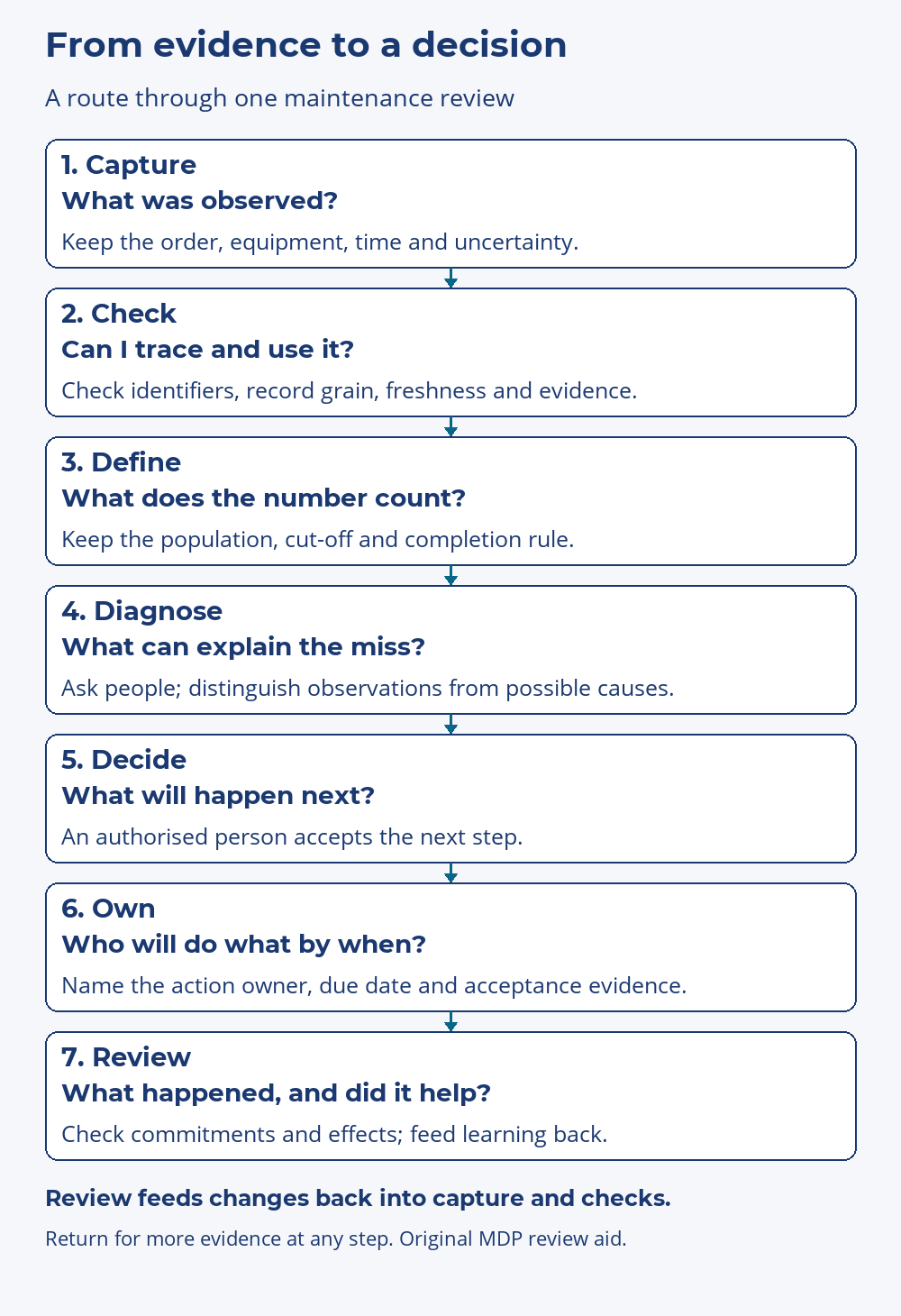
You can work backwards from the decision, then follow the evidence forwards to check whether it gets you there.
 Open full-size image (opens in a new tab)
An original MDP review aid developed from the handbook's decision-support themes. The arrows show a route through the questions, with returns for more evidence whenever it's needed. They don't imply that a calculation establishes a cause.
Agree what the 60% actually counts
At the fictional site, the weekly schedule was frozen at 15:00 on Friday 5 June 2026 for Monday 8 to Sunday 14 June. It contained 10 distinct work orders. Each had a scope and a planned completion within that week.
The example measure counts those frozen-schedule orders whose agreed scope was physically completed by 23:59 on Sunday 14 June, supported by a completion record checked by the supervisor. It divides that count by the 10 orders in the frozen schedule. Each order counts once, regardless of its estimated hours.
Six met that rule. Four didn't. Six divided by 10 gives 60%.
The fictional team's target is at least 80%, so the card is red. That target is an example, with no claim that it's suitable for another site. The measure says nothing on its own about whether the work was the right priority or whether all the site's maintenance obligations were met.
There's no ambiguity about extra work here: jobs added after the freeze are tracked separately. They don't enter this denominator. An order removed during the week stays in the original selection, with its reason for removal. The review can discuss that decision without rewriting what the team originally committed to.
Your site might use hours, tasks or another completion rule. Agree it and show it. A count-based measure gives a 2-hour job the same weight as a 40-hour job. If you're trying to understand use of craft capacity, you'll need other information alongside it.
I'd keep a short definition beside the report: purpose, population, cut-off, completion rule, exclusions, target, source and accountable person. Add the version and date the definition took effect.
It sounds like admin until 2 people bring different answers to the same meeting. One has counted current scheduled orders. The other has counted the original commitment. Both calculations might be doing exactly what their authors intended.
Then there's the date. Physical completion, supervisor acceptance and administrative closure can happen at different times. If you use the closure date to answer a question about completed work, find out what that date means in the system. Someone closing records on Monday can otherwise make last week's physical work appear to have happened this week.
For this example, the completion evidence is checked at 08:00 on Monday 15 June. That gives the review an explicit reporting cut-off. A later correction would retain the original result and show what changed, why and who accepted it.
That history matters when you compare weeks. A new definition or a corrected record can move the line without a corresponding change in the work. Explain that movement where the reader can see it.
Follow the number back to its records
Before diagnosing anything, I'd check whether the report can reproduce its own result.
Can I get the 10 frozen-schedule order numbers? Can I identify the 6 supported completions and the 4 misses? Does the total still hold when I follow a link into the detail?
A work order can have several labour bookings, material lines and status changes. If an export joins those tables together, one order might appear 12 times. Counting the rows would answer a different question. Summing the repeated estimate could give a very impressive workload (and an awkward conversation later).
Check what one row represents before trusting its total. Keep order identifiers through the preparation so you can reconcile distinct orders to the frozen list. Then inspect the dates and evidence used to classify a completion.
You also need to know how current the information is. A report refreshed at 06:00 and a planner's update at 07:30 can disagree quite reasonably. Show the extract time and the time through which updates were checked. A fresh-looking screen doesn't tell you when the underlying records last changed.
In this example, the analyst reconciles the 10 identifiers to the frozen schedule. Six have checked completion evidence within the week. The 4 misses are WO-6207 to WO-6210. No duplicate order changes the count. The 60% stands.
That's a useful result. The team can now spend its time discussing the work rather than arguing over which list belongs in the meeting.
My 2017 MSc dissertation examined whether maintenance information already being collected could support maintenance and reliability analysis. In that case study, many required elements were collected fully or partially, while key quality problems still limited the methods that could be applied. Inconsistent links between systems also made it difficult to bring information together at equipment level.
That finding makes me cautious about the phrase “the data's there”. I'd want to see what it can answer.
For a schedule review, the important link may be from the frozen schedule to the order, its preparation evidence and the change decision. For a recurring equipment problem, it may be from the equipment to repairs, downtime and the consequences of each failure. A shared equipment name alone might be too vague to make that connection reliably.
Start with the links your question needs. Test a few through to their source before adding more systems to the model.
Ask whether people could record what you now need
Open WO-6207. Its delay field says “materials”.
There's a category. There's still no explanation of what happened.
The fictional planner's note says “check coupling variant”. That note existed before the schedule freeze. The materials coordinator later confirms that the reserved coupling was for another equipment variant. The correct part wasn't available during the scheduled week.
If the analyst had used only the delay category, the explanation might have become “supplier performance”. Nothing in those supplied observations establishes a late supplier delivery. The useful question is why a job entered the schedule with the part identity unresolved.
This is where data quality gets very specific. For that question, you need the order reference, the reservation, the unresolved check, when it was known and the evidence used at schedule agreement. A completely populated priority field doesn't fill any of those gaps.
You can find several different capture problems. There might be no place to record the unresolved check. There might be a suitable field that nobody knows about. The planner might have written the detail in a note that the report never brings through. Or the field might say the part was confirmed when the supporting record says otherwise.
Those problems need different changes. I'd want to watch someone enter and use the information before deciding that another mandatory field will help.
Murphy's 2009 paper on manually captured engineering data applies the theory of planned behaviour to this sort of difficulty. It asks how attitudes, perceived expectations and perceived control affect intention, and considers time pressure and feedback. Its proposed relationships are useful questions for a local investigation, rather than proof that one intervention will work at your site. Murphy's paper
Does the planner know who uses the readiness note? Do the conversations around schedule agreement encourage an honest “not confirmed”? Can the person record the gap while doing the rest of the job?
I'd ask those questions before concluding that someone doesn't care about data quality.
There's a fuller close-out example in Why good intentions still produce poor maintenance data. The same practical concern applies here: give people a task they understand, the means to do it and some feedback about how their effort was used.
Correcting this week's record helps this week's review. Changing the conditions that produced the gap could help the next one. Keep both pieces of work visible, with someone responsible for each.
Separate the explanation from the first plausible story
Here's what the fictional review establishes about the 4 misses. These are checked observations added to the pack through the conversations described, rather than facts the original delay fields already contained.
| Order | Initial record | What the review establishes | Question or next step |
|---|---|---|---|
| WO-6207 | Materials | Reserved coupling was the wrong variant; the pre-freeze note asked for an identity check | Check how unresolved part identity passed schedule agreement |
| WO-6208 | Materials | Correct part was confirmed before the freeze; an urgent job used the shared mechanical crew during the planned slot | Review the resource-change decision and how displaced work was followed up |
| WO-6209 | Operations | Candidate access window was still unconfirmed at the freeze; operations couldn't release the equipment during the week | Agree what access evidence the scheduler needs before making the commitment |
| WO-6210 | No reason | Completion note records partial work and an unresolved test; agreed scope wasn't complete by Sunday | Supervisor to establish remaining scope and the required checks through normal work control |
Two orders mention materials. They lead to different conversations.
For WO-6208, the part was available. The scheduler and supervisor check the change record and confirm that a shared crew moved to urgent work. The review hasn't established whether that was a poor decision. An appropriate urgent response can still displace scheduled work. I'd want the reason, authority and consequence understood before recommending that someone protect the schedule at all costs.
WO-6209 asks about the promise made at the freeze. “Awaiting operations” hides the fact that the access window had never been confirmed. The operations representative and scheduler need to agree what they can reasonably commit to and how provisional work appears in the plan.
For WO-6210, the blank reason code needs attention. The partial completion and unresolved test also need an operational handover. Filling in the code doesn't establish what work remains or whether equipment can return to service. Those decisions follow the site's competent review and authorisation arrangements.
I wouldn't call these root causes yet. The review has established specific constraints and some questions about earlier decisions. Someone still needs to examine why the coupling check stayed unresolved or why the unconfirmed window became a commitment.
Keep the distinction visible in the words you use. “Wrong variant confirmed by materials coordinator” is an observation. “Readiness checks are being rushed” is a possible explanation to investigate. It would need evidence from the people and process involved.
The report should let someone disagree with the explanation without having to dispute the arithmetic. All 4 orders missed the agreed completion rule. The reasons and appropriate responses can still differ.
Work management from request to close-out follows the handovers around a job in more detail. Here, I'd use those handovers to locate the unanswered question. Was it an equipment-identification gap, a preparation gap, a schedule-change decision or something discovered during execution?
That gives the team a place to investigate. A large “other” segment on a chart rarely manages that on its own.
Make the decision small enough to own
Mara could write “improve planning” against this review. Everyone would probably agree. Next Monday, they'd have very little to check.
For WO-6207, she instead agrees a limited preparation change with the planner, Iona, and materials coordinator, Sam. Before the next freeze, they will review material-dependent candidate jobs together, record the checked part identity and reservation evidence, and leave unresolved items visible for the scheduling decision.
Iona owns preparing that list by Thursday 18 June. Sam owns confirming the material evidence by Friday 19 June at 10:00. The scheduler uses the accepted readiness evidence at the 15:00 freeze. Mara reviews the trial on Monday 22 June.
The next review will need the checked list, the exceptions and the actual schedule decision. It will also ask Iona and Sam whether the check was practical and whether it duplicated work already being done elsewhere.
That last question matters. It's easy to design a reporting improvement that adds another spreadsheet for the same people to maintain. I'd want to know what the team can stop doing, or where the accepted evidence can live in the existing process.
For WO-6208, the scheduler owns documenting how a displaced job gets a revised commitment and who needs informing. For WO-6209, operations and scheduling agree the access-confirmation handover. For WO-6210, the supervisor owns establishing and preparing the remaining work through the normal process. Each has a due date and evidence for review; each may need different authority to accept the result.
An action owner carries out the agreed task. The decision owner accepts the proposed change or result within their authority. Those can be the same person, although I'd still make clear what they're accepting.
If an action needs support the owner can't obtain, record that while there's time to make a decision. “Sam to resolve materials” could hide an issue requiring engineering confirmation, procurement support or a budget decision. A name beside an impossible task won't create any of those things.
The useful action record is short: source issue, agreed task, owner, due date, evidence required and who accepts it. Keep the original question and any uncertainty alongside it.
A backlog review that produces decisions follows several orders into the next meeting. It shows why closing a duplicate, completing maintenance and accepting a job as ready need different explanations, even when all 3 change the report.
Return to the evidence next week
The next review, on Monday 22 June, can check whether Iona and Sam did what they agreed. The schedule frozen on Friday 19 June covers 22–28 June, so its weekly attainment won't be available yet.
I'd still open last week's commitments.
In the invented follow-up, Iona and Sam checked all 5 material-dependent candidates before the 19 June freeze. Four had accepted identity and reservation evidence. One had an unresolved equipment detail and stayed out of the frozen schedule while it returned to preparation. The full candidate list retains that job and its follow-up owner.
Now move forward to Monday 29 June. The supervisor checks the completion evidence at 08:00 for the 22–28 June period. That frozen schedule contained 10 orders, of which 8 met the same completion rule by Sunday 28 June at 23:59. That's 80%, green for the example target. The original 60% remains the result for 8–14 June. No one has removed WO-6207 from history because the review found an explanation. The intervening 15–21 June schedule isn't included in this example.
Did the preparation change improve performance? Those observations show the agreed check happened and affected a scheduling decision. Comparing those 2 weeks at 60% and 80% doesn't establish how much of the movement it caused. The mix of work, available people, urgent demands and operating windows may also have changed.
There's another question in that unresolved candidate. Keeping it out of the schedule may have made the commitment more credible. The work still needs attention. Track its time waiting and the consequence of delay, so a better percentage doesn't quietly hide a growing preparation backlog.
I'd compare the checked candidates, the exceptions, the schedule changes and the next misses over several reviews. I'd also ask the people doing the checks whether the evidence was useful and what effort it took to produce.
If the action wasn't done, find out why. If it was done and the same problem recurred, examine whether the action addressed the issue. If the work changed for another reason, record that rather than crediting the latest initiative with everything that went well.
Feed the result back to the people who supplied the information. Sam's confirmation held one unready job out of the schedule. Iona's earlier note exposed a gap that the original delay category would have hidden. Show them how those details helped the decision.
That's a reason to keep recording useful information. A request for “better data” gives them rather less to go on.
Look at the system in 2 directions
There's a temptation to describe reporting maturity by where the data lives. Spreadsheet, database, Power BI, warehouse. The bigger architecture can look like the next obvious step.
I'd also ask what happens after the number appears.
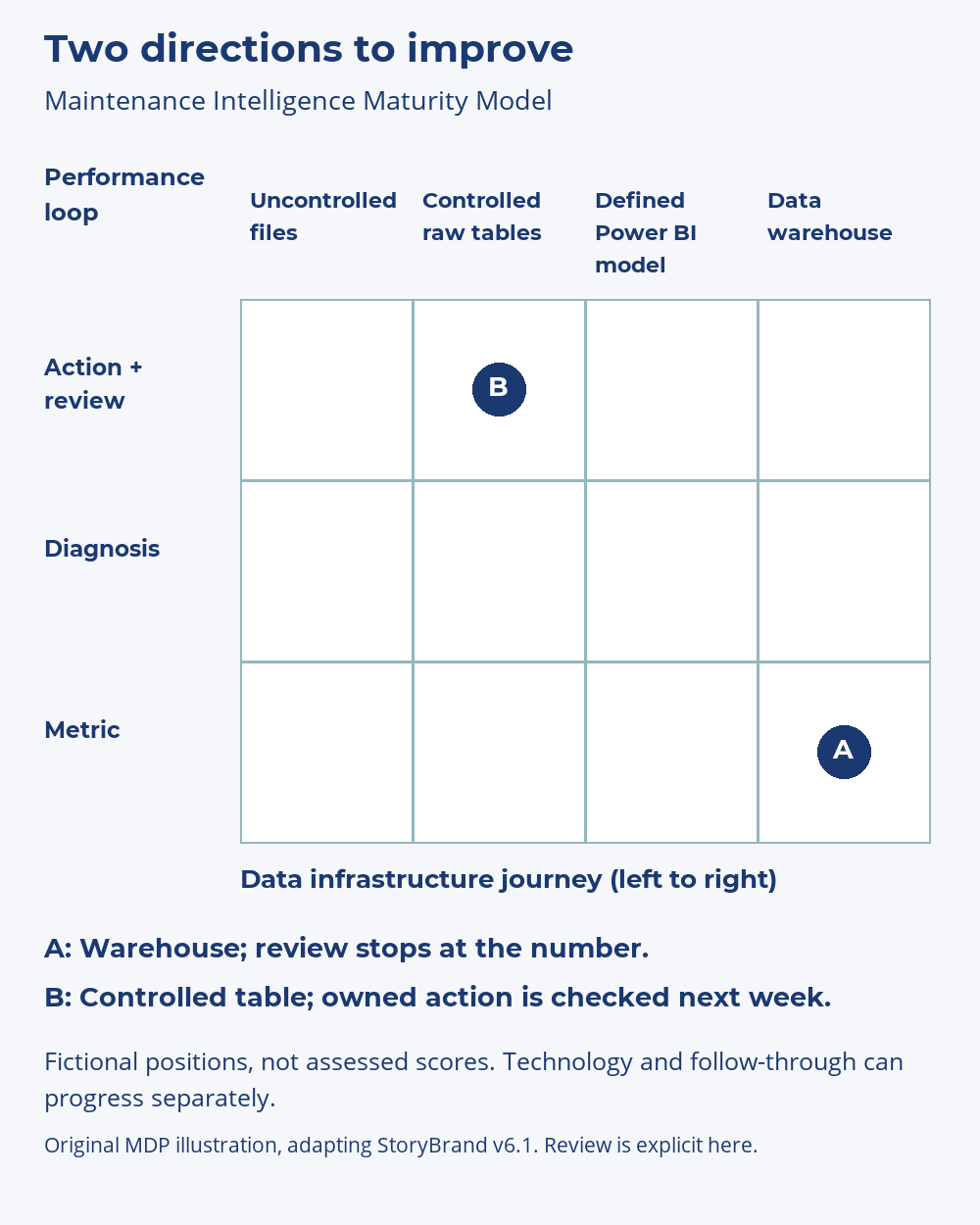
In my MDP Maintenance Intelligence Maturity Model, I use 2 dimensions: the data infrastructure journey and the performance loop. It's a practical framework for discussing the next improvement. It isn't a validated scoring system or a requirement to buy your way through a fixed sequence.
The infrastructure journey starts with uncontrolled exports and hidden calculations, moves towards controlled raw tables, then a defined model and measures in Power BI, with a warehouse where the wider need warrants it. Each step still needs its own checks. Installing Power BI doesn't establish that the order count is correct.
The performance loop asks whether the team stops at the metric, investigates the miss, or agrees owned action and follows it through. My framework calls those stages metric, diagnosis and action. In this guide, I've made the return to evidence explicit because that's how I'd check whether the action helped.
 Open full-size image (opens in a new tab)
An original illustration adapting the 2 dimensions in MDP's StoryBrand v6.1 framework. The fictional positions prompt discussion; they aren't assessed scores. “Review” makes the check after action explicit. This later MDP framework is distinct from the collectively authored corporate Maintenance Excellence Model.
Imagine one team with a well-managed warehouse and a report that ends every meeting at “below target”. Another uses a small controlled table, checks the source orders and returns to named commitments the following week.
They have different strengths and different next steps. The first needs to work on how the information enters a decision. The second may need a more sustainable way to prepare and maintain its evidence as the scope grows.
For a builder, that distinction helps avoid spending months solving an architecture problem that isn't the current constraint. For a leader, it raises a fair question about the investment already made: which decisions does the system help people make, and can someone show what followed?
The corporate Maintenance Excellence Model has a broader organisational purpose and collective authorship. The 2-dimensional map here comes from my later MDP framework. It shouldn't be presented as a new name or scoring layer for that corporate model.
Try placing one review on the map rather than rating your whole organisation. Show the actual files, definition, source checks and last agreed action. Then choose a next step you can demonstrate.
Give AI a bounded preparation task
An assistant could help assemble the pack for this review. I'd start by giving it the frozen schedule, checked completion list, definition, cut-off and the supplied notes for the 4 misses. Keep the identifiers and timestamps with the text.
The request would be limited: reconcile the supplied counts, summarise each order, identify unanswered questions, and separate observations from possible explanations. Every explanation needs a reference back to the supplied record. Missing context stays missing.
For WO-6207, an illustrative draft could read:
The note recorded before the freeze asks for a coupling-variant check. The materials coordinator subsequently confirmed the reserved item was the wrong variant. Ask the planner and materials coordinator what evidence was accepted at schedule agreement. The records supplied don't establish why the check stayed unresolved.
Those observations are in the fictional pack described above. The assistant hasn't discovered them independently. This text illustrates the output I'd ask for; it isn't measured behaviour from a model trial.
The planner checks that draft against the note and reservation evidence. The materials coordinator confirms the part detail. Mara decides what preparation change to trial. The assistant has no authority to declare a job ready, change a priority or write an accepted decision into the CMMS.
I'd pay particular attention to wording that turns a category into a cause. “Materials” could become “late delivery”. “Urgent work used the crew” could become “poor resource planning”. Both sound plausible. The supplied observations support neither conclusion by themselves.
Check the total as well as the story. Confirm all 10 scheduled orders are accounted for and all 4 misses appear. Make sure the draft hasn't merged 2 orders because their descriptions look similar. Check that an uncertain explanation hasn't become confident simply because the summary is shorter.
Retain the draft beside the corrected version while evaluating the approach. That lets you see what people had to fix and whether preparing with AI saved effort once review time was included. Agree the permitted data environment and access before using operational records.
I'd begin with one review and a human-prepared comparison. If the draft repeatedly drops missing information or invents causes, narrow the task or stop using that output. A fluent paragraph can still send the meeting towards the wrong person.
Try a KPI decision worksheet before building an app
For a first attempt, I'd put one measure and one review on a sheet. The KPI decision worksheet has a fictional completed example and a blank copy you can try.
Write the decision and the person accountable for it at the top. Underneath, record the population, dates, exclusions, calculation, target and source cut-off. Leave enough room to reconcile the displayed number to its records.
Then take one exception through the conversation. What does the record establish? What remains uncertain? Who can answer it? What did the authorised person decide? Record the action owner, due date and evidence the next review needs.
For the example here, that sheet would keep the 60%, the 10 frozen orders and WO-6207's unresolved part check together. It would also keep the candidate held out of the following schedule visible. Someone should be able to pick it up next Monday and understand both the decision and the work still waiting.
A companion mini app could later check that those fields are present, reconcile the supplied order counts and produce an exception-and-action pack. The user would supply the definition, frozen selection, checked completions, source references and review notes. The output would show the arithmetic, missing evidence, draft questions and actions awaiting acceptance.
The decision stays with the nominated owner. The app couldn't verify that a coupling fits by checking whether a field contains text. It couldn't establish a root cause, judge operating risk or claim an improvement from a greener card. This is a proposed tool, with development and testing still to be scoped separately.
For now, choose a red measure you already review. Follow it back to a handful of records and talk to the people who can explain them. Agree one specific change, give it an owner and decide what you'll open at the next meeting.
You should be able to follow the whole route: what someone captured, what was checked, what the measure means, how the team interpreted it, what they decided and what happened afterwards.
And if the card's still red next week, you'll have a much better conversation available than “try harder”.