“Eight out of 10. That's 80%.”
The planner looks at the screen. “One of those was reopened. And why have you taken the cancelled job out?”
Now the meeting has 2 jobs: work out what happened to the maintenance, and work out what happened to the calculation.
I'd rather settle the calculation before the meeting. Especially when someone will use it to judge how another person did their job.
Here's a made-up example. The site, work orders, dates, conversations and rules below are fictional. They show the choices behind a weekly schedule KPI. Your site may need different choices, agreed by the people accountable for the work.
The aim is to produce a number someone can explain by opening the records. Including the awkward one.
Give the measure a job
At this fictional site, the maintenance supervisor uses the weekly review to decide which preparation and scheduling problems need investigating before the next schedule is agreed.
That gives the measure a purpose: show how much of the agreed weekly work reached its agreed completion point on time. The supervisor can then open the misses and ask what prevented them.
My draft reliability-culture handbook recommends a controlled definition that explains the calculation, target, purpose and link to business performance. My MDP content plan approaches KPI design from the decision someone needs to make. I'd put those ideas together here: name the decision, then write rules that let people reconstruct the number used in it.
“Schedule attainment” on its own leaves plenty of room for interpretation. You could count orders, tasks or hours. You could compare against the schedule agreed on Friday or the revised list on Sunday evening. Each choice changes what you're asking.
For this example, I'll count distinct work orders in the original weekly commitment. Each order has an agreed scope and completion requirement. A 2-hour order and a 20-hour order each count once. That's a deliberate limitation. Anyone asking about the proportion of planned labour delivered would need an hours-based measure alongside it.
I'd call this one frozen weekly schedule completion, by order count. A slightly clumsy name, perhaps. It gives the next person more to work with than “maintenance performance”.
Keep the denominator where everyone can see it
The schedule freezes at 15:00 on Friday 2 October 2026. It covers Monday 5 to Sunday 11 October, with 12 distinct work orders whose agreed scopes are due within that week.
Twelve is the denominator: the population against which completion will be judged.
The fictional definition keeps all 12 orders in that population. An order cancelled or deferred after the freeze stays in the denominator, with its reason visible. Work added after the freeze appears on a separate list and contributes nothing to this measure's numerator or denominator.
Why keep a cancelled duplicate? Because this particular question asks what happened to the commitment accepted at the freeze. Discovering a duplicate afterwards says something about that commitment. The supervisor can recognise that cancelling it was sensible while still seeing that the frozen list contained it.
Another site might exclude formally cancelled duplicates. That's a choice its process owner needs to accept and document, including who can approve the exclusion and what evidence they need. I'd show the removed orders beside the adjusted total so the change remains visible.
For this example, nobody gets to quietly remove an inconvenient order on Monday morning. There's a separate explanation for every miss, and that explanation can lead to a different response.
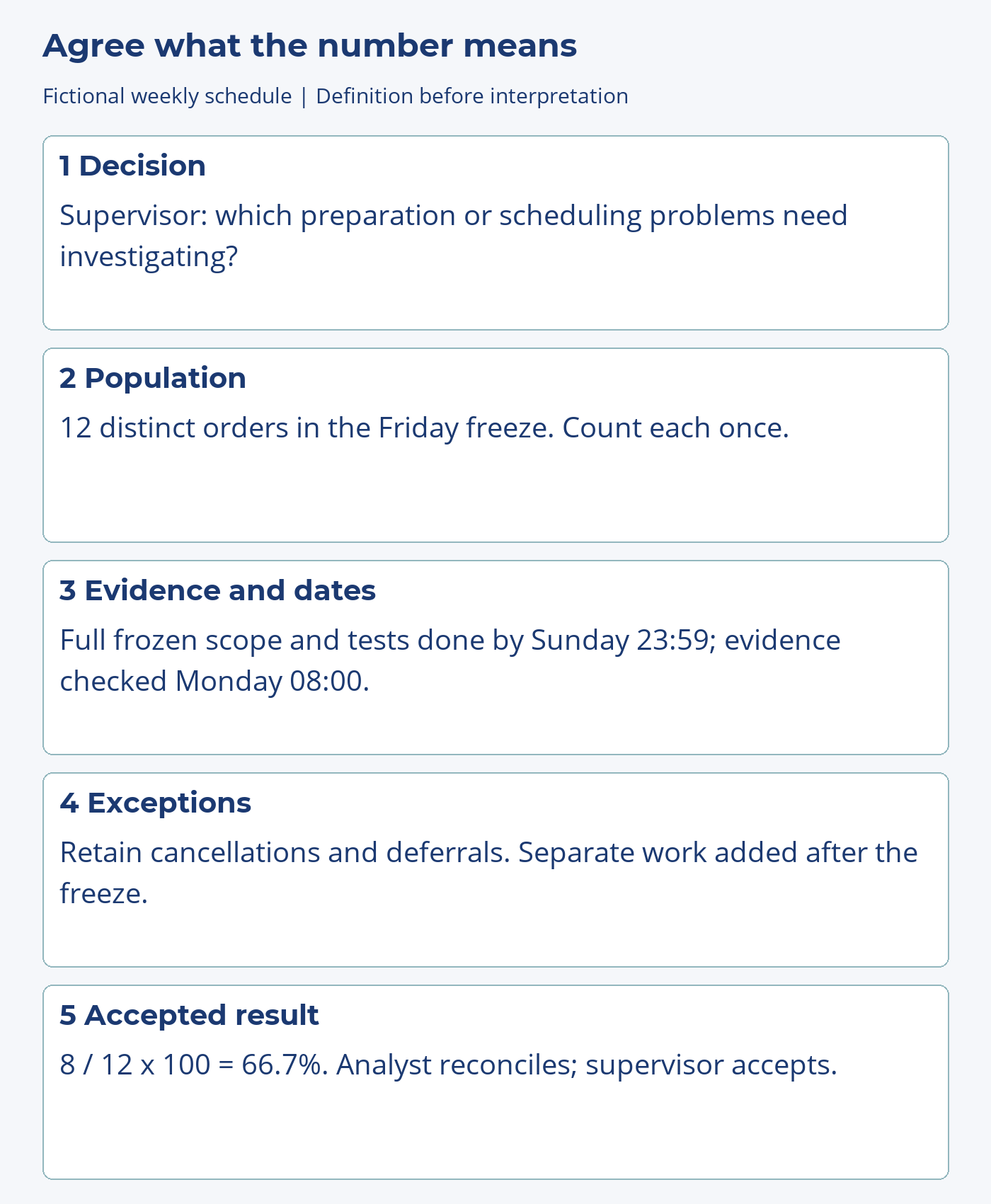 Open full-size image (opens in a new tab)
An original MDP definition aid. Agree the rules before reading the result; retain the order list so someone else can repeat the calculation.
Write down which date answers the question
“Completed last week” sounds clear until you open the dates.
An order might have a physical completion time, a technician's note-entry time, a supervisor's acceptance time and an administrative closure time. Sometimes those dates are close together. Sometimes they cross the reporting boundary.
The fictional rule counts an order when its entire frozen scope, including required tests, was physically complete by 23:59 on Sunday 11 October. The supervisor checks the supporting record by 08:00 on Monday 12 October. All times use the site's agreed Europe/London clock.
For an order already on the frozen list, accepted early completion also counts, even if the scope finished before Monday. The list still concerns the commitments due in this reporting week.
Those are 2 different boundaries. Sunday ends the work period. Monday ends the evidence check for the issued result.
A Monday administrative closure can therefore support a Sunday completion, if the checked evidence establishes that the full scope and required tests finished by Sunday. A Sunday closure status cannot rescue a job whose required test remained unfinished.
For this worked example, the frozen list and checked evidence are available together at the Monday reporting cut-off. In a real system, I'd check whether the extract actually contains the relevant history and timestamps. A current status column usually won't explain what was known at an earlier cut-off.
Missing completion evidence stays visible as “completion not established”. It doesn't enter the numerator. That wording matters: the measure hasn't established timely completion, and the reviewer may still need to find out whether the work happened.
If there were no eligible frozen orders, I'd show “not applicable, 0 orders”. Dividing by zero won't produce a useful performance percentage.
Account for all 12 orders
Here's the complete fictional selection. The supervisor has checked the observations in this table by the Monday cut-off. The shortened identifiers keep the arithmetic readable.
| Frozen orders | Checked observation | Counted complete? |
|---|---|---|
| WO-901 to WO-907 | Each full agreed scope and required tests complete by Sunday; evidence accepted by Monday 08:00 | Yes: 7 |
| WO-908 | Full scope and tests complete Sunday 18:00; administrative closure Monday 07:00; evidence accepted by 08:00 | Yes: 1 |
| WO-909 | Marked complete Friday; reopened Saturday because a required test in the frozen scope wasn't done; test still outstanding Sunday | No |
| WO-910 | Cancelled Tuesday after being confirmed as a duplicate | No; retained in frozen population |
| WO-911 | Deferred Wednesday because access wasn't available; scope incomplete Sunday | No; retained in frozen population |
| WO-912 | Open Sunday; completion note confirms work remained | No |
WO-913 is additional urgent work accepted on Tuesday and completed Thursday. It appears in the additional-work list. It was never one of the 12 frozen orders, so it enters neither part of this calculation.
The numerator is 7 plus 1: 8 orders. The denominator is 12 orders. Eight divided by 12, multiplied by 100, gives 66.666…%, displayed to 1 decimal place as 66.7%.
The 4 misses are WO-909, WO-910, WO-911 and WO-912. Eight supported completions plus 4 misses reconcile to the 12 frozen identifiers. WO-913 stays separate.
For the fictional review, the agreed target is at least 80%. Compare the unrounded result with the target, then round for display. This result is below target. The target is invented for the example; it isn't a recommendation for your site.
Notice how little the percentage says about the reasons. One test wasn't finished, one duplicate was cancelled, one job lost access and one still had work remaining. I'd want 4 conversations available behind the same number.
Open the reopened order
WO-909 is the order I'd use to test the definition with the analyst and supervisor.
On Friday, someone marked it complete. On Saturday, the reviewer found that a required test within the original scope hadn't been done and reopened it. At the end of Sunday, that test was still outstanding.
Under the stated rule, WO-909 doesn't count. The Friday status change can't establish completion of a scope that the checked evidence says remained unfinished.
I'd also ask what the reopening means before writing a general rule for every reopened order.
Suppose an order was reopened just to correct a cost code, with accepted evidence that the full physical scope and tests had finished on time. Under this example's physical-completion rule, that administrative change alone wouldn't remove its completion. A newly identified defect after an accepted repair would need checking to establish whether it concerns unfinished original scope or new work.
Those situations need local judgement and evidence. “Reopened equals failed” would hide the distinction. “Ever marked complete equals passed” would hide it too.
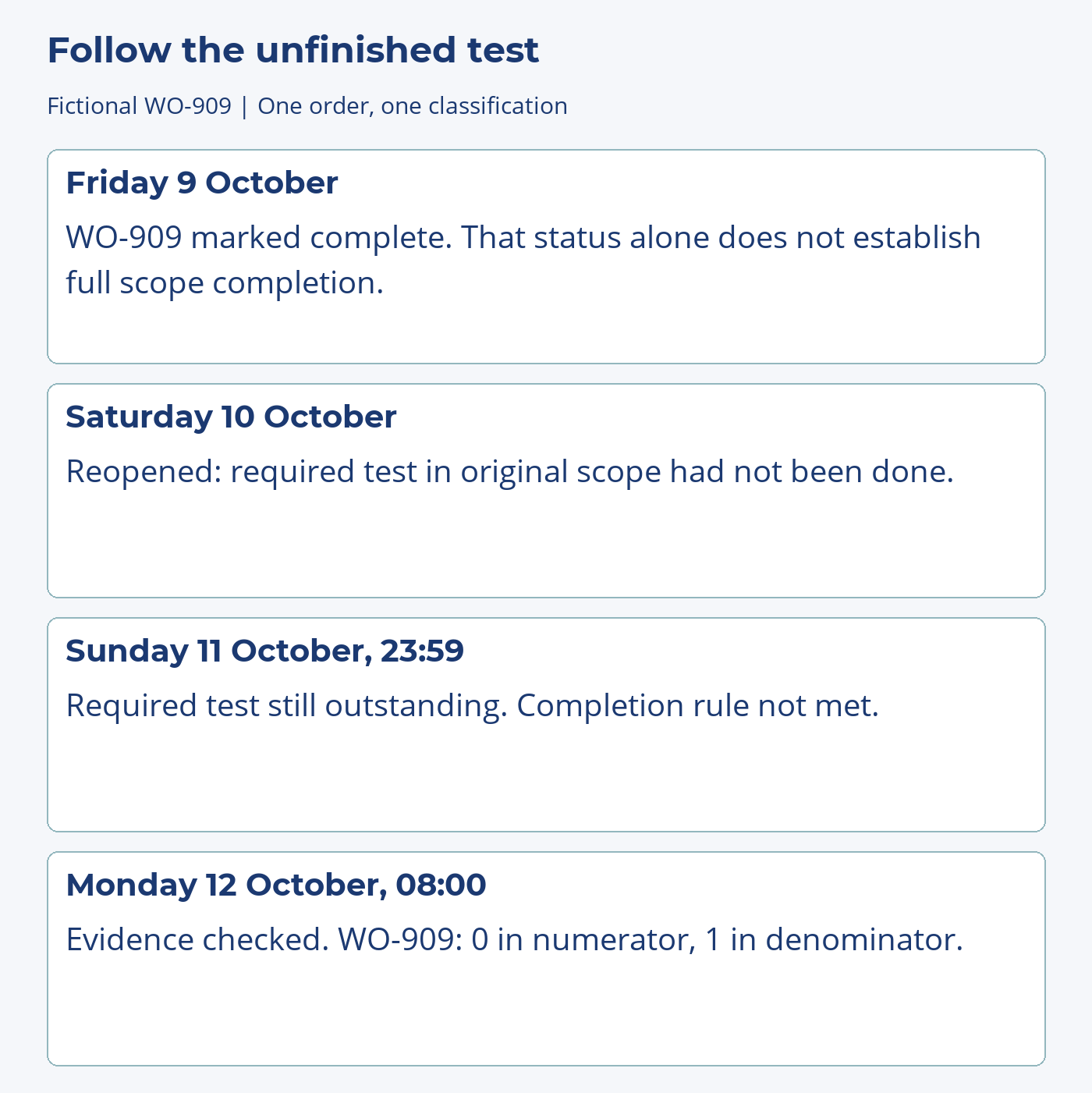 Open full-size image (opens in a new tab)
WO-909's fictional history. The required test belongs to its frozen scope. That observation, checked against the definition, explains its treatment.
Keep the issued result and the evidence used to accept it. If later evidence establishes that the original report was wrong, record a correction, its reason and who accepted it. Show the original and corrected versions. Finishing the test the following week wouldn't make WO-909 complete within this reporting week.
Check the explanation as carefully as the fraction
Imagine asking an AI assistant to interpret this pack. Supply the frozen identifiers, the definition, target, timestamps, all the observations in the table and WO-913's separate status.
Here's a deliberately flawed hypothetical response, written to show what I'd check. No separate model trial was run for this example:
Schedule completion was 80%: 8 of 10 eligible orders. The cancelled and deferred orders were excluded. WO-909 shows a quality failure caused by technicians closing work too early. Tightening close-out discipline should improve next week's result.
It sounds ready for the minutes. I'd stop it there.
First, the denominator. The accepted definition retains WO-910 and WO-911, so excluding them changes 12 to 10 without authority. Eight divided by 10 does equal 80%. The arithmetic works after the rules have been changed. That's exactly why I'd check both.
Then the story. WO-909's history establishes an unfinished required test and an earlier completion status. It doesn't establish who made the entry, why they made it, or whether instructions, access, system behaviour or a misunderstanding contributed. “Caused by technicians” adds a claim the supplied observations don't contain.
Finally, the proposed benefit. The pack contains no next-week observations and no evidence that tighter discipline would resolve the problem. The supervisor needs to investigate the handover before choosing a change.
A checked replacement could read:
Eight of the 12 frozen orders met the completion rule, giving 66.7%. WO-909 had a required test outstanding at Sunday’s cut-off. WO-910 was cancelled as a duplicate, WO-911 was deferred for unavailable access, and WO-912 remained incomplete. These 4 orders stay in the denominator. WO-913 is additional work and stays outside this KPI. Ask how WO-909 reached completion status with its required test unfinished, and what access evidence supported WO-911's original commitment.
Every statement in that replacement points to the definition or the supplied records. The questions remain questions.
The analyst checks the identifiers and calculation. The supervisor checks the scope and completion evidence, then accepts the interpretation for the review. Any action follows the site's normal authority. An assistant could prepare a draft; the accountable people still need to recognise and accept what it says.
Give the definition an owner and a version
I'd put the fictional maintenance supervisor down as accountable for this KPI's operational meaning and its use in the review. The analyst maintains the calculation and reconciliation. The scheduler retains the frozen selection. Those responsibilities need names at a real site.
The definition should also say who can approve a change, when it takes effect and what happens to comparisons across the change. If next month the site moves from order counts to hours, label the new series. A line that joins the 2 without explanation invites the reader to mistake a definition change for a change in performance.
Agree the target with the people responsible for the process and its consequences. I'd avoid judging the supervisor solely on this percentage. It gives every order equal weight and leaves urgent additional work outside its calculation. Review that work, the reasons for misses and any work waiting outside the schedule alongside it.
The completed urgent job matters. So does the duplicate cancellation. You can recognise both while retaining a consistent answer to the question the frozen-schedule measure asks.
Try the definition on a sheet first
I've included a KPI definition worksheet with the example rules and a blank copy. Start with the decision and accountable owner. Write the population, counting unit, completion evidence, dates, exclusions, target and correction rule. Then test an ordinary completion and an awkward order together.
The output should be an accepted definition and a worked reconciliation someone else can repeat. The worksheet assumes the people using it can inspect the scope and history; it can't establish physical completion from a populated field.
A small calculator could later accept a frozen list and human-checked classifications, reject duplicate identifiers, flag missing evidence and show the numerator, denominator and result. Its decision owner would still accept the rules and classifications. That's a proposal for a separately scoped tool, with no live connection or operational validation claimed.
From maintenance data to decisions follows the wider review through action and follow-up. Can your maintenance data answer the question? checks whether the underlying records can support the question at all.
For this task, I'd start smaller. Take one KPI into a room with the person who calculates it and the person who uses it. Open a cancelled order, a late closure and a reopened order. Ask each person to calculate the result using the written definition.
If their answers differ, you've found something worth fixing before the next performance meeting.