“That's the third seal job on that pump. Should the seals be changed more often?”
You open the history. Three work orders, all with a problem code and a cause code. Someone has even checked that the fields are complete.
Useful start. I'd still want to open the notes before answering that question.
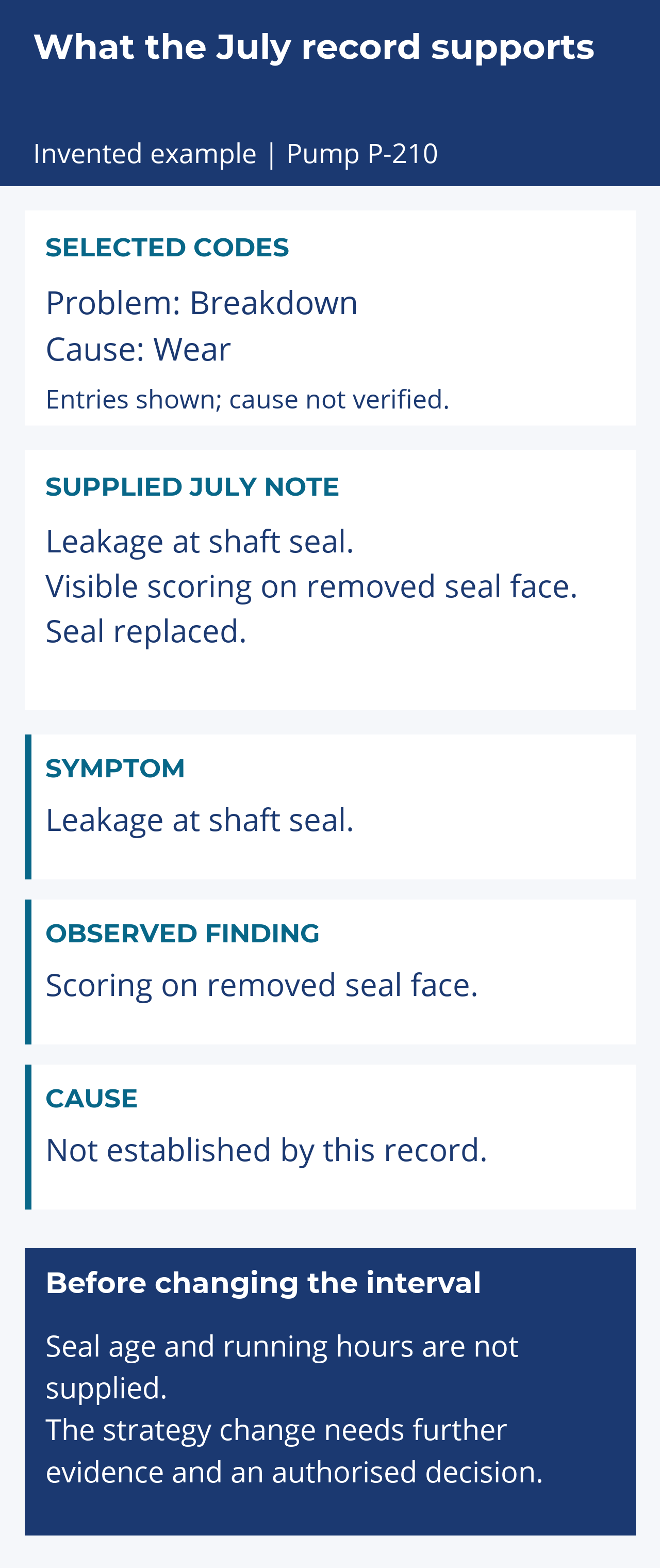
Here's a made-up example. These are three separate repair events on pump P-210, in January, April and July. In each case, the technician recorded leakage at the shaft seal and replaced the seal. The problem code says “Breakdown”. The cause code says “Wear”.
The July note adds that the removed seal face had visible scoring. None of the records establishes why the seal failed. The supplied history has no running hours or seal ages.
All six code fields contain a value. You can produce a very tidy chart labelled “Breakdowns caused by wear”.
I'd be uncomfortable using that chart to recommend a shorter seal replacement interval.
What does “wear” tell you here?
The notes give you something useful: leakage at the shaft seal on three separate occasions. That's a reason to look into the repeat work. The July record also gives you an observed finding, scoring on the seal face.
How did the scoring occur? Did it explain the leakage? Would replacing the seal earlier have prevented the event? The record doesn't answer those questions.
You could spend a fair bit of time debating which cause code fits, while the records in front of you still don't give you enough to choose one.
 Open full-size image (opens in a new tab)
Original MDP illustration using invented records. The annotations show what the supplied observations support. They don't establish a cause or justify changing a maintenance task.
I'd keep three things separate when discussing this record. The symptom is what drew attention to the problem: leakage. The observed finding is what the technician saw on the removed part: scoring. The cause remains unestablished. Replacing the seal records the action taken; it doesn't fill that last gap.
The code names and fields will vary between systems. Whatever yours calls them, the person reading the record needs to understand what was observed and what someone has concluded from it.
In my 2017 MSc dissertation, I examined failure classes, problem codes and cause codes in one company's maintenance history. Some populated codes were too general to support the intended failure analysis. Some classifications described systems rather than equipment types. Those were findings from that study, rather than a verdict on your CMMS.
The practical question I'd carry into this example is what the selected code lets the next person conclude.
Give people a way to record uncertainty
Imagine being the person closing the July job. You've seen scoring. You haven't established what caused it. The form still wants a cause.
What are you expected to select?
I'd want that answered with the people doing the work, using the site's coding rules. An agreed way to record “cause not established” can preserve a useful distinction. It also leaves someone with a decision about whether further investigation is needed. It shouldn't quietly become the end of every investigation.
My unfinished handbook on reliability culture looks at data input, the conditions people face when entering it, and checks on the resulting history. I'd bring those together here: explain the code, make uncertainty possible to record, then review whether people can use the result.
Try a coding discussion on a few actual jobs
I'd take a technician, a reliability engineer and the person responsible for the coding rules through the same small set of records. Let each person suggest a code and point to the words or evidence supporting it. Where they disagree, ask what extra information would settle it.
A short discussion sheet could capture the original note, proposed code, supporting observation, unresolved question and who accepts the classification. I'd keep the original entry visible and record any agreed correction through the site's process. The sheet is a proposed aid, not a tested coding standard.
For P-210, the reliability engineer has enough to propose investigating repeated seal leakage. A shorter replacement interval still needs evidence about the failure process, time in service and the task it would replace. The person authorised to approve maintenance strategy changes owns that decision.
Start with a few jobs people remember. Agree what the codes mean, show where the evidence runs out, and check the next records together. That gives the person entering the code something more useful than another reminder to fill in the box.