“Which cooling-water pump should the reliability engineer look at first?”
The analyst opens the work-order export. Equipment reference, failure code, completion date. All filled in. There are notes as well. This should be a fairly quick job.
Then someone adds, “And can you tell me whether changing the seal-maintenance task would help?”
Ah. There's quite a bit tucked into that request.
You need to know which pump the work belongs to, what actually failed, whether several orders describe separate events, and what happened when the equipment was unavailable. Changing a maintenance task needs more evidence again.
I'd start by checking what the records can support before building the comparison. Otherwise, you can spend a morning producing a very tidy answer to a question nobody asked.
Give the data a specific job
Here's a made-up example. The site, records, dates and conversations below are fictional. They illustrate a check you could make; they aren't a client result or a maintenance recommendation.
At this site, the reliability engineer wants to choose which of 2 cooling-water pumps deserves an initial investigation into recurring seal problems. The engineer also wants to consider the disruption caused by those events. The maintenance strategy owner would decide any later change to the maintenance task, using the investigation and the site's normal review process.
That gives the analyst something useful to work towards. A list of repeated seal events might support choosing an investigation. It wouldn't, on its own, establish why the seals failed or which task would prevent it.
I'd write those boundaries beside the request. They save a lot of trouble when someone forwards the eventual chart without the conversation that produced it.
My 2017 MSc dissertation looked at this gap between collecting maintenance data and being able to use it. I first compared what was collected with the requirements of the standard used in that study, then tried to apply maintenance and reliability analysis to the existing records. Much of the data was collected fully or partially. Key fields and links still limited what the analysis could do.
That's a finding from a historical case study, rather than a verdict on your system. The practical question travels quite well, though: can these records support this particular decision?
Open a few records before you trust the column headings
The fictional analyst has 4 completed corrective work orders reported during April to June 2026. Each row is one distinct order. For this worked example, the checked job history confirms that each concerns a separate event, rather than several orders for the same event.
| Order | Equipment reference | Failure code | What the completion note establishes |
|---|---|---|---|
| WO-7101 | CW-P41A | General failure | 8 April: seal leakage observed; seal replaced |
| WO-7102 | CW-P41A | General failure | 12 June: seal leakage observed; seal replaced |
| WO-7103 | CW-P41B | General failure | 20 May: “Repaired and returned to service”; component and symptom unspecified |
| WO-7104 | CW-SYSTEM | General failure | 24 June: motor replaced; individual pump unspecified |
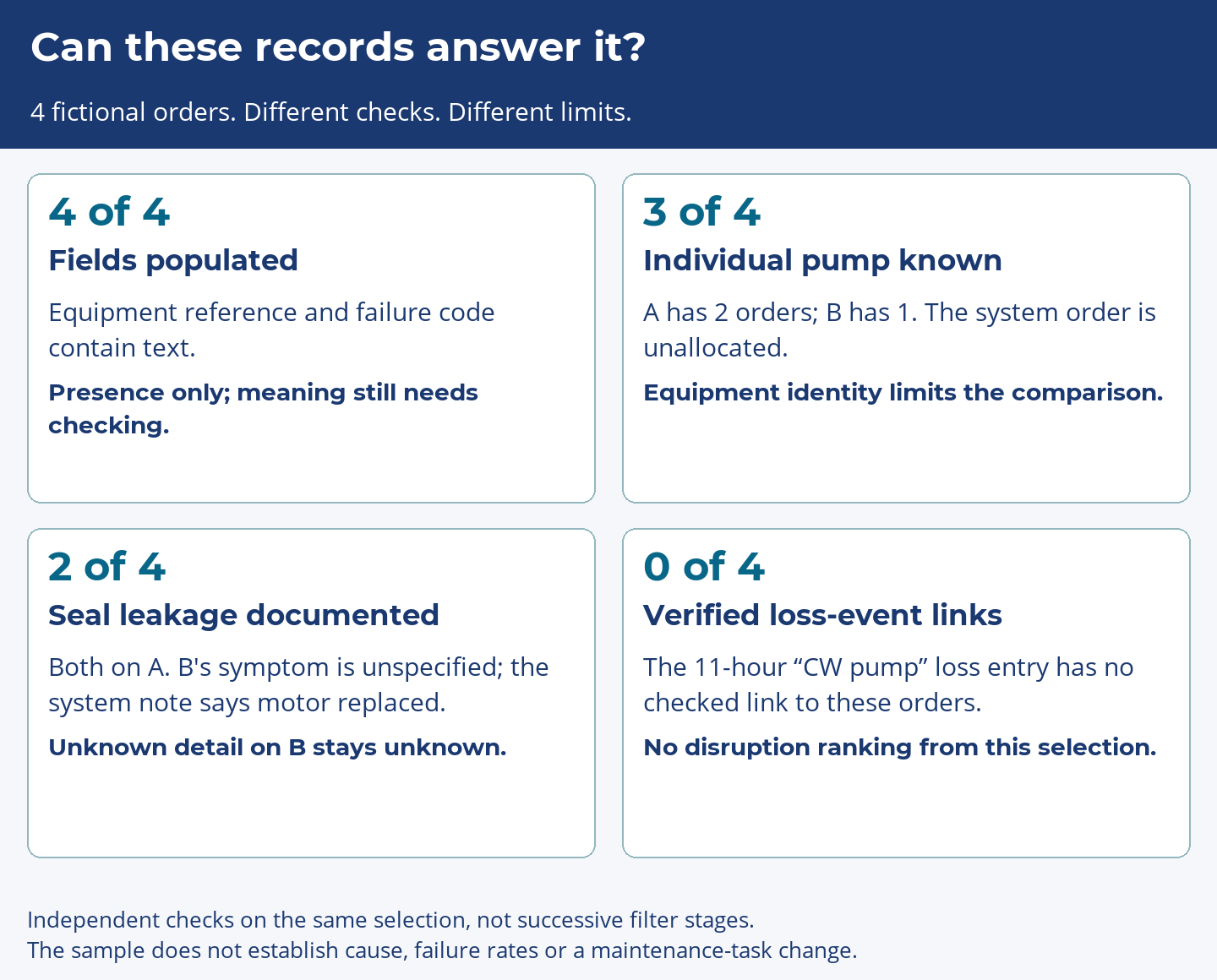
All 4 equipment-reference fields contain text. All 4 failure-code fields do too.
Would you call that complete?
For a check that only asks whether the fields are blank, yes. For this pump review, WO-7104 can't yet be allocated to either pump. “CW-SYSTEM” identifies a wider system. It doesn't tell the engineer which machine had the motor replaced.
The failure code has a different problem. “General failure” doesn't tell you which component was involved or what anyone observed. The notes establish 2 seal-leakage events on CW-P41A. They leave the component and symptom on WO-7103 unresolved.
So the analyst can say there are 2 documented seal-leakage events on A in this selection. They can't say B had no seal problems. Its one identified order doesn't answer that question.
I found related problems in the dissertation's CMMS analysis: records assigned to system-level classifications, and populated problem or cause codes that gave little help with the intended analysis. Counting a field as collected hadn't established that its contents would answer the next question.
The notes here rescue part of the example. I'd keep their source order numbers alongside any classification and have the reliability engineer check the interpretation. “Seal replaced” records an action. The observed leakage supplies the symptom. Neither statement establishes the cause of the failure.
 Open full-size image (opens in a new tab)
Different checks on the same 4 fictional records. These aren't successive filter stages or a data-quality score. A populated field, a usable equipment reference and evidence for a particular failure each tell you something different.
Check whether the systems mean the same equipment
The analyst now opens the disruption log. It contains an 11-hour loss entry labelled “CW pump”. There's no work-order reference, no individual pump identifier and no checked link to any of the 4 orders.
It might concern A. It might concern B. The supplied records don't settle it.
Matching on the words “CW pump” would hide that uncertainty inside the report. Splitting the 11 hours equally would invent a different answer. I'd leave the entry unallocated and ask the operations record owner to check it against the event history.
An equipment link needs enough identity to distinguish the thing you're discussing. At another site, the same tag might exist twice. A location might retain its name after a machine is replaced. For a question about an installed position, the location could be appropriate. For a question about the life of a particular machine or seal, you may need the installed asset and its history as well.
Even a confirmed pump identifier wouldn't automatically establish which event caused the loss. You still need the event relationship, dates and context. A loss entry might span several jobs; a work order might address only part of an event.
My dissertation identified inconsistent equipment links across systems as a major obstacle to bringing the information together. My unfinished reliability-culture handbook develops that equipment-centred view, including links between work, equipment performance and loss events. I'd use the question to decide which links need checking here, rather than trying to connect every table before starting.
In this example, no loss entry has a verified link to the 4 work orders. The analyst can report the gap. They can't rank the pumps by disruption from these records.
Keep the useful answer, and show where it stops
I'd be comfortable taking this statement to the engineer:
In the 4 checked orders, CW-P41A has 2 documented seal-leakage events. CW-P41B has 1 order whose component and symptom aren't specified. One system-level order can't be assigned to a pump. The 11-hour loss entry remains unallocated. These records support starting a conversation about A's repeated seal leakage; they don't establish a disruption ranking or a change to the seal-maintenance task.
That's more useful than abandoning the whole dataset. It also gives the next conversation a purpose.
The engineer can examine A's 2 events and ask for the missing detail on B. The operations record owner can investigate the loss entry. The person responsible for the equipment records can help resolve the system-level order.
I'd resist calculating a comparative failure rate at this point. The example has no checked operating exposure, duty history or complete event population. Two documented events on A don't establish that its seal is less reliable than B's. They do give someone a reason to look more closely.
And I'd keep the unknowns in the review. Quietly dropping them can make the remaining records look much more convincing than the evidence warrants.
Ask what made useful capture difficult
There's a person behind “General failure”. Before changing the form, I'd ask them to show me how they selected it.
Can they identify the equipment from the screen they're using? Do the available codes describe what they observed? Does the form let them record an unresolved cause without making something up? Who helps when the right equipment reference is missing?
Glen Murphy's paper applies Icek Ajzen's theory of planned behaviour to manually captured engineering data. It considers attitude, perceived expectations from others and perceived ability to carry out the task. Murphy also discusses supervisory support, time pressure and feedback. His paper offers a conceptual way to examine capture conditions, rather than proof that one intervention will work at your site. Murphy's paper
For the fictional pump review, I'd make that conversation quite specific. Show the person how the equipment reference affects which pump appears in the investigation. Ask what the supervisor checks at close-out. Find out whether the person has access, time and enough guidance to choose a useful code.
If the screen only offers a system reference, another reminder to “improve data quality” leaves them with the same screen tomorrow. If useful detail goes into notes because the code list doesn't fit, ask what the analyst can recover and what the form needs to change.
Murphy proposes that the value of feedback depends partly on whether people feel able to act on it. I'd check that before sending a list of incomplete records back to the shift.
Why good intentions still produce poor maintenance data follows that conversation in more detail. Here, the immediate job is to identify the obstacle that prevents this particular question being answered.
Put one decision on a sheet
I've included a decision-to-data worksheet, with this fictional example and a blank version. It's a static discussion aid you can try with an analyst and the person who'll use the result.
Start with the decision, owner and scope. For each piece of evidence, write what would make it usable, which records you checked, what remains unresolved and how that limits the decision. Give each follow-up a person and a review date.
The sheet's output is a bounded answer and a short evidence-gap list. The nominated decision owner accepts whether that's enough to proceed. It can't certify the wider database or authorise a maintenance change.
An AI assistant could help draft that list from the 4 orders, the confirmed separate-event check and the unallocated loss entry. I'd ask it to retain the identifiers, quote the supplied observations and keep unknowns visible. The analyst would check every classification; the reliability engineer would decide what investigation to pursue. It mustn't turn “motor replaced” into a seal failure, or assign the 11 hours to A because A appears twice. This is a proposed use, with no trial or integration claimed.
From maintenance data to decisions takes the wider route through a review, owned action and follow-up. This check comes earlier: establish what you can reasonably bring into that conversation.
Choose one question someone has already asked of your maintenance data. Open a handful of records together and try to answer it. Keep what they establish, name what they leave uncertain, and agree who can resolve the gap.
You'll have a useful starting point for the analysis. You'll also know what to ask the people entering tomorrow's records.