“Materials again. Can someone sort that out for next week?”
The schedule-attainment card is red. Someone adds an action to the minutes. The meeting moves on.
Next Monday, what would you open to find out whether anyone had sorted it?
Let me use a made-up example. All the people, records and outcomes here are fictional.
Ten work orders were in the schedule frozen before the week began. Six met the agreed completion rule by Sunday night. The supervisor checked the completion evidence on Monday morning. That's 60%, against this team's example target of 80%.
Each order counts once. Added jobs sit outside that original selection, and removing a job during the week doesn't remove it from the measure. The rule counts physically completed agreed scope, supported by checked completion evidence. Your site may define attainment differently.
The team can account for all 10 orders. Now I'd open one of the 4 misses.
What does “materials” actually tell you?
WO-6207 needed a replacement coupling. Its delay category says “materials”.
The planner, Iona, opens a note written before the schedule freeze: “check coupling variant”. Sam, the materials coordinator, confirms that the reserved coupling was for another equipment variant. The correct part wasn't available during the scheduled week.
You could put “supplier late” in the minutes. Nothing in those observations tells you that a supplier delivered late.
I'd ask a different question: what evidence did the team use to accept this job into the schedule while the part check was still unresolved?
That gives Iona, Sam and the scheduler something specific to examine. It also gives them room to explain what happened. Perhaps the note wasn't visible at schedule agreement. Perhaps someone thought another person had checked it. Those are possibilities to investigate, rather than conclusions to type into the report.
The other 3 misses still need their own review. This one order can't explain the whole 60%.
Give the next meeting something to open
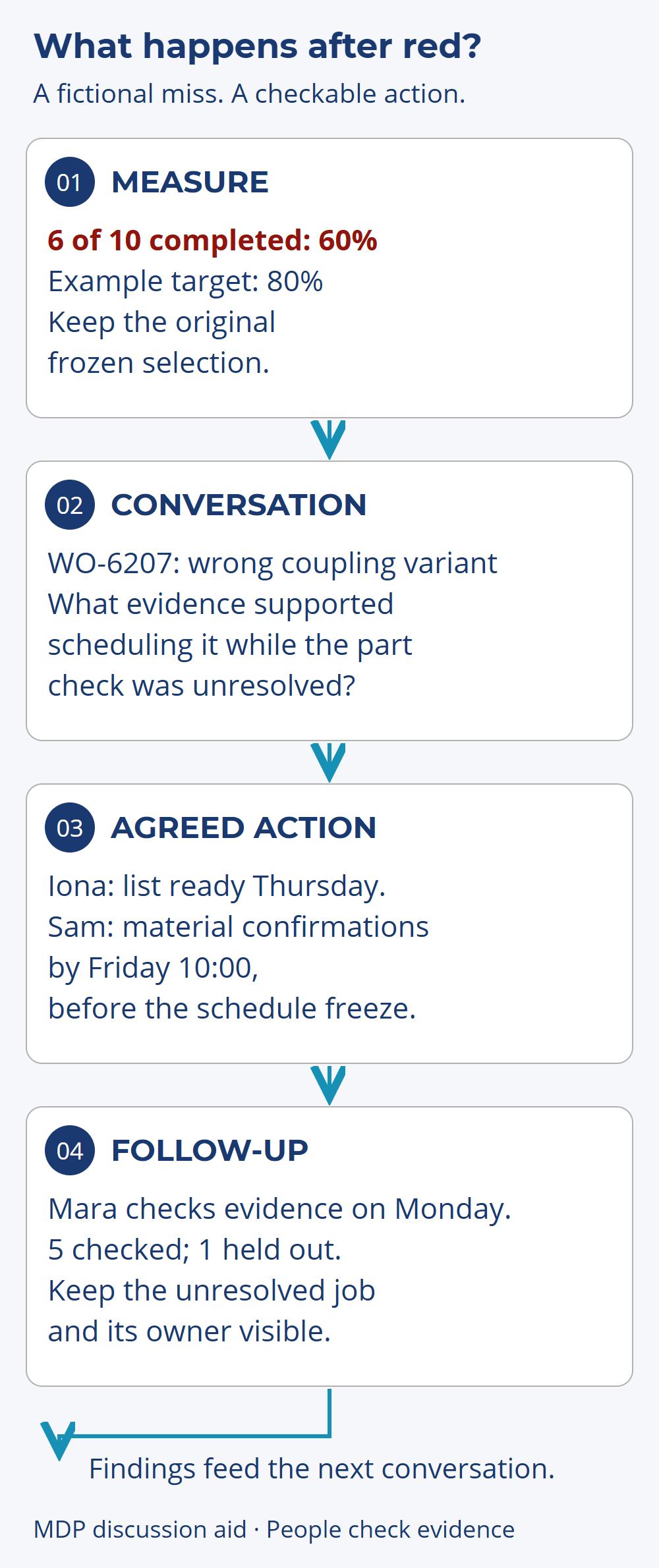
Mara, the supervisor, agrees a small trial within her authority over job preparation. Before Friday's schedule freeze, Iona and Sam will check the part identity and reservation evidence for the material-dependent candidate jobs together.
Iona owns preparing the list by Thursday. Sam owns confirming the material evidence by Friday at 10:00. An unresolved check stays visible for the scheduler's decision, with a named follow-up owner.
On Monday, Mara wants to open the list, its supporting records and the actual schedule decision. She'll also ask Iona and Sam whether the check was practical (including whether it duplicated something they already did).
“Improve planning” would have been quicker to write. I'd struggle to tell you what evidence would close that action.
 Open full-size image (opens in a new tab)
An original MDP discussion aid, drawing on the metric, diagnosis and action stages in my MDP performance loop. Follow-up makes the return to evidence explicit. The figures and people are fictional.
Come back to the commitment
In the invented Monday follow-up, the list shows 5 material-dependent candidates. Four have checked part identity and reservation evidence. One still has an unresolved equipment detail. The scheduler kept that job out of the frozen schedule; its preparation follow-up remains assigned to Iona.
Mara checks those records and accepts that the agreed preparation check happened. She keeps the unresolved job visible, including its time waiting and the consequence of delay. The job still needs attention.
Has the trial improved schedule attainment? The new scheduled week has only just begun. There's no result to claim yet. Even a greener card later wouldn't establish how much this one change contributed.
For now, the team can show what it checked and how that affected a scheduling decision. That's useful evidence to bring back to the people who did the checking.
My longer guide, From maintenance data to decisions, follows this example through the wider definition, evidence and decision process. Here I'd start with a small follow-up card in the existing action record: the order, unanswered question, agreed task, owner, due date, evidence to open and person who accepts the result.
Choose one red KPI from your next review. Before leaving that conversation, agree what someone will bring back and who'll check it.
Next Monday, open it.