“Four work orders have been waiting more than 7 days. Which one do you want me to deal with?”
The report shows 40%. There's a trend beside it. The line has come down since last week, which looks encouraging.
Leah, the maintenance manager, still has to answer the planner's question.
She needs to see the orders, understand what's holding each one up and decide what she can approve or send back for more information. Preferably while the people who know about the work are still in the room.
That's the page I'd like to build.
Let me use a made-up example. The site, people, work orders, dates and conversations in this article are fictional. The report is an original static concept, with no connection to a CMMS or a live Power BI report. Its numbers are small enough to check by opening the records.
Start with Leah's next decision
It's Monday 26 October 2026. Leah is reviewing the routine mechanical work awaiting her team's approval. The data stops at 08:00 UTC; the review starts at 09:00 UTC. I'll use UTC throughout this example so the clock change doesn't introduce another argument.
The question at the top of the page is:
Which overdue approval requests can Leah decide today, and what evidence must someone obtain for the others?
That wording gives the page a fairly specific job. It also tells me what to leave out. I don't need maintenance expenditure, plant availability or a picture of the site to answer it. Those subjects deserve their own questions and evidence.
I'd want Arun, the planner, beside Leah when they first try the page. I'd ask him to bring the work-order records and show how he normally follows up an approval request. There's little point designing a lovely sequence that requires 3 people to find a note he already has open.
In my draft reliability-culture handbook, the visualisation sections begin with questions about the measure, current value, target, trend and action. The work-management example then asks the report to expose delays through the process. My MDP content strategy takes the same practical starting point: name the decision the report should support.
Here's how I'd apply those ideas to one page.
 Open full-size image (opens in a new tab)
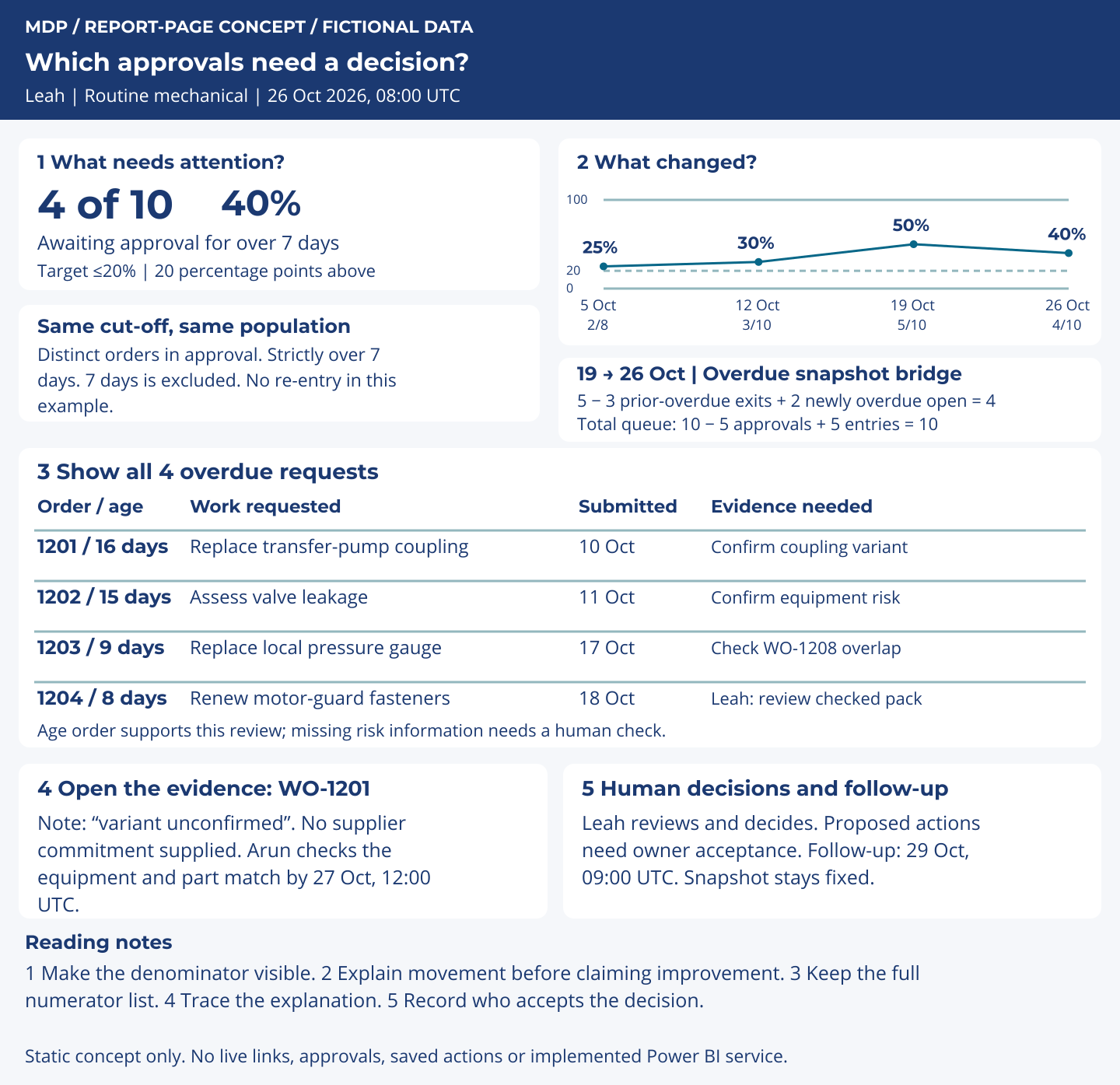
An original MDP report concept using fictional data. The numbered notes explain the reading order. The companion review page includes a stacked version for smaller screens and links to the full-size images.
“Forty per cent of what?”
Ten distinct work orders are awaiting approval at the cut-off. Four have been in that approval queue for more than 7 calendar days. Four divided by 10 gives 40%.
I'd show 4 of 10, 40% and over 7 days together. Anyone reading the card can see the size of the problem and the population behind it. A percentage on its own makes you do a bit of guessing.
For this example, the queue contains routine mechanical work at the fictional site that was formally submitted for approval and hadn't left that stage by the cut-off. Draft requests, other disciplines and orders already approved, rejected or cancelled are outside it. Each work order counts once, regardless of the number of operations or notes attached.
Age means elapsed whole calendar days since the recorded submission date, measured at these 08:00 UTC snapshots. All submissions and stage exits in this deliberately simple dataset occur at 08:00 UTC. A request submitted on 19 October is 7 days old on 26 October. It stays outside the “over 7 days” count until the next day.
The 10 current ages are 16, 15, 9, 8, 7, 6, 5, 4, 3 and 2 days. That boundary matters. Counting the 7-day-old order would change the result to 50%.
There's no reopening or resubmission in this dataset. I'd agree how those events affect queue age before using this definition elsewhere. Replacing the first submission date with the latest update date could make an old request look new every time someone edits it.
Leah has chosen an illustrative review target of no more than 20% over 7 days. The current result is 20 percentage points above it. That's a local prompt to investigate delays, chosen for this example. It says nothing about whether an individual request is safe to leave waiting, and it isn't an industry benchmark.
If the queue stays at 10, 1 more request crossing that 7-day boundary adds 10 percentage points. I'd keep that in view before anyone starts celebrating a small movement in the line.
Article 009, Defining a maintenance KPI people can defend, goes further into the rules behind a measure. Here, I'd keep the short definition beside the number and make the supporting records available.
“Is it getting better?”
The trend shows 4 Monday snapshots, each taken at 08:00 UTC using the same population and age rule.
| Snapshot | Over 7 days | Awaiting approval | Share |
|---|---|---|---|
| 5 October | 2 | 8 | 25% |
| 12 October | 3 | 10 | 30% |
| 19 October | 5 | 10 | 50% |
| 26 October | 4 | 10 | 40% |
I'd label the points directly, with the counts alongside the percentages. Four weekly observations earn a modest amount of space. They don't need a large chart stretching across half the page.
The latest result is down 10 percentage points from 50%. The count over 7 days has fallen by 1.
Leah could reasonably ask what happened between those last 2 snapshots. Arun can compare the lists: 3 of the 5 requests already overdue on 19 October were approved before 26 October. Two requests that were younger on 19 October remain open and are now overdue. Five minus 3 plus 2 leaves 4.
Across the whole queue, 5 orders were approved and 5 new requests entered. The total stayed at 10. The other 2 approvals concerned requests that became overdue after 19 October and were approved before 26 October. Neither appears in either overdue snapshot count. Weekly snapshots leave some of the week's activity out of view.
That makes the change much easier to discuss. The page can show the movement without inventing a reason for it. Four points don't establish that the approval process has improved, or that a particular intervention worked.
The trend gives Leah a reason to ask about the older requests that remain. I'd put those records immediately below it.
“Show me the four”
| Order | Work requested | Submitted | Age at cut-off | Evidence still needed |
|---|---|---|---|---|
| WO-1201 | Replace transfer-pump coupling | 10 October | 16 days | Confirm the coupling variant against the equipment |
| WO-1202 | Assess valve leakage | 11 October | 15 days | Confirm the equipment risk classification and required response |
| WO-1203 | Replace local pressure gauge | 17 October | 9 days | Check possible overlap with WO-1208 |
| WO-1204 | Renew motor-guard fasteners | 18 October | 8 days | Pack recorded complete; Leah must review and decide |
This table contains all 4 orders in the numerator. It isn't a sample of interesting jobs or a list that silently stops after the first few rows.
I'd sort by age initially because the page is about time awaiting approval. I'd still show a known risk or urgent escalation prominently if one existed. An age sort mustn't quietly become the site's method for deciding maintenance priority.
For WO-1202, the risk classification hasn't been confirmed. I want that gap visible. “Routine mechanical” describes the reporting selection; it doesn't prove the consequences of delaying that particular job are acceptable. Nia, the engineer, needs to check the asset and apply the site's escalation process if required.
I wouldn't colour every old order red. A routine delay and a verified severe exception need different treatment. Here, words such as “variant unconfirmed” and “risk classification missing” do more useful work than another coloured dot. Colour can support those messages once the site has agreed what it means.
WO-1203 is especially easy to mishandle. There's a possible duplicate, WO-1208, which is 4 days old and sits among the 6 younger requests. Both remain in the count until someone checks their scopes and an authorised person resolves the records. A suspicion of duplication isn't enough to remove an inconvenient order.
The row labels should take the reader towards the actual evidence in an implemented report. This static concept shows the intended reading route. It doesn't contain working CMMS links or an approval button.
“What does Leah need before she can decide?”
I'd open WO-1201 alongside the table.
The request says to replace the transfer-pump coupling. The preparation note says “variant unconfirmed”. There's no supplier order or promised delivery date in the supplied evidence.
That's enough to ask Arun to check the equipment reference and part variant. It gives Leah a reason to hold the approval pending that information. It gives nobody a basis for saying the supplier is late.
I'd keep that evidence panel close to the order list: the observation, where it came from, what remains unknown and who can check it. A paragraph of confident explanation with no route back to the record would make me nervous.
There's also a timing detail. WO-1204's pack is recorded complete in the 08:00 snapshot. Arun checks that pack at 08:30, after the snapshot and before the review. The evidence panel should label his check with its own time. If Leah approves the order during the meeting, the frozen 08:00 result remains 4 of 10. A later snapshot can show the changed queue.
Otherwise someone will refresh the page halfway through the conversation and ask why the number in the minutes has changed. Quite a lot of faffing for a problem a clear cut-off could have avoided.
Give AI the evidence and inspect what it adds
An assistant could be asked to prepare a short review note from the definition, snapshots, movement records and order evidence. I'd give it the actual observations and ask it to separate recorded facts, questions and proposed actions.
Here's a hypothetical example, written to show the check. No AI service or integration was run for this article.
For WO-1201, the supplied facts are its submission date, its 16-day age, the requested coupling replacement and the note “variant unconfirmed”. The evidence supplied includes no supplier commitment.
Suppose the draft says:
Supplier delays are driving the overdue approvals. Expedite the coupling and approve the remaining jobs.
Arun can catch the unsupported explanation by asking which supplied record establishes a supplier delay. There isn't one. The proposed blanket approval also ignores WO-1202's missing risk classification and WO-1203's possible overlap.
I'd expect the corrected draft to say:
WO-1201 has awaited approval for 16 days. The coupling variant remains unconfirmed. Ask Arun to verify the equipment and part match before Leah decides. The supplied evidence doesn't establish a supplier delay.
The other orders need their own checks. An assistant could propose wording or prepare the arithmetic for inspection. Arun checks record identity, dates and totals. Nia checks the engineering interpretation where needed. Leah accepts the reported number for the review, the interpretation she uses and the decisions within her authority.
Article 010, The failure code is filled in. Can you use it?, follows the same concern into failure history: a plausible label can carry more certainty than its evidence supports.
Leave with a decision someone can find again
I'd reserve a small area beside the evidence for the proposed next steps. The fictional review could agree the following. These are proposed actions, with no claim that they've happened.
| Order | Proposed next step | Owner | Due, UTC |
|---|---|---|---|
| WO-1201 | Verify coupling variant and return evidence to Leah | Arun | 27 October, 12:00 |
| WO-1202 | Check risk classification and required response; escalate if needed | Nia | 27 October, 12:00 |
| WO-1203 | Compare scopes with WO-1208 and recommend how to resolve them | Arun | 28 October, 12:00 |
| WO-1204 | Review checked pack and record approval or rejection with reason | Leah | 26 October, 12:00 |
Leah would confirm those commitments with the people doing them. She'd review the outstanding evidence and recorded decisions on 29 October at 09:00 UTC. Any risk requiring earlier attention follows the site's existing process.
I'd keep the action record somewhere the team can update and retrieve, and show a reference from the report. The mockup only illustrates that relationship. It doesn't save actions or write decisions back to a system.
Article 008, What happens after a KPI turns red?, spends more time on that follow-through. Article 006, From maintenance data to decisions, covers the wider evidence route, and 007, Can your maintenance data answer the question?, helps test whether the fields can support it.
 Open full-size image (opens in a new tab)
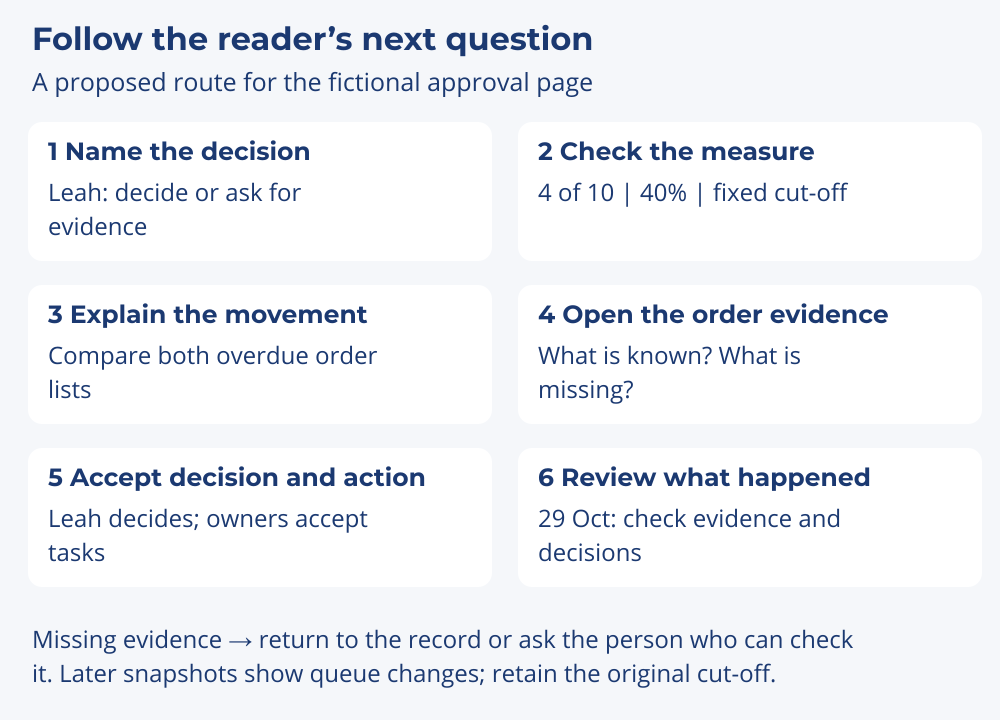
A proposed reading route for this page. Missing evidence sends the discussion back to the record or the person who can check it. A new snapshot shows later queue changes; the original review keeps its cut-off.
Try the page with the person who'll use it
Before building this in a reporting tool, I'd put the sketch in front of Leah and Arun and ask them to work through those 4 orders.
Can they explain 4 of 10? Can they find the note behind the oldest request? Can they distinguish an accepted decision from a suggestion waiting for someone to check it?
Then I'd watch where they stop. If Leah has to leave the page to ask what “overdue” means, the definition needs work. If Arun needs another system to check the coupling, I'd make that handover explicit. The broader design choices belong in 011, Building a maintenance reporting system people can use.
On a desktop, the measure, trend and relevant orders can sit together. On a phone, I'd stack them in the same reading order and give each order enough space to read. Shrinking the whole desktop page until the text is tiny would defeat the point.
A useful companion would be a report-page decision sheet for a planner and report builder to complete together: the named reader, decision, population, cut-off, calculation, source records, missing evidence, proposed action and person who accepts it. I've included a blank static sheet with this draft. It records design choices; it doesn't approve maintenance or connect to a system.
Take one page you're already responsible for. Sit beside the person who uses it, open one number and follow their next question through to an order and a decision. Sketch what they need along the way.
I'd start building from that conversation.