It's 08:45. The maintenance review starts at 09:00, and the planner is still comparing 2 exports to work out which orders have appeared since last week. Someone's asking whether the action list is up to date. The explanation beside the chart still says “awaiting parts”.
I'd quite like the computer to have done some of that before anyone arrived.
Here's a made-up weekly review at Fenbrook, with planner Priya, maintenance supervisor Helen and stores coordinator Dan. Every person, record and outcome below is fictional. This is a workflow I'd propose testing. No integration has been built, and the draft wording is an authored illustration, rather than output from a separate AI experiment.
I'd start with the work Priya repeats each week: preparing the same population, checking what's changed and bringing last week's actions back into the conversation. Then I'd look at where an assistant could help her write a useful first draft.
Agree what the meeting is deciding
Fenbrook's Monday review has a specific job: agree which gaps in planning information someone will check before the next scheduling discussion. Helen can accept those preparation actions within her delegated authority. Decisions about doing maintenance, accepting risk or committing work to the schedule follow the site's existing arrangements.
The selected list contains orders with the local field “Planning information needed” set to “Yes”. That's the agreed filter for this example. It doesn't tell Helen how urgent a job is, whether it's safe to defer or why the information is missing.
Priya brings the current and previous Monday's 08:00 exports, the filter definition and last week's accepted action log. Each export needs its extraction time, source and version. The action log needs the accepted wording, owner, due time and any evidence returned.
I'd settle that before arranging an automated Monday email. Otherwise, it's quite easy to deliver a beautifully formatted answer to a question nobody agreed to ask.
Prepare the same pack every week
I'd use fixed rules for dates, filters, joins and arithmetic. An AI assistant wouldn't need to decide how many distinct order IDs appear in an export.
For this fictional review, the previous list contains WO-2001, WO-2002 and WO-2003. The corrected current list contains WO-2002, WO-2003, WO-2004 and WO-2005. Both use the same definition and cut-off time, 1 week apart.
The checked comparison is:
- 3 selected orders last week and 4 this week: an increase of 1.
- 2 remain in the population: WO-2002 and WO-2003.
- 2 enter it: WO-2004 and WO-2005.
- 1 leaves it: WO-2001.
WO-2001 leaving this list doesn't establish that the job was completed. Priya would need its source record to explain the change.
There's a small snag in the first current export: WO-2005 appears twice. I'd want the preparation to stop there, show the repeated ID and ask for a corrected export. Quietly deleting a row would hide a problem that might affect more than the count. Priya checks the replacement against the source and keeps both versions with the correction recorded.
Other checks would cover missing IDs, an unexpected column, an unrecognised field value and a missed extraction. A failed check should produce a visible exception with a person responsible for resolving it. If this week's pack hasn't passed, last week's report must keep its old date and a clear stale label.
The proposed outputs are a versioned review pack, the comparison above, a list of exceptions and the carried-forward action log. Those give Priya something she can inspect before any prose gets added.
Give AI a bounded writing job
WO-2004 has one relevant note: “Parts availability not confirmed.” There's no supplier response, delivery date or reason for the missing confirmation in this pack.
I could ask an assistant to draft a short meeting brief from the checked comparison and the supplied notes. I'd want order references beside claims, unknowns kept visible and proposed questions separated from recorded observations.
For example, I'd be happy to put this wording in front of Priya for checking:
The selected population increased from 3 to 4 orders. WO-2004 entered the list, and its note says parts availability hasn't been confirmed. Suggested question for Dan: what evidence is available about the material position for this order?
That's illustrative wording. It hasn't been returned by a tested assistant.
Priya can trace each part to the pack. An explanation about a late supplier delivery would have no support here. Even “awaiting parts” loses the distinction between something being unavailable and somebody still needing to check it.
An assistant could also draft questions against overdue actions or turn accepted meeting notes into a proposed update. Priya would check that the action really was accepted and that the wording preserved its scope. I'd leave assigning priorities, inventing due dates and deciding whether an action is finished with the people who have the context and authority.
Make acceptance an actual handover
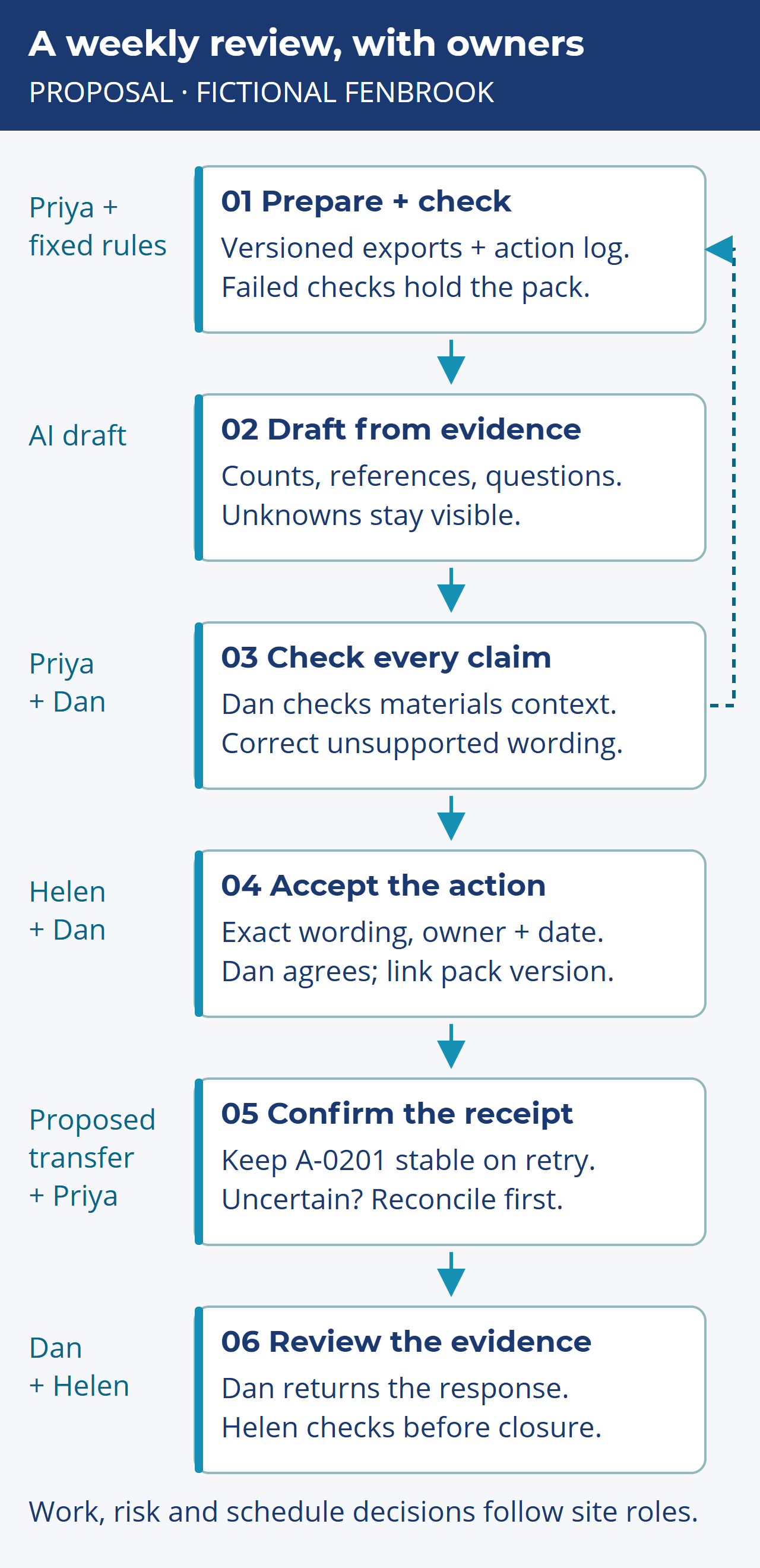
Priya checks the draft before the meeting. Dan checks the local meaning of the materials question. Helen then decides whether the preparation action belongs in the agreed workflow.
In this example, Helen accepts: “Dan to check the specified material and its receipt and reservation position for WO-2004, and return the evidence by 12:00 on Tuesday 10 November.” Dan agrees to own it. The action gets the reference A-0201 and links back to the 9 November review pack.
That acceptance needs its own record: who accepted which wording, when, with which owner and due time. A proposed action sitting in a draft remains proposed. A status such as “approved” on the underlying work order wouldn't supply Helen's acceptance of this follow-up.
Only then would I allow a later, tested integration to transfer the accepted action into the agreed action register. The receiving register would return its action reference, or the transfer would remain visibly unconfirmed. I'd want Priya to see which happened.
 Open full-size image (opens in a new tab)
Original proposed workflow for fictional Fenbrook. The people named at each handover check or accept that step; the diagram doesn't grant operational authority.
In my original content notes, I put meetings, action tracking and feedback alongside the reports. This is the part of the proposal that would make that useful: an agreed question reaches a person, with a date and a route back to the next review.
Make a mistake recoverable
Suppose the transfer times out. Has A-0201 reached the register?
I'd want the system to check for that same accepted action before retrying. It needs a stable action reference and a record of the receiving system's response. Matching only the work-order number would be too crude, because one order could have several different follow-ups.
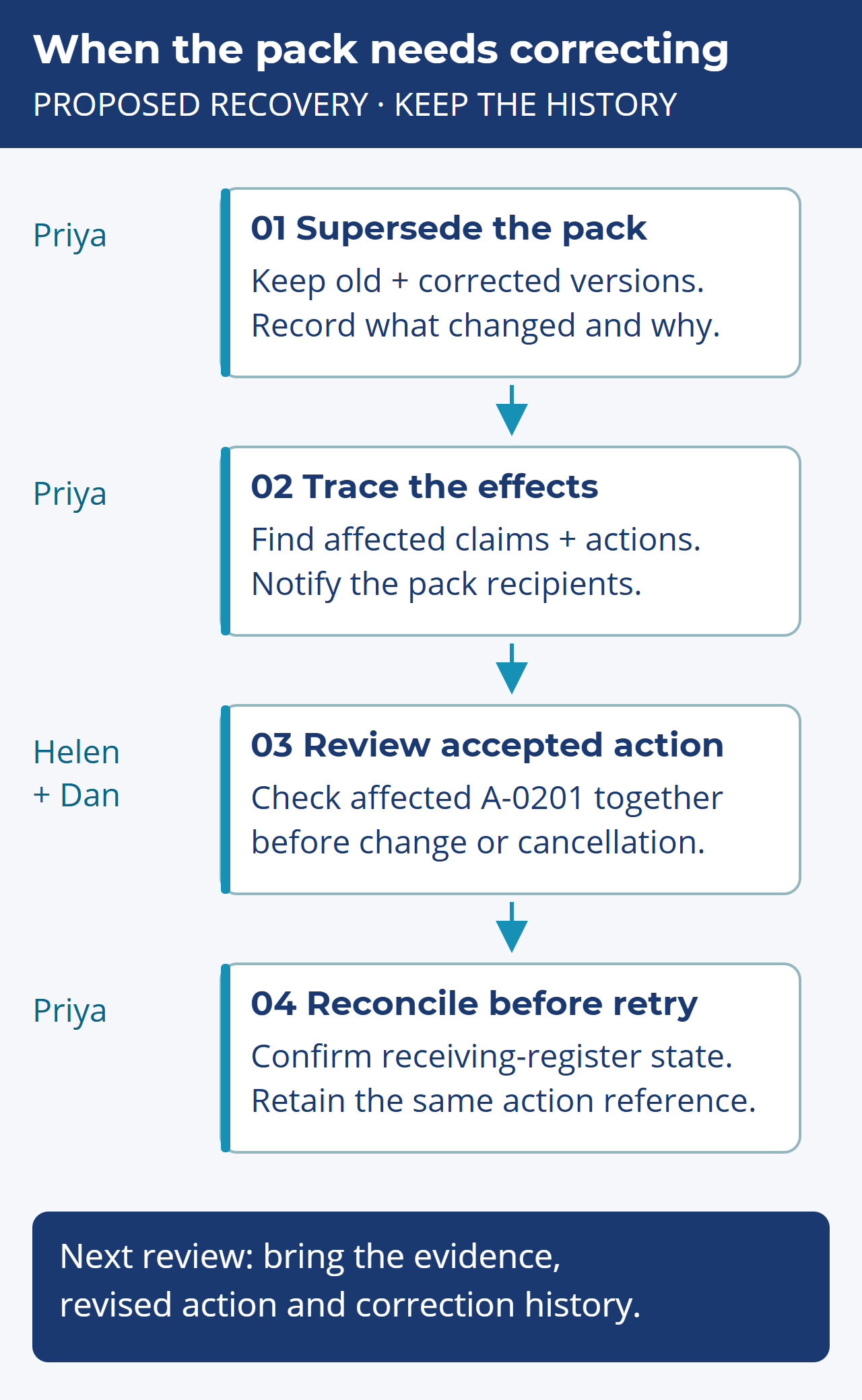
If the receiving system can't confirm what happened, Priya reconciles it there before anyone sends it again. A rerun of the pack shouldn't give Dan 2 copies of the same task.
Now suppose Priya discovers that the export used the wrong filter after the brief has been circulated. She marks that pack as superseded, records the corrected version and alerts its recipients through the agreed process. She checks which statements and actions depended on it. Helen reviews any affected accepted action with its owner before changing or cancelling it. Keeping the earlier record makes the correction explainable.
 Open full-size image (opens in a new tab)
Original correction path for this proposal. A corrected summary and a changed accepted action each need their own visible record.
At the next review, Dan's response returns beside A-0201. Helen checks whether it answers the agreed question before accepting closure. If the evidence is still missing, the action stays open with the gap recorded. A completed-task label alone wouldn't answer the materials question.
I'd also want a manual route for a missed run. Priya could prepare the pack using the same definition, label it as manually prepared and follow the same checks. The meeting shouldn't need someone to repair an automation before it can have a useful conversation.
Start with the preparation you can check
I'd try the preparation beside the existing process first. Compare its counts and order references with a manually checked pack. Include an unchanged week, a repeated ID, a missing export and a retry after an uncertain transfer. Ask Priya whether checking the result takes less effort than preparing it herself. Record rework as well as time saved.
The process owner would accept the trial's results; the system and data owners would need to agree access, data handling and the proposed transfer before any connection went live. I'd keep those decisions visible in the scope, rather than assuming that a successful draft settles them.
A companion automation-scope worksheet comes with this article. It lets the planner and process owner write down the inputs, repeatable rule, proposed output, exception owner, human acceptance and correction route for one task. There's a completed WO-2004 example and a blank sheet. It's a static planning aid; a connected tool would need its own build and acceptance work.
For the detailed AI examples and review questions, the related pieces are:
- AI in maintenance decision support: following a draft back to its evidence.
- Giving AI a maintenance KPI to review: a separate model experiment, still being prepared when this article was drafted.
- Who owns the decision when AI suggests the next action?: allocating the human decisions.
- Before I use an AI-written explanation in a meeting: the proposed checks before using a summary, with that article awaiting the separate experiment.
I'd begin with one weekly pack and its action list. Let the computer prepare something Priya can check, let Helen accept a specific follow-up, and bring the evidence back next week. Then I'd have something concrete to judge before adding more automation.