“A spare is available. Put WO-1801 into Friday’s schedule.”
That would be a useful recommendation, if someone had checked the spare and agreed the work could go ahead.
Let me use a fictional review at Northbank. The people, records and site authority described here are invented. The AI wording is an illustration I’ve written, rather than output from a model experiment.
Priya, the planner, has prepared a pack for Thursday’s meeting. WO-1801, a seal replacement on pump P-18, says “awaiting material”. A stores list includes a seal for the same pump family. The pack contains no confirmed part match, reservation or agreed operating window.
The proposed AI task is to summarise what needs checking before the job can enter the schedule. Imagine the draft returns that opening recommendation.
It’s skipped quite a bit of the conversation.
Priya owns the preparation
Priya checks that the draft refers to the right work order and the records in Thursday’s pack. She keeps the stores entry beside the work-order note so the apparent mismatch is visible.
She can accept “check whether this spare can support WO-1801” as a question for the review. She can’t accept “spare available” as an established fact about this job. Nobody has confirmed that yet.
I’d want her name against that check. “Human reviewed” leaves the next person guessing what somebody actually reviewed (and whether they looked beyond the wording).
Mo owns the technical interpretation
Mo, the reliability engineer, looks at the two records. In this example, the family description doesn’t establish which seal P-18 needs. He leaves suitability unresolved and agrees to check the specified part against the stores item.
That’s his technical judgement to support with evidence. Priya’s neat summary can help him find the question; it can’t supply the missing part match.
The revised note now says:
WO-1801 remains recorded as awaiting material. A stores entry may be relevant. Mo to confirm whether the listed seal matches the specified part. Reservation and operating window remain unconfirmed.
There’s still something useful to take to the meeting. The uncertainty has a person and a next step attached to it.
Helen owns what she authorises
Helen chairs the review. Under this fictional site’s arrangements, she can authorise preparation checks. A schedule change needs her separate approval and an operating window agreed by Sam, the operations lead. The site’s work controls still apply after that.
She agrees Mo’s part check and Priya’s reservation check, both due by 14:00 Thursday. Priya will ask stores about reservation only if Mo confirms a match. Each accepts their action.
Helen records “preparation checks authorised”. Friday’s schedule entry stays pending. Sam hasn’t agreed a window, and nobody has established material readiness. The meeting hasn’t authorised a deferral of any existing work either.
I think this is where “AI recommended it” can become a rather convenient phrase. Helen still has to say what she’s agreeing to. A suggested action doesn’t expand her authority.
 Open full-size image (opens in a new tab)
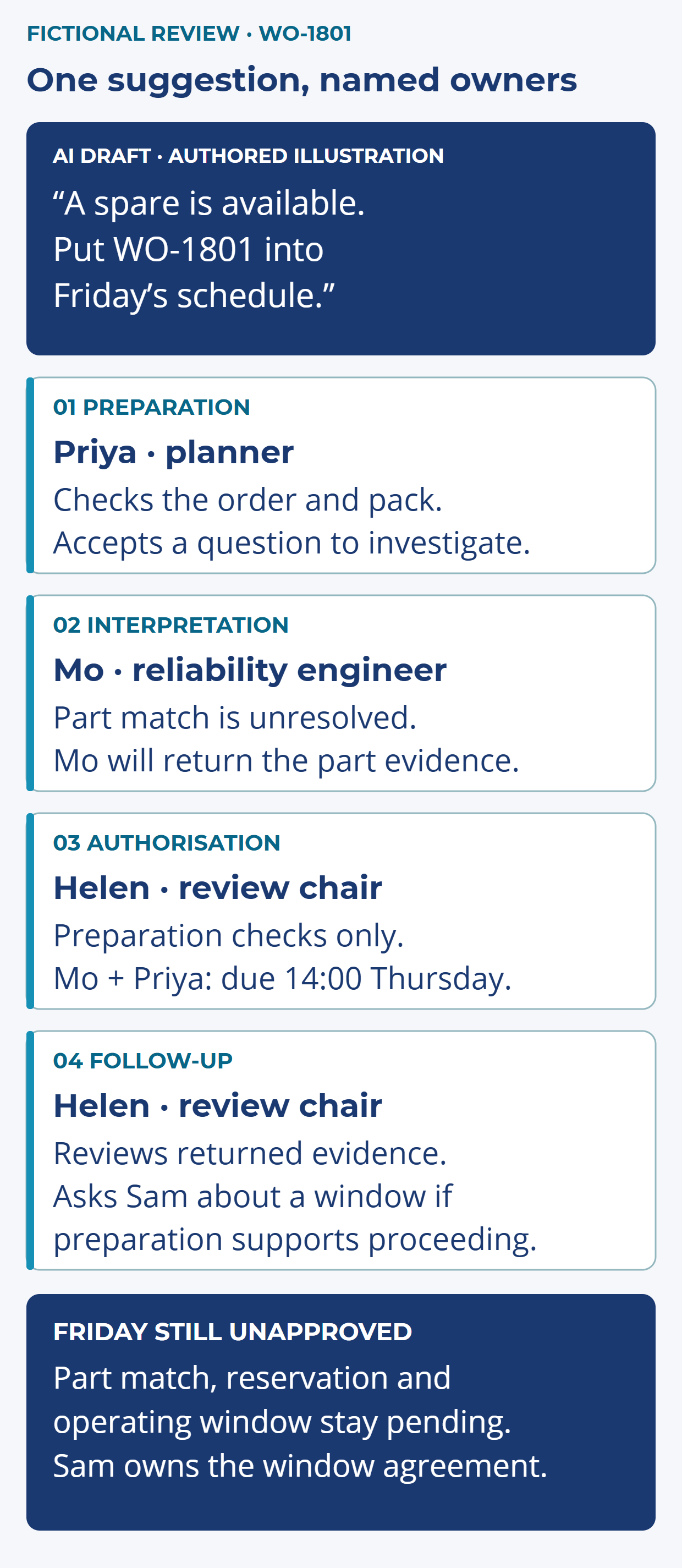
One review, several distinct decisions. This original illustration records the agreed checks separately from the schedule decision that remains pending.
Helen also owns the return to the decision
At 14:00, Helen will review the evidence Mo and Priya return. She’ll ask Sam for an operating-window decision if the preparation checks support proceeding. Those results haven’t happened in this example.
Sending an email to stores won’t close Priya’s action. She needs the reservation answer, or a recorded reason it remains unresolved. If the checks miss the agreed time, Helen must decide who to involve and when to review again. Friday remains unapproved meanwhile.
This extends a theme in my unfinished handbook: be specific about each person’s actions and the decisions a group has authority to make. An AI draft gives you another handover to manage.
For the next review, I’d try a one-page acceptance card. Keep the suggestion, source references, missing evidence, named checker, authorised decision and follow-up together. Let the person accepting the decision record exactly what they accept, including what stays pending. Use your site’s actual authority arrangements.
The broader AI in maintenance decision support guide follows the evidence checks in more depth. The companion Giving AI a maintenance KPI to review is being prepared as an actual model experiment; its results need verification before they can be used here.
Pick one suggestion at your next meeting. Before it becomes an action, ask the person agreeing it to say what they’ve checked, what they can authorise and when they’ll come back with evidence.