If I'm about to read an AI-written explanation aloud, I'd want to be able to answer the first interruption: “Which records are you basing that on?”
For Giving AI a maintenance KPI to review, an actual model run received 13 fictional work orders and a written KPI definition. It returned the correct result, accounted for every order and left the causes unresolved. No real supervisor accepted an action during that experiment.
That gives me a useful draft to check. I'd work through it with the definition and records open, including the parts that look perfectly reasonable (especially those, perhaps).
Can I reproduce the number?
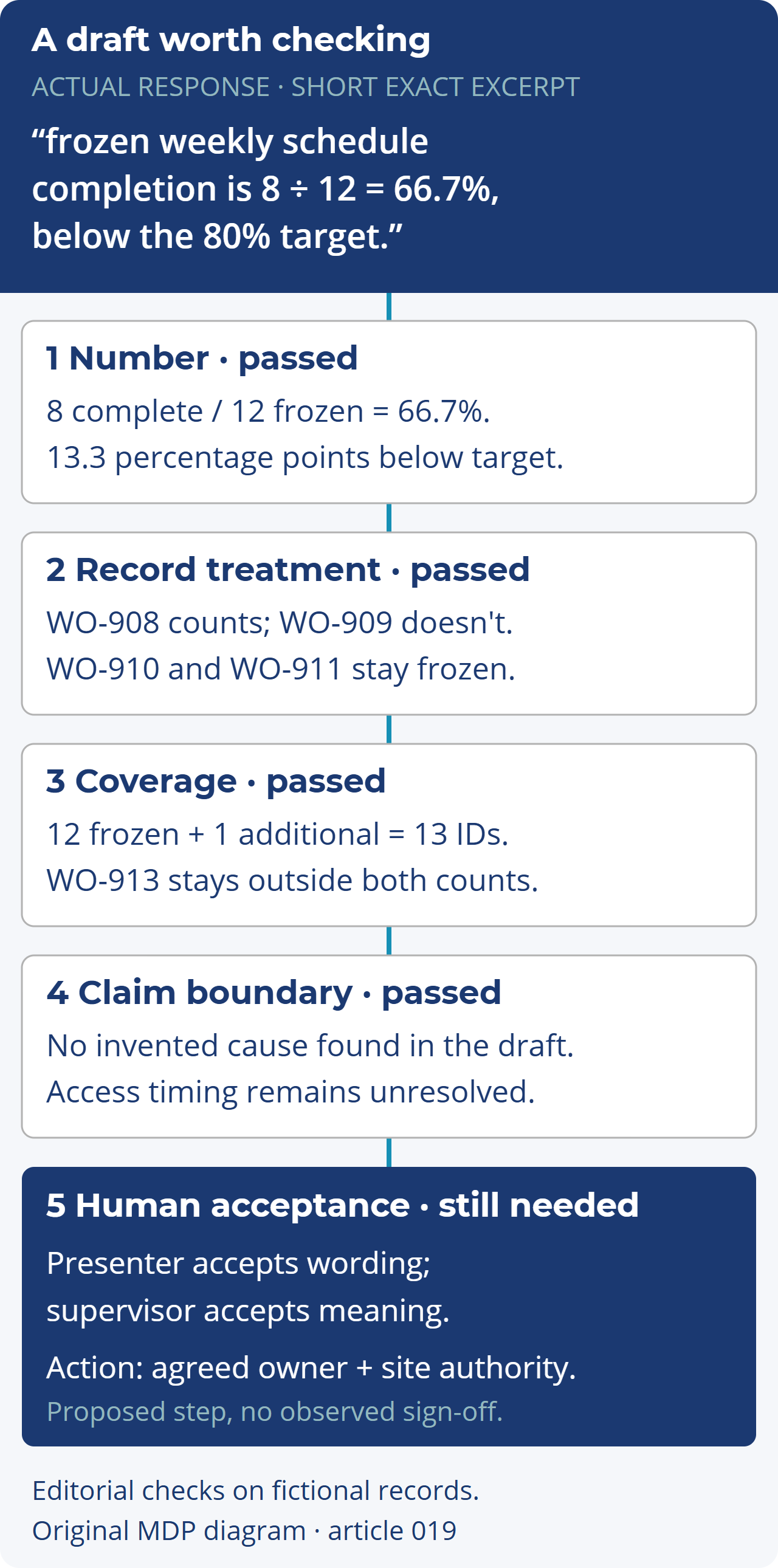
The response reported 8 completed orders out of 12 on the frozen schedule: 66.7%, below the fictional 80% target.
I'd rebuild those counts from the supplied observations before checking the division. WO-901 through WO-907 contribute 7 completions. WO-908 adds 1. Four other frozen orders contribute none, giving 8 completions and 12 orders in the denominator.
Then 8 ÷ 12 × 100 gives 66.666…%, displayed as 66.7%. The unrounded result is below 80%. The draft's 13.3 percentage-point shortfall also checks out.
I'd mark that check as passed. Rewriting a correct number would achieve very little.
Do the record references support the treatment?
WO-908's entire scope and tests were physically complete on Sunday. Its Monday administrative closure doesn't remove it from the numerator under this definition. WO-909 had a required test outstanding on Sunday, despite an earlier completion status, so it doesn't count as complete.
The response handled both correctly. It also retained the cancelled duplicate WO-910 and deferred WO-911 in the frozen denominator, as instructed.
I'd want those references beside the explanation. Otherwise, the meeting can drift into a discussion about what “complete” usually means while everyone has a different rule in mind.
Has anything quietly disappeared?
I'd compare the full identifier list with the output. Here, all 12 frozen orders appear, including WO-912, whose note confirms work remained. The additional urgent job, WO-913, appears separately and enters neither count.
That's all 13 supplied IDs accounted for. A check of the headline alone wouldn't establish that. Nor would checking only the orders the assistant chose to mention in a short summary.
 Open full-size image (opens in a new tab)
Original MDP check sequence using article 017's captured response to fictional records. The arithmetic and coverage checks passed; operational acceptance remains a human step.
Has an observation grown into a cause?
WO-911 was deferred because access wasn't available. The records don't establish why access was unavailable or when that constraint became known. The response preserved that gap and proposed asking about it.
WO-913 was urgent and completed during the week. Nothing supplied establishes that it displaced frozen work. I'd leave that explanation out unless someone brought evidence for it.
The returned draft didn't invent either cause. That's another passed check, with unanswered questions still visible.
What might the room assume this number tells them?
Every order has equal weight in this measure. The response says it doesn't measure labour hours, risk, quality or overall maintenance performance. I'd also note that the pack supplies no production consequences. Those limits belong in the shortened explanation, too.
I'd also keep the evidence timing clear: work had to be physically complete by Sunday at 23:59, with supporting evidence accepted by Monday at 08:00. Both times use Europe/London. A later status extract could answer a different question.
This was one run on an unusually explicit fictional pack. It doesn't establish how another draft would behave, or whether this approach saves meeting-preparation time.
Who needs to answer before I say more?
I'd bring the checked result and the open questions together. The analyst checks identifiers and arithmetic. The supervisor accepts the scope, evidence and operational meaning; the scheduler retains the frozen list.
For WO-911, that could mean asking the supervisor and scheduler what access information existed at the freeze. The draft suggested those reviewers. Nobody had agreed to investigate anything yet.
As presenter, I'd own the explanation I use. If I can't defend a sentence, I'd leave it unaccepted and state what evidence or conversation it needs. A proposed action needs a person who accepts it, a return point and the site's normal authority.
The static meeting-preparation check card puts those checks beside a draft, with space for the source, unresolved question and human acceptance. It's a blank aid, not a completed sign-off. The wider AI in maintenance decision support guide follows the process through action and follow-up.
I'd take a checked number and a clear question into the room. Then listen to the person who knows what happened.