In this fictional weekly review, a work order was marked complete, then reopened because a required test hadn't been done. Another was cancelled as a duplicate. An urgent job arrived after the schedule was agreed and was finished within the week.
You can probably picture the discussion. Which jobs count? What does the missed target tell the supervisor? Did the urgent job affect the original schedule?
Before asking AI to explain any of that, I'd want the rules and records beside it.
For this article, an actual model run received the fictional KPI definition and work orders from Defining a maintenance KPI people can defend. It returned the right calculation, kept the awkward orders in the right places and left the causes open. That's a useful result to examine.
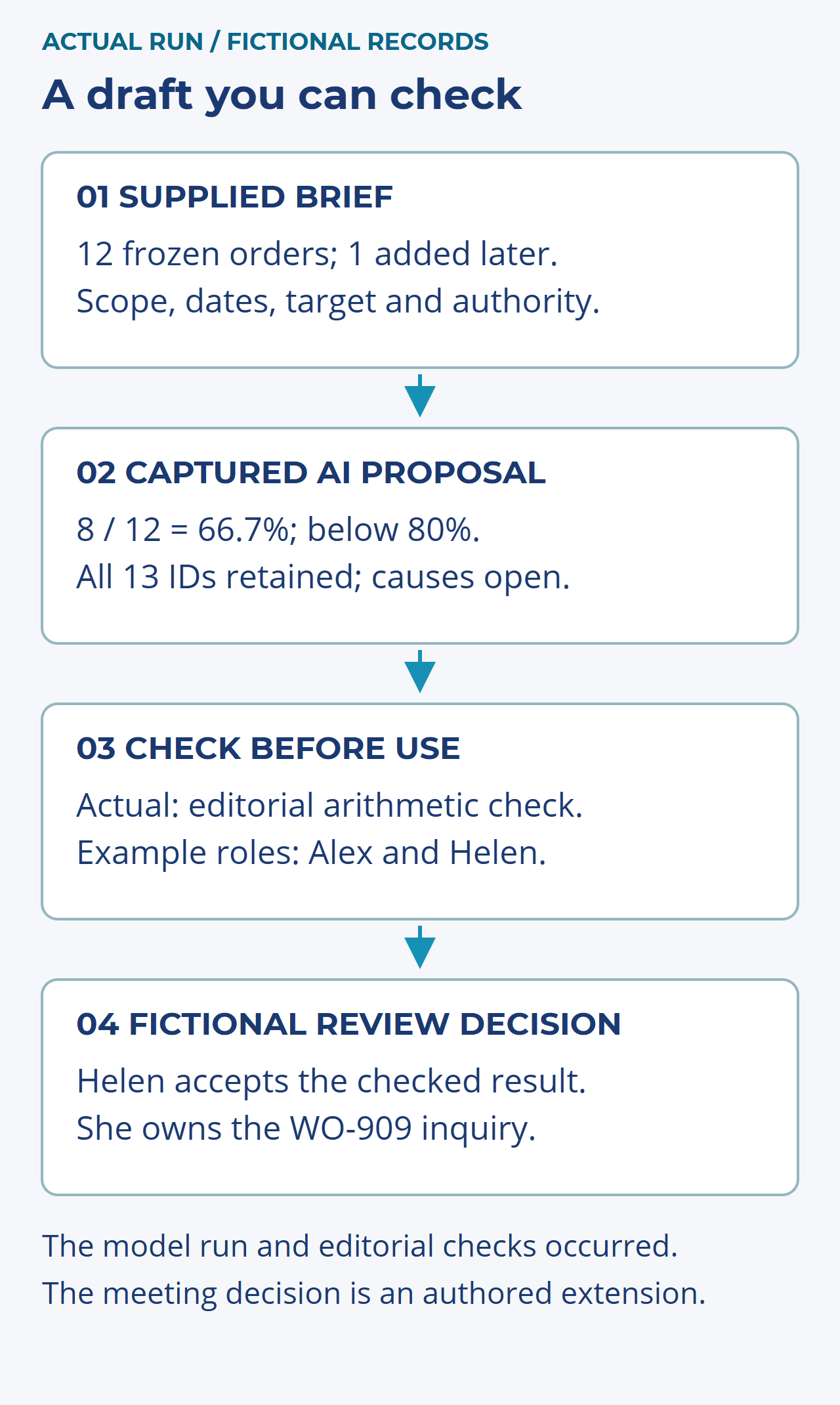
The model run and code checks happened during preparation of this article. Alex, the analyst, and Helen, the maintenance supervisor, are fictional role labels added to show how someone could review and accept the draft. Their later conversation is an authored continuation. No real supervisor participated or made an operational decision.
Give the draft a decision to support
Helen's question is which preparation and scheduling problems need investigating before the next schedule is agreed.
That gives the assistant a bounded job: calculate the supplied measure, account for every order, explain what the observations support and suggest questions for the review. Helen can then decide what evidence she needs next.
“Review our maintenance performance” would leave a lot more for the assistant to make up for itself. In this example, it has one measure and one frozen population. There are no labour hours, risk assessments, production consequences or earlier weeks from which to judge overall performance.
My unfinished reliability-culture handbook asks why a measure is needed, how it's calculated, who is accountable and what action it can inform. It also recommends a controlled KPI definition. Those questions are useful preparation for the brief. Someone needs to settle them before asking for an interpretation.
Alex checks identifiers and arithmetic. Helen accepts the scope, evidence and operational meaning. The scheduler retains the frozen list. These are responsibilities supplied in the example, with normal site authority still required for any operational action.
Put the rules beside the work orders
The measure is frozen weekly schedule completion, by distinct order count.
The schedule freezes at 15:00 on Friday 2 October 2026. Its 12 orders are due in the week from Monday 5 to Sunday 11 October. To count as complete, the entire agreed scope, including required tests, must be physically finished by Sunday at 23:59. Supporting evidence must be accepted by Monday 12 October at 08:00. All times use Europe/London.
The denominator stays at 12. Orders cancelled or deferred after the freeze remain in it. Additional work accepted after the freeze enters neither part of this KPI and appears separately.
The target is at least 80%, invented for this case. The unrounded result decides whether the target is met; the displayed percentage has 1 decimal place. Every order has equal weight, whatever its size.
The full KPI definition worksheet includes the other boundary rules. An accepted early completion can count for an order on the frozen list. Missing completion evidence contributes no completion, and a zero denominator would display “not applicable, 0 orders”. None of those exceptions changes this week's result.
The input already supplies checked observations for each record. The trial didn't have to find a work order, inspect a test certificate or resolve conflicting accounts from a shift. That's quite a lot of help, and it matters when judging the output.
Ask for something you can check
The actual brief asked the assistant to:
Calculate the KPI, reconcile every supplied work-order identifier, compare with the target, distinguish supported observations from missing context, and propose up to 3 useful follow-up questions with suggested human reviewers.
It also required order IDs beside record-based statements and told the assistant to leave unsupported causes, blame, impact, agreements and future benefits out of the draft. It had no authority to change the definition, amend records, approve work or assign agreed actions.
Those instructions make the expected output inspectable. Alex can find the order list. Helen can see which questions remain open. Suggested reviewers remain suggestions until people agree to do something.
Before the run, a separate reference answer recorded the expected classifications and arithmetic. That prevents the returned paragraph becoming its own answer key. The reference wasn't supplied to the model.
The single run took place on 13 November 2026, configured as gpt-6.1-sol with max reasoning. It used only the supplied task brief as case evidence, with no inherited article conversation, visible tool calls or follow-up prompts. The platform didn't expose a backend build or seed. The experiment record keeps the exact brief, complete unedited response and verification notes together.
There was one returned answer. No retry was used to find a more convenient result.
Read what actually came back
The response opened:
Draft for the maintenance supervisor’s review: frozen weekly schedule completion is 8 ÷ 12 = 66.7%, below the 80% target.
It then listed all 12 frozen orders individually, showed each one's contribution to the denominator and numerator, and kept WO-913 on a separate row contributing zero to both.
WO-908 counted despite its Monday administrative closure. WO-909 didn't count because the required test remained outstanding on Sunday. The cancelled duplicate and deferred order stayed in the frozen population. All of that followed the supplied definition.
The draft also named missing context and proposed 3 follow-up questions. It suggested human reviewers without pretending they'd agreed to an action or deadline.
That's what this run produced. The deliberately flawed AI paragraph in the earlier KPI article was an authored illustration; this is a captured response. There was no need to manufacture a mistake to make the review interesting.
I'd still open the records before accepting it. A sensible-looking answer deserves the same checks as an awkward one.
 Open full-size image (opens in a new tab)
Original MDP workflow. The model response and editorial verification actually occurred. The supervisor's decision is an authored fictional continuation showing where acceptance would sit.
Reconcile the number independently
Here's the check against the supplied case, condensed so you can follow it without reading 13 separate rows. This is the independent reconciliation, rather than a replacement model response.
| Orders | Supplied observation and rule check | Complete / frozen |
|---|---|---|
| WO-901 to WO-907 | Full scope and required tests complete by Sunday; evidence accepted by Monday 08:00 | 7 / 7 |
| WO-908 | Full scope and tests complete Sunday 18:00; administrative closure Monday 07:00; evidence accepted by 08:00 | 1 / 1 |
| WO-909 | Required test in the frozen scope still outstanding Sunday, following Saturday reopening | 0 / 1 |
| WO-910 | Cancelled Tuesday as a confirmed duplicate; retained under the frozen-population rule | 0 / 1 |
| WO-911 | Deferred Wednesday because access was unavailable; scope incomplete Sunday; retained | 0 / 1 |
| WO-912 | Open Sunday, with a note confirming work remained | 0 / 1 |
| WO-913 | Urgent work added Tuesday and completed Thursday; outside the frozen list | 0 / 0 |
Seven plus 1 gives 8 supported completions. WO-909 through WO-912 give 4 misses. Eight plus 4 gets back to 12 frozen orders, and the separate additional order accounts for the 13th supplied identifier.
Then the arithmetic: 8 ÷ 12 × 100 = 66.666…%, displayed as 66.7%. The unrounded result is below 80%. The response's additional shortfall of 13.3 percentage points also checks out after rounding.
An independent code check used the pre-run classifications and exact fractions to verify those results. The editorial review compared the response with the definition and observations. These are actual AI-assisted editorial checks on fictional inputs; Alex's role in the story illustrates who would perform the check at a site.
The record treatment deserves as much attention as the division. Taking WO-910 and WO-911 out would turn 8/12 into 8/10 and display 80%. The calculation would then answer a changed question. The returned draft kept both orders where the accepted rule put them.
WO-908 tests another boundary. Its administrative closure was late for the work period, while its physical scope and tests were finished on Sunday. WO-909 tests the reverse temptation: a completion status existed, while part of the required scope remained unfinished. The response handled both correctly.
For a larger pack, I'd want a repeatable comparison of the full identifier lists, including duplicates and omissions. Here, the small list makes the complete reconciliation visible to the reader.
Check how far the explanation travels
The fraction passed. The next check is whether each explanatory sentence stays within the evidence.
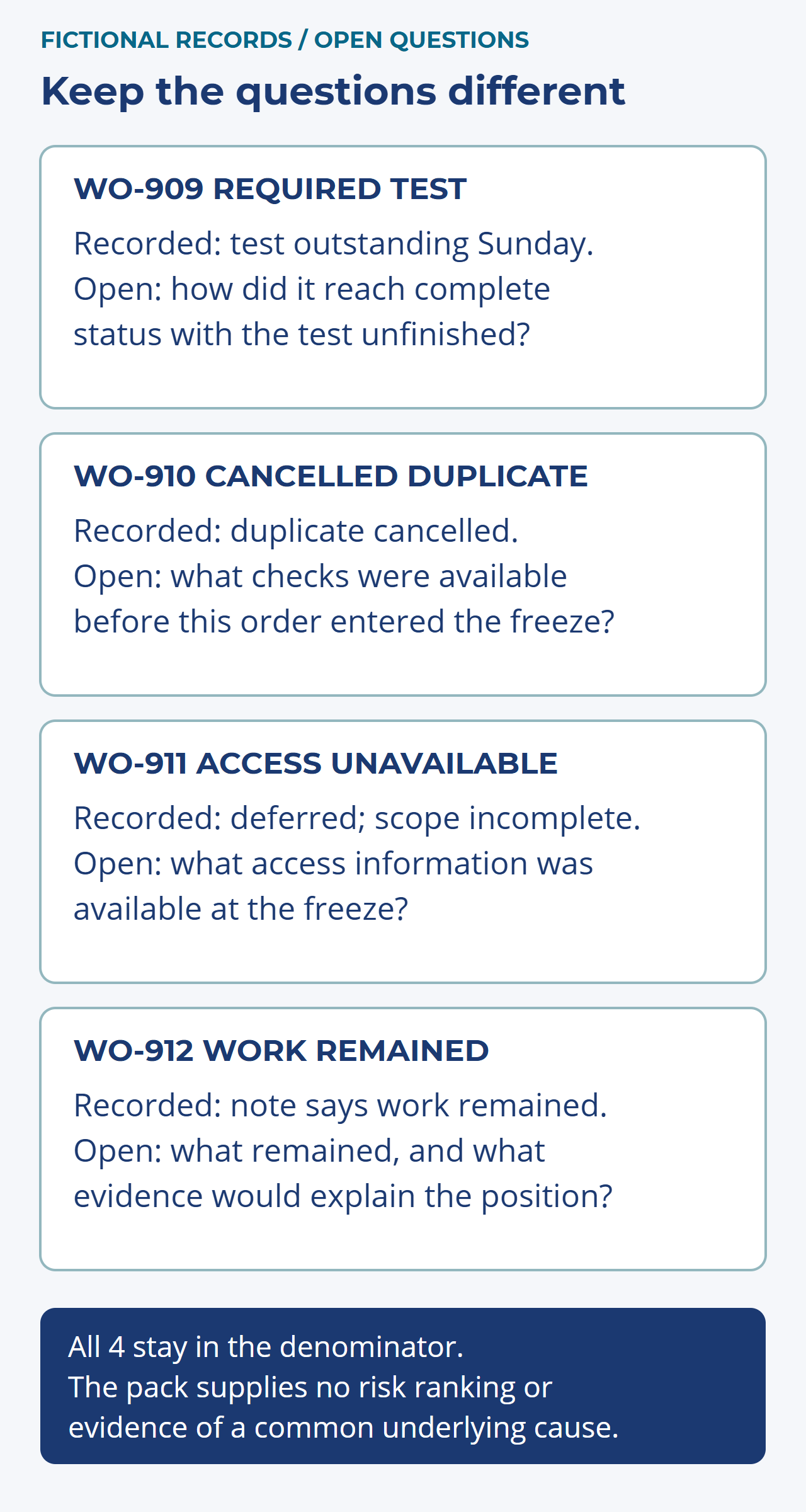
For WO-909, the supplied history establishes a completion status, a reopening and an unfinished required test. It leaves the person who made the entry and their reason unknown. The response preserved that gap.
WO-911 has a recorded reason for deferral: access wasn't available. The pack doesn't explain the underlying access constraint or what was known when the schedule froze. The response asked about that timing rather than supplying a cause.
WO-910 was a duplicate. The records don't establish whether the duplication could have been detected earlier. WO-912 had work remaining, with no detail about what remained or why. Those questions also stayed open.
 Open full-size image (opens in a new tab)
Original MDP discussion aid using fictional records. A recorded reason or status can guide the next question while leaving the underlying explanation unresolved.
WO-913 is worth a separate look. The completed urgent job is visible, and the draft gives it no credit in this particular KPI. Nothing supplied establishes that it displaced a frozen order. I'd keep that question available without writing “urgent work caused the miss” into the minutes.
Here's how its 3 proposed questions divide up. These are condensed descriptions of the returned questions; the exact wording is in the experiment record.
| Records | What the draft proposed asking | Suggested human reviewer |
|---|---|---|
| WO-909 and WO-912 | What prevented the required test, and what remained on the other unfinished order? | Supervisor checks scope and supporting evidence |
| WO-911 | When was access identified, and what readiness information existed at the freeze? | Supervisor and scheduler |
| WO-910 | What identifier and duplicate checks were available before the freeze, and what do they show? | Analyst checks identifiers; scheduler supplies frozen list; supervisor interprets |
That's a reasonable starting list. Helen would still need to choose what to pursue, given the people, evidence and time available. The first question brings 2 different orders together. She could split it if they need different evidence or conversations.
No material calculation, record-reference or unsupported-cause error was found in this returned draft. Acceptance can follow a clean check. Rewriting a correct result just to demonstrate human intervention would add little.
Let the supervisor accept something specific
Here's the fictional human continuation, authored to show the next handover. It wasn't part of the model run or an observed meeting.
Alex brings the checked reconciliation to Helen. In the story, he confirms that all identifiers are accounted for and the result follows the written definition. Helen accepts 66.7%, below the fictional target, as the result for this review.
She also accepts the draft's distinction between the observations and the missing explanation. There is no calculation to correct. She narrows the proposed questions to one preparation investigation she can own:
I'll inspect WO-909's status history, required-test record and handover information before the next schedule freeze. I want to establish how it reached completion status while that test remained unfinished, and bring the evidence back before choosing a change.
For this authored example, Helen agrees to own that check by 14:00 on Friday 16 October 2026, Europe/London, an hour before the next freeze. Her agreement, ownership and deadline are new fictional facts supplied here. The assistant didn't assign them.
That leaves an action someone could review: named order, defined evidence question, owner and due time. It leaves the cause unresolved. Helen hasn't blamed a technician, changed a completion rule or promised that next week's percentage will improve.
The other misses remain visible in the pack. Selecting one investigation doesn't make the other questions answered, or establish that WO-909 carries the greatest operational risk. No priority ranking has been supplied.
At the return, Helen would need to examine the evidence and decide whether it answers the question. This story supplies no later findings. Any decision about maintenance execution, release or scheduling would still follow the site's normal authority.
Notice what the supplied pack made possible
Imagine receiving only a current status of Complete for WO-909. That would leave Alex without the supplied reopening history and unfinished-test observation that made its treatment clear here. He'd need the relevant history and scope evidence before accepting that classification.
Or suppose the extract contained WO-913 alongside the other orders, with nothing identifying the frozen population. A neat table of 13 rows would leave the denominator unresolved. Someone would need to retrieve the retained commitment and establish which orders belonged to it.
Those are hypothetical changes to the pack, with no second model run. They show where I'd look before repeating this task. The assistant in the actual trial was given the information needed to handle both cases. A real review needs someone to establish that the right information has reached the brief.
I'd keep that work visible when assessing whether the draft helped. Preparing the frozen list and checking the completion evidence are part of the job. You can't judge the effort from the paragraph that arrives at the end.
Try the same small task with your own rules
The model had quite a head start here: 13 fictional identifiers, an explicit definition and observations already described as checked. It shows that one returned draft followed those inputs and gave useful questions. It doesn't establish how often the model would succeed on another pack, how much review time it would need or whether the arrangement helps a real meeting.
The AI in maintenance decision support guide follows the wider process, including grouping, query checks, action acceptance and follow-up. This example gives you one captured draft to inspect alongside it.
I've included a static KPI review brief with the worked case and a blank copy. It's for the analyst preparing a pack and the supervisor accepting its use. The inputs are the decision, controlled definition, frozen selection, checked observations and known gaps. The outputs are a draft calculation, reconciliation, open questions and an acceptance record.
The sheet assumes someone can inspect the relevant scope and history. It can't establish physical completion from a status field or make anyone agree to an action. Use approved arrangements for any real records you choose to trial.
I'd start with a retrospective pack whose answer the analyst and supervisor can already defend. Write that reference first. Then compare the returned draft with it, keeping the source records beside the check. Include preparation, review and correction when judging the effort involved.
For Alex and Helen, the worthwhile handover is small: a checked number, four visible misses and one evidence question with an agreed owner. If an assistant helps you arrive there, you've got something concrete to assess before taking the next step.