“Both seal jobs are delayed by late suppliers. Escalate procurement and schedule both next week.”
That's a tidy paragraph for the maintenance meeting. Someone could read it out, agree an action and move on.
I'd want the planner to stop them.
One kit is already in stores. The other reservation identifies a different variant, with engineering confirmation still open. Neither order has supplied evidence of a late delivery. And who agreed that either job could go into next week's schedule?
The paragraph is an invented AI response. I'll use one fictional maintenance review to follow how an assistant could help prepare the discussion, how people would check its work, and what happens after someone accepts an action.
The useful opportunity is quite practical: less time assembling and rewriting the pack, with enough evidence left visible for people to challenge it. Getting there means being precise about what the assistant receives and what someone must accept before its draft goes any further.
The short version: give AI a bounded preparation task, keep its claims linked to records, preserve unanswered questions and name the person who decides. Use repeatable calculations for agreed rules. Check whether the whole arrangement helps the people doing the review.
In this guide:
- Give the assistant a useful job
- Put the evidence beside the request
- Ask for a draft people can check
- Check the summary and its grouping
- Draft and check a calculation
- Turn questions into human decisions
- Keep the follow-up attached
- Choose what to repeat and what to retain
- Try it within an accepted process
- A review sheet I'd put beside the draft
Give the assistant a useful job
At the fictional Northbank site, planner Priya is preparing for Monday's work-preparation review. Helen, the maintenance supervisor, wants to decide which information gaps need resolving before the schedule discussion. The question is small enough to do something with: which of these selected orders needs a check, who can do it, and what evidence should they bring back?
Helen can agree preparation follow-up in this example. Physical work, equipment operation, deferrals and schedule commitments still go through the site's authorised arrangements. An assistant drafting the pack gets no authority to change any of them.
I'd make that boundary clear before giving it a file. Otherwise, “help with the review” leaves a lot of room for an enthusiastic answer.
Priya owns preparation of the pack. Alex, the analyst, checks the extract and calculation. Dan in materials, Elena in operations and Mo in engineering help interpret the parts of the work they know. Helen accepts the review actions, with an identified person responsible for bringing each one back.
That division gives the assistant several useful jobs. It could shorten supplied notes without losing their meaning, arrange orders under questions that need answering, draft a query, suggest questions for the relevant people and prepare action wording for their review. Each output has a reader and a purpose.
I'd start with the summary and unresolved questions. You can judge whether those help before joining anything to a live process.
All records, people, conversations and later developments below are invented. The AI responses and prompts are authored illustrations for this guide, rather than a transcript from a separate model trial. The SQL calculation was actually run locally against the 6 fictional rows and checked. No CMMS or report connection was built, no operational action was taken, and no business improvement was measured.
For the wider route from a number to a decision, From maintenance data to decisions covers the reporting logic. Here, I'm concentrating on what changes when an assistant helps with the preparation.
Put the evidence beside the request
Priya's first input is pack A: 6 selected orders as recorded at 16:00 on Friday 6 November 2026, Northbank site time. The review takes place at 09:00 on Monday 9 November. These were selected to discuss preparation issues; they aren't the site's complete backlog or a representative sample of its work.
Each row is one distinct order. Target finish is a date. Approved, Waiting materials and Ready all count as open for this example; Complete counts as closed. The label Ready records a preparation position and doesn't establish crew availability or permission to carry out work.
| Order | Equipment | Target finish | Recorded status | Supplied note |
|---|---|---|---|---|
| WO-1601 | P-201A | 2 Nov | Waiting materials | Seal kit not confirmed |
| WO-1602 | P-201B | 3 Nov | Waiting materials | Seal kit reserved; fit check open |
| WO-1603 | V-204 | 5 Nov | Approved | Access window requested; not confirmed |
| WO-1604 | P-202 | 6 Nov | Ready | Planning checks recorded complete; crew not allocated |
| WO-1605 | P-203 | 4 Nov | Complete | Seal replaced; 10-minute run with no visible leakage; cause not established |
| WO-1606 | HX-206 | Not entered | Approved | Scope confirmed; target finish not entered |
Two other notes exist. They become pack B when Priya checks the first summary:
- B1, Dan's materials check, 6 November at 15:00: the specified kit for WO-1601 was received on 4 November and remains in stores. No reservation is recorded for this order.
- B2, Priya's planning check, 6 November at 15:30: WO-1602's reserved kit is a different variant. Engineering confirmation of the required variant remains open.
Those notes pre-date the snapshot. The first request below deliberately contains only A, so the assistant wouldn't have B1 or B2. That's a limitation in the supplied pack. A real preparation process should bring relevant checked notes through before asking for an explanation.
I'd keep the pack version and record references with the output. If someone later adds a stores check, you need to see which summary used it. Copying a paragraph into the minutes without its source position makes that much harder.
I'd also retain the wording “not confirmed”. It tells you where the evidence stops. Replacing it with “not available” would add a fact the first pack doesn't contain.
My unfinished handbook's chapter on decision support works through data, context, quality and use. The practical extension here is to make the assistant's working material inspectable, including the gaps. An unrecorded conversation stays outside this pack, however useful its contents might be.
Ask for a draft people can check
Here's the sort of instruction I'd give with pack A:
Prepare a draft for Priya's work-preparation review using pack A only. Summarise the selected orders and cite their IDs beside each statement. Separate recorded observations, unknowns and proposed questions. Keep the difference between “not confirmed” and “not available”. Don't infer a cause from a status label. Don't recommend operational work, a deferral or a schedule commitment. Mark information you need rather than filling it in.
That's a proposed brief, with a review task attached. It doesn't establish that a particular model will follow every instruction. Priya still needs to check the result.
I'd ask for an order-by-order table before a paragraph. A paragraph can make several different records sound like one common explanation. A table makes it easier to see whether WO-1602 has disappeared, whether a missing date has become a guessed date, or whether the assistant has carried a qualification through.
Keep the original note accessible. If the draft says “repair successful”, Priya should be able to compare it with WO-1605's actual observation: a 10-minute run with no visible leakage. The note doesn't establish performance at every duty or resolve the failure cause. The person responsible for accepting the maintenance work must apply the site's requirements.
I'd also ask for an explicit list of things the supplied records can't answer. Here that includes current material readiness, the confirmed access window, crew availability, WO-1606's target date and the cause behind WO-1605. Some need another record. Some need a conversation.
That list would help Priya prepare the meeting. It also gives her something concrete to challenge if the next draft suddenly sounds certain.
Check the summary and its grouping
Return to the opening paragraph about late suppliers. It's a deliberately flawed illustration, written to expose the checks. It isn't an observed failure rate or evidence that a named model behaved this way.
“Both seal jobs” can be traced to WO-1601 and WO-1602. “Late suppliers” can't be traced to anything in pack A. Their statuses concern materials; neither note contains an agreed delivery date or a late receipt. The suggested schedule commitment goes beyond both the evidence and the assistant's assigned role.
Priya rejects that explanation. She adds B1 and B2, then asks for a revised summary that keeps the records separate:
WO-1601: the recorded status is Waiting materials. B1 says the specified kit is in stores, with no reservation recorded. Ask Dan and Priya to check the reservation and the current preparation position. WO-1602: B2 describes the reserved kit as a different variant; engineering confirmation remains open. Neither record establishes a late supplier delivery. Readiness and schedule decisions remain for the authorised people.
That's the accepted illustrative wording for the pack. Priya has checked each statement against A, B1 or B2. She hasn't established why the reservation was missing, who made the variant selection, or whether either job can be scheduled.
Notice what the correction needed: a person recognising an unsupported claim, access to the right notes, and a second check of the revised text. “Human review” is quite a vague promise until someone has time and evidence to do those things.
NIST's guidance on generative AI identifies confidently stated false content as a risk, commonly called confabulation. That supports taking the check seriously; it doesn't validate this example or tell you how often an assistant will be wrong in your workflow. NIST's Generative AI Profile, §2.2
Now Priya can ask for grouping. I'd group these orders by the next preparation question, keeping the order IDs visible:
| Proposed group | Evidence in the pack | Person who checks the interpretation |
|---|---|---|
| Reservation and recorded status | WO-1601; A and B1 | Priya with Dan |
| Part identity | WO-1602; A and B2 | Mo with Priya |
| Access confirmation | WO-1603; A | Elena |
| Crew allocation | WO-1604; A | Helen with Priya |
| Target-date exception | WO-1606; A | Priya with Helen |
| Completed-order note, retained separately | WO-1605; A | Helen, with technical advice if needed |
These are proposed discussion groups. They aren't established delay causes or replacement CMMS codes. One order could raise several questions in a fuller pack. If the team needs one primary group for counting, agree that rule separately and retain the other issues.
“Materials problem” would combine the first 2 rows and lose the distinction the review needs. A convenient group can be too convenient.
 Open full-size image (opens in a new tab)
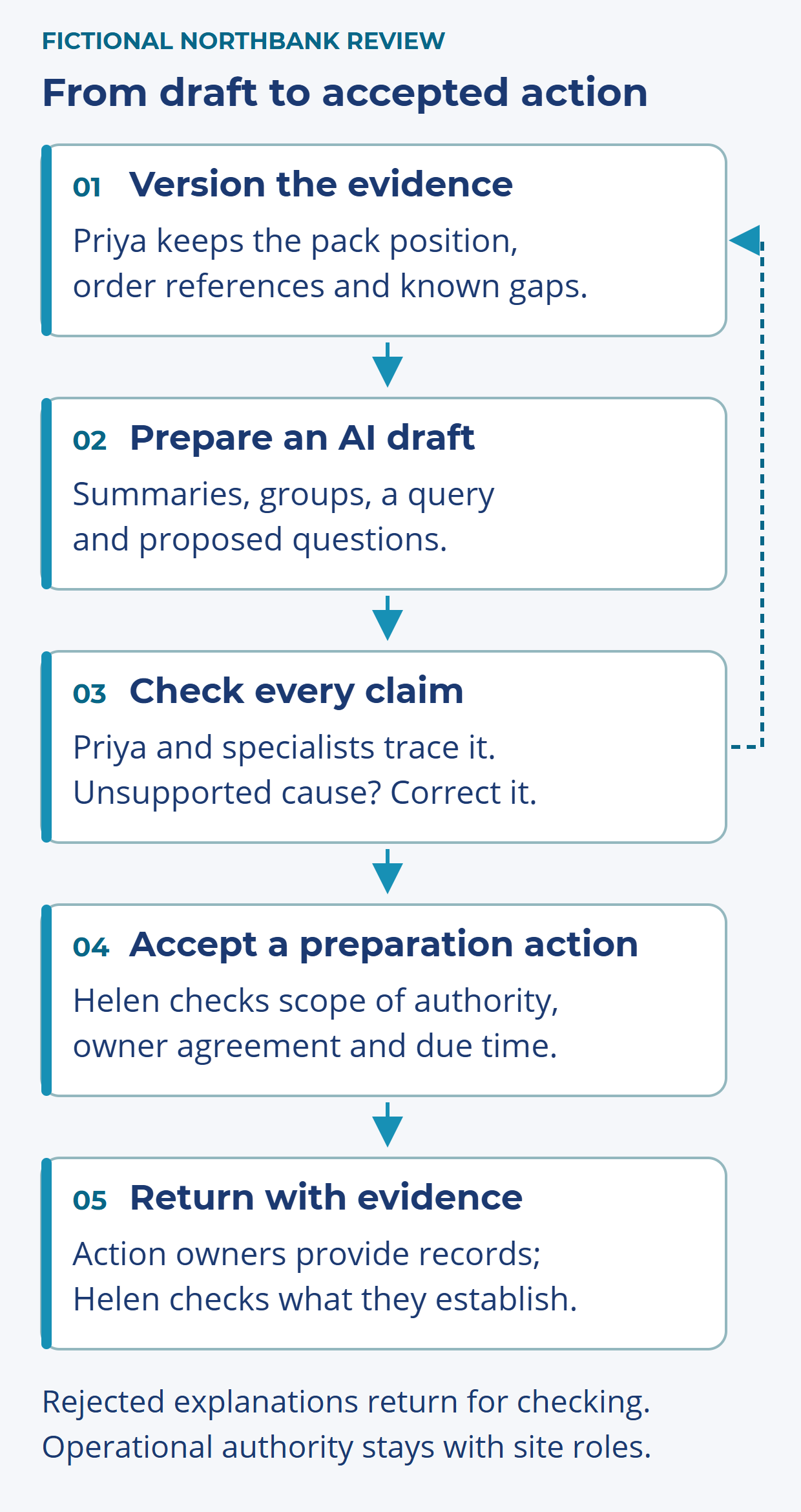
Original MDP workflow for this fictional example. Every handover keeps the order references, evidence gaps and human owner. The return path shows a rejected explanation being checked again.
Draft and check a calculation
Alex has a smaller question for the pack: which open orders have a target finish before the review date, and which open orders have no target date?
That question has an agreed rule. Use A as the Friday snapshot, compare target dates with 9 November 2026, and keep missing dates separate. Count distinct orders at that snapshot. There are no status-history or material-line joins in this little table.
I'd let an assistant draft the query from that definition and the supplied schema. I'd want Alex to read and run it in an isolated test before using it anywhere else. Code that looks familiar can still answer the wrong question.
Here's the illustrative draft, using SQLite syntax. The local check used this exact query, with the 6 fictional rows and review_date set to 2026-11-09:
SELECT
  CASE
    WHEN target_finish IS NULL THEN 'Missing target'
    WHEN target_finish < :review_date THEN 'Dated before review'
    ELSE 'Dated on or after review'
  END AS review_group,
  COUNT(*) AS orders
FROM review_orders
WHERE status IN ('Approved', 'Waiting materials', 'Ready')
GROUP BY review_group
ORDER BY review_group;
The result is 4 dated open orders before the review date, WO-1601 to WO-1604, and 1 open order with a missing target, WO-1606. WO-1605 is Complete and stays outside that open-order result. Four plus 1 reconciles to the 5 open orders; adding the completed order gets back to the 6 supplied rows.
Alex can check that by hand. The missing date doesn't quietly become an overdue date. The completed job doesn't enter the count merely because its target date has passed.
COUNT(*) works here because the test table has one row per order and a unique order ID. Joining material reservations onto it would change that assumption. Alex would need to establish the resulting grain and test it again. Copying the query into another database also needs syntax, date and access checks.
The executed result demonstrates this calculation on this fixture. It says nothing about a live extract's completeness, the meaning of another site's statuses, or a model's ability to write correct queries generally. It doesn't establish current readiness on Monday either. The underlying positions were recorded on Friday.
Once a calculation is agreed, I'd normally keep it as reviewed code that can run consistently. Asking AI to reinvent the definition each Monday would add another thing to check. The wider model and reporting arrangement belongs in Building a maintenance reporting system people can use.
Turn questions into human decisions
The corrected pack can now help Priya ask specific questions. An illustrative assistant draft might suggest:
- WO-1601, A and B1: does Dan's receipt evidence match the specified kit, and what remains to be done about the reservation and recorded preparation status?
- WO-1602, B2: what evidence does Mo need to confirm the required variant, and who will correct the reservation after that confirmation?
- WO-1603, A: can Elena confirm an access window through the site's normal process, or identify what prevents confirmation?
- WO-1604, A: who can confirm crew availability before anyone offers a schedule slot?
- WO-1606, A: who can agree the target finish, and what information do they need?
Each question has a source and a person who can answer. The draft hasn't decided which order matters most. This pack contains no accepted risk ranking, production consequences or comparison of maintenance obligations from which to make that choice.
I'd be wary of asking “what should the team prioritise?” unless those inputs and the decision owner's authority were explicit. Even then, I'd treat the answer as a proposal to examine. Someone needs to know what a delay means locally and what choices are actually available.
In the fictional meeting, Helen, Dan and Priya agree a preparation action for WO-1601. Dan will verify the kit against the specified part and provide the receipt and reservation position by 12:00 on Tuesday 10 November. Priya will then review the preparation record and route any required correction through the normal process. Helen accepts that follow-up and will check its evidence at the next review.
The draft action can help with wording. Helen checks Dan's agreement to the task and deadline, and Priya's agreement to review the answer. An assistant adding their names to a table wouldn't establish either person's agreement.
Mo agrees to a separate WO-1602 task and deadline: establish the required variant with supporting engineering evidence by 15:00 on Wednesday 11 November. Helen accepts the investigation action. Any engineering acceptance, purchasing change or work release remains with the relevant authorised person. The example doesn't supply an answer about which kit is suitable.
That leaves an honest record of progress: two preparation questions have owners and dates. There hasn't been a decision to execute either job.
 Open full-size image (opens in a new tab)
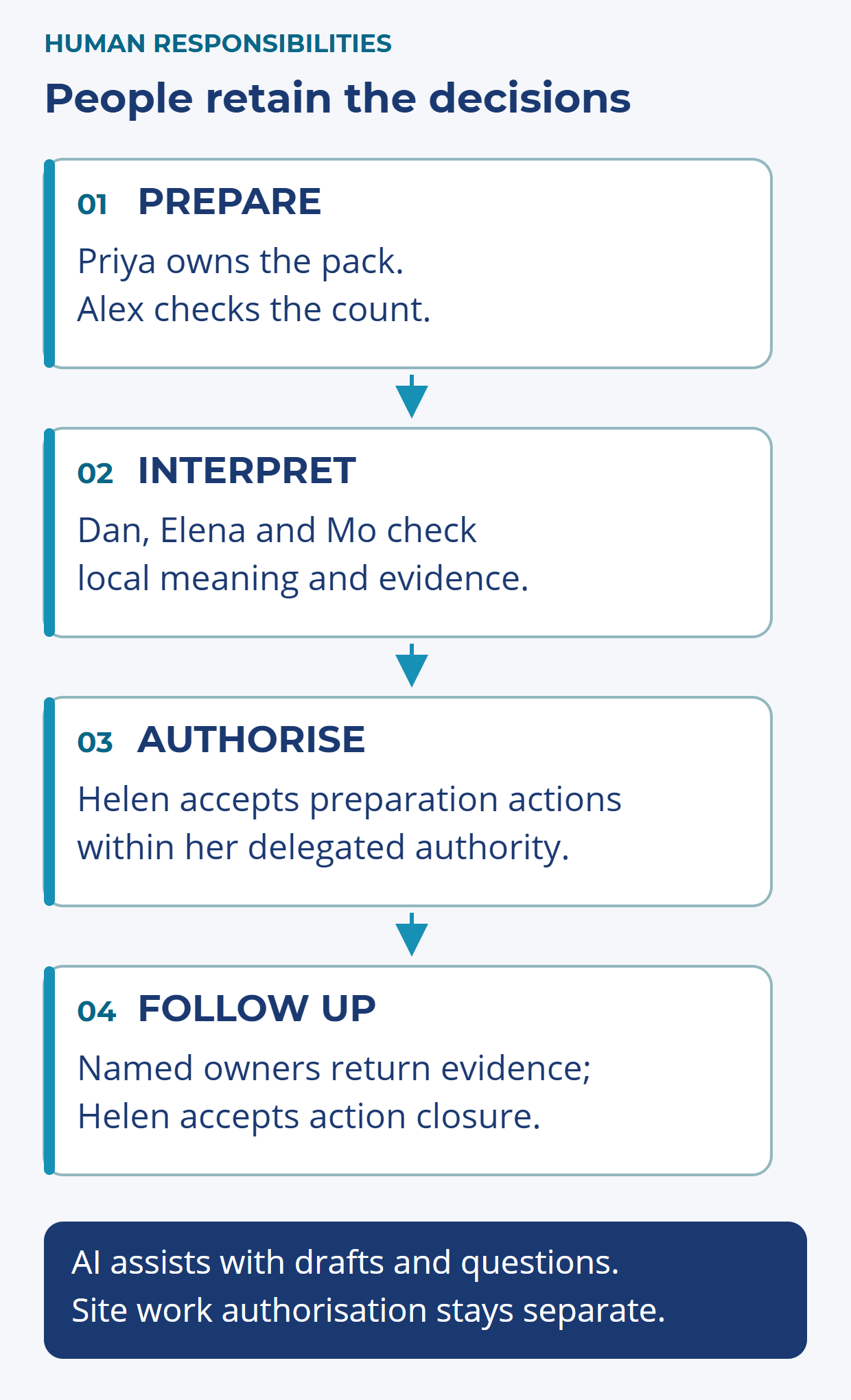
Original MDP responsibility map. The assistant can help prepare wording and questions. People accept the evidence, interpretation, authority and follow-up assigned to them.
Keep the follow-up attached
I'd keep the corrected summary and the action linked to the same order. Otherwise, next Monday someone may see “materials issue resolved” and assume the job is ready.
For WO-1601, the decision log needs a little more than a tick box:
| Log field | Fictional entry agreed at the review |
|---|---|
| Question and evidence | WO-1601; reconcile A with B1 and establish the reservation position |
| Rejected explanation | Late supplier delivery; unsupported by A or B1 |
| Accepted preparation action | Dan verifies the specified kit and provides receipt/reservation evidence; Priya reviews the preparation record |
| Decision owner | Helen accepts preparation follow-up within her delegated authority |
| Owner and due time | Dan, 10 Nov at 12:00; Priya reviews the returned evidence |
| Still unresolved | Remaining readiness checks, crew, access and any required authorisations |
| Next review | Helen checks the evidence and remaining action on 16 Nov |
Now extend the story to that next review. The following is invented follow-up C1, not an outcome observed in a trial: on 10 November, Dan supplied a receipt and reservation reference for the specified kit, and Priya recorded her check. No new evidence about crew, access or permission to execute is supplied.
Given A, B1, the accepted action and C1, an illustrative update could say:
WO-1601: Dan's materials evidence and Priya's check are recorded in C1. The accepted kit-verification and reservation follow-up has evidence of completion. The supplied follow-up doesn't establish overall readiness or an agreed schedule slot. Helen to review the remaining preparation position.
Helen would check the underlying references before accepting closure of that follow-up. “Evidence received” and “accepted as answering the question” need separate attention. If the wrong kit appeared in the receipt, a full-looking log would still leave the question open.
No follow-up is supplied for WO-1602. The pack should say that explicitly and ask Mo for the position. It shouldn't infer completion from the due date having passed, or invent a reason for the missing update.
That's where I'd want the assistant's contribution to continue: help identify an unanswered action and prepare the question. The action owner brings the evidence; the decision owner accepts what it means.
Choose what to repeat and what to retain
There are useful pieces of repeatable work in that review. I'd assess them separately, because they need different tools and checks.
| Activity | Work an assistant could absorb after local testing | What a person still needs to accept |
|---|---|---|
| Shorten supplied notes | Draft concise text with order references and qualifications | Priya checks meaning, omissions and unsupported additions |
| Arrange the pack | Suggest discussion groups and list unassigned records | Priya accepts useful categories; specialists challenge misleading combinations |
| Prepare a calculation | Draft code and explain its assumptions | Alex checks the definition, code, test results and source coverage |
| Calculate a repeated agreed count | Help create the reviewed calculation initially | Alex maintains tested code; Helen accepts the measure's purpose and scope |
| Prepare questions | Suggest questions grounded in named gaps | The relevant person decides what evidence would answer them |
| Draft actions and updates | Put accepted facts and decisions into consistent wording | Helen and the action owner accept responsibility, dates and completion evidence |
The amount of writing involved might fall. Whether the whole process takes less effort depends on preparing the inputs, checking the drafts, correcting mistakes and maintaining the arrangement. I'd measure those together before claiming a saving.
Some of the work is better handled by ordinary automation once its rules are clear. Bringing agreed fields into a table, checking a required date or running the accepted count doesn't need a fresh language-model interpretation. AI might help build those steps; the running process can remain deterministic.
The difficult part in WO-1602 is establishing which kit the equipment needs. That requires technical evidence and an authorised interpretation. The assistant can organise the question and help locate supplied references. This example gives no basis for letting it accept a substitution.
There's also work between systems. Someone must establish which order the evidence belongs to, whether an action already exists, which update was accepted, and what happens if a transfer fails. A proposal on a screen doesn't settle those questions. The system owner and process owner would need to test them in any later integration.
I'd judge the opportunity activity by activity. A person who used to spend an hour rewriting notes might spend some of that time checking and discussing them. Another review might gain little because the inputs need too much repair. This guide supplies no measured time saving or basis for predicting how many jobs disappear.
A useful local question is: after including review and correction, what repeatable burden has actually reduced, and which decisions are people now better able to make?
Try it within an accepted process
For a real trial, I'd start with a retrospective pack and an environment the organisation has accepted for those records. Agree the task, the reviewers and the stopping point before anyone uploads a file. Keep the first outputs away from live work control.
The example here uses entirely invented records. Removing a name from a real export wouldn't, by itself, establish that the remaining equipment, dates, failure details and commercial information were suitable to share. The organisation's data owner needs to accept what is used, by whom and where.
Before choosing a tool, ask the system and data owners to check its current official documentation and the actual organisational configuration: access, retention, use of submitted data, onward sharing and deletion. There isn't a product-specific privacy or security assurance in this guide. Those answers depend on the service and arrangement actually proposed.
I'd have someone prepare a checked reference answer for the trial pack. Compare the assistant's output against it for invented facts, missing records, lost qualifications, correct record references and useful questions. Include awkward cases such as conflicting notes, unknown causes and missing dates. Record the time spent preparing, checking and repairing the result.
Let the intended reviewer try it under realistic conditions. Can Priya find B1 quickly? Can she reject a sentence without accepting the rest of the draft? Can she get the pack ready if the assistant is unavailable? A technically correct output that nobody has time to check is a poor fit for this meeting.
Keep the tested tool/configuration, input version and instructions with the results. Repeat relevant checks when those change. NIST's profile cautions against generalising capability from narrow, informal assessments; one tidy fictional example gives you questions to test, rather than a deployment verdict. NIST's Generative AI Profile, MS-2.5-001
My content notes put the meeting, action tracking and feedback alongside the reporting. I'd apply the same thinking here. Test whether the preparation helps that whole process, including the return next week.
A review sheet I'd put beside the draft
I'd give Priya a short check before the pack is accepted:
- Can I find every supplied order, including the missing-date exception and the completed order kept separately?
- Can I trace each statement to the stated pack version and a specific record or checked note?
- Have uncertainty, time limits and unresolved causes survived the rewrite?
- Do the calculation and groups answer the agreed question without adding a cause?
- Have the right people checked the local meaning and accepted any proposed action, owner and date?
- Does the log show what evidence will close the action, who accepts it and when the team returns to it?
If a statement fails a check, leave it unaccepted and say what's needed. Priya can still use the checked parts of the pack, provided the unresolved parts remain visible.
A companion to this guide is a static AI-assisted maintenance review log, with a blank sheet and the WO-1601 example. It takes the pack reference, draft claim, evidence, correction, decision owner and follow-up. It produces a reviewable record of what was accepted and what remains open. It's supplied as a worksheet; an app or connection to a maintenance system would be a separate proposal.
I'd begin with one review task, one checked pack and someone who actually uses the output. Ask them where the draft helped and where they had to go back to the work.
For Priya, the worthwhile result would be arriving at the meeting with two different seal-kit questions clearly explained, the evidence beside them and the right people ready to answer. Then coming back with the evidence the team agreed to obtain.
That's something you can check.