The pump job's approved. It's been approved for 3 weeks.
At the scheduling meeting, someone asks why it still isn't on next week's schedule. The planner says the seal hasn't been confirmed. Stores says there's a seal on the shelf. Operations asks which pump the job's actually for, because the description says “water pump” and there are 2 of them.
Everyone's looking at the same work order. They're answering different questions.
Let me use a made-up job to work through this. Pump P-204B has a reported leak around its shaft seal. The linked work request names the pump, but that detail hasn't carried through into the description and equipment reference on approved order WO-1048. Nobody has yet checked whether the spare on the shelf matches the installed pump.
You could put a date against that order today. The technician would still have to sort those things out when the job arrived.
I'd want to follow the job back through the handovers. What did the person raising it know? What did approval authorise? What does the planner still need? Who can answer the question about the spare?
This guide follows that fictional job from request, screening and approval through preparation, scheduling, execution, close-out and feedback. At each stage, the useful question is whether the next person has enough information and authority to do their part. Your site may combine stages or use different names. The decisions still need a home.
Find the handover you need
- Capture the problem while someone can explain it
- Screen the request and decide what to approve
- Prepare the job someone will actually do
- Agree when the work can happen
- Keep the plan connected to the work
- Leave a record the next person can use
- Use the feedback and show what changed
- Try it with one order
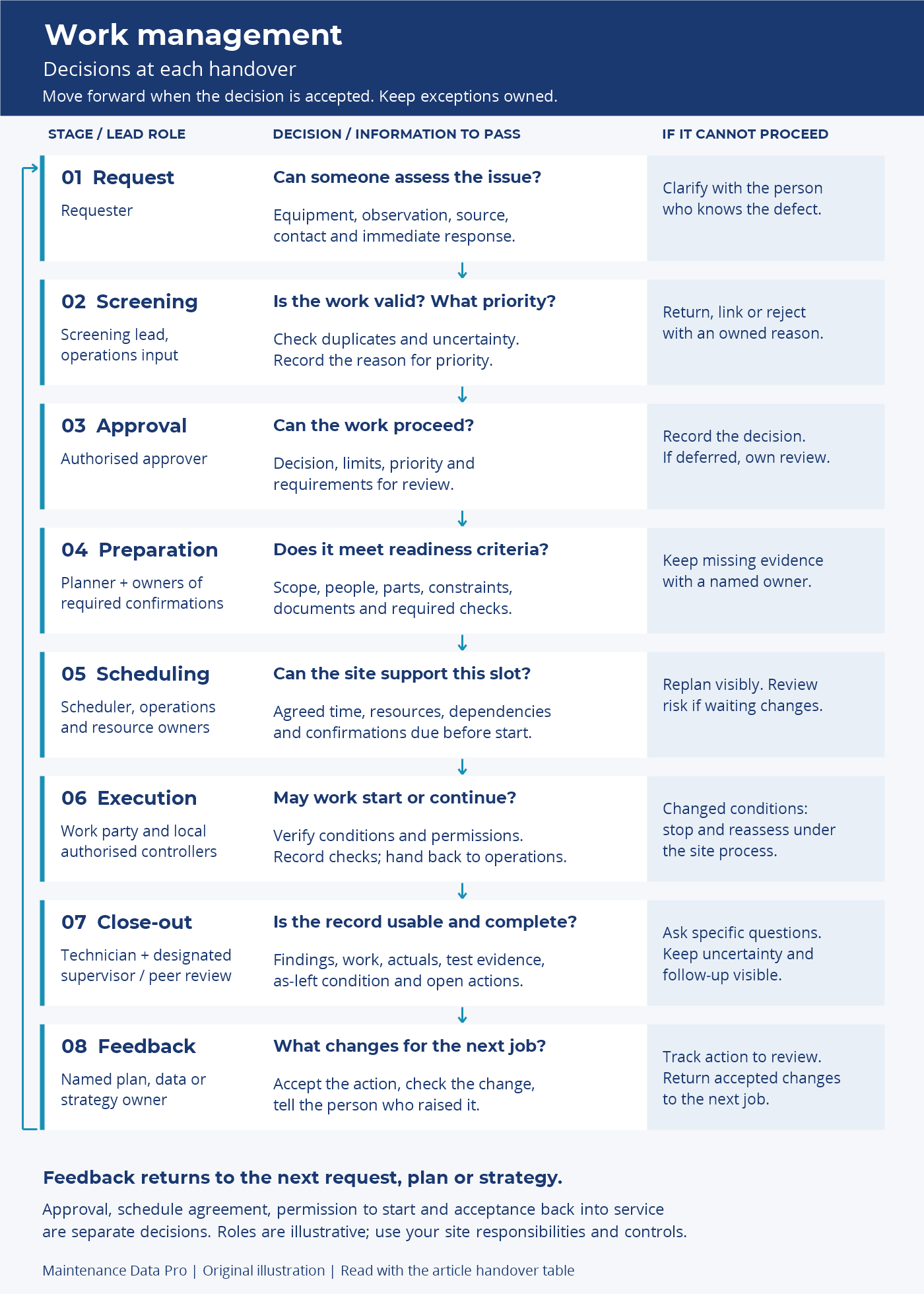 Open full-size image (opens in a new tab)
An original MDP map of the decisions around a job. Roles are illustrative: agree the responsibilities and approval limits for your site. Work-order approval, schedule agreement, permission to start and acceptance back into service are separate decisions.
Capture the problem while someone can explain it
“Water pump leaking.”
There's a real observation in those 3 words. The person who raised the request probably knows which pump, where the leak appeared and what the pump was doing at the time. Someone reading it next week may know none of that.
Go back to the start of this fictional job. An operator saw leakage around the shaft seal area of P-204B while the pump was running. They reported it to the shift lead. That observation belongs in the request, along with when it happened and a clear equipment reference.
The request can say what was seen without pretending the cause is known. “Replace seal” already points towards a particular repair. “Leakage observed around shaft seal area” leaves room for someone competent to establish what work is needed.
That difference matters when the job reaches a planner. A proposed remedy can become the scope simply because it's the only thing written down.
I'd want the request to make the observation traceable: the equipment, location, symptom, operating conditions and person to contact. A useful photograph or linked inspection finding can help. You don't need a long essay or a fully engineered solution at this point. You need enough for the screening team to recognise the issue and decide what happens next.
If the equipment tag is uncertain, say so and get someone to verify it. Choosing the nearest-looking record creates a tidy request attached to the wrong history. The consequences follow it through parts selection, work instructions, costs and later analysis.
I'd also ask what happened immediately after the observation. Did the operator inform the shift lead? Was equipment taken out of service under the site's arrangements? Is there a linked inspection or another order already dealing with the defect? Record the actual response. Leave decisions about continued operation and any controls with the people authorised to make them.
Some work enters through a preventive task or condition-monitoring finding. Link that source to the corrective request. It helps the next person understand how the defect was detected and gives the reliability team something to examine later. A routine task that finds a defect has supplied useful evidence, even if the repair happens on another order.
For WO-1048, the operator and shift lead confirm P-204B and record the observation in the request. The screening team can discuss a particular defect on a particular pump. That information also needs to survive the move into the work order.
The operator should be able to see what happened to the request afterwards. If it disappears into the system, they're left wondering whether anyone read it. A short explanation of the decision gives them a reason to keep reporting useful detail next time.
Screen the request and decide what to approve
The request arrives alongside everything else the site would like to do. Some items are duplicates. Some need more investigation. Some are valid and can wait. Others need an immediate response through the site's urgent-work arrangements.
Screening gives someone the responsibility to sort those out before the work consumes more effort downstream.
For the pump, I'd expect the reviewers to check the equipment reference, the defect description and existing open work. Then I'd want the people responsible for the operating risk to consider the consequence of leaving the defect unresolved, using the site's agreed method.
The priority needs a reason that another person can understand. “Operations wants it” doesn't tell the planner what could happen or when a decision needs revisiting. Neither does a priority code on its own.
In this fictional example, the designated reviewers accept that WO-1048 is valid corrective work. Operations assesses the operating situation through the site's process, and the authorised approver allows the job to proceed into preparation. This article doesn't establish whether any real leaking pump can remain in service. That depends on the equipment, duty, hazards and local authority.
Approval should leave a visible decision: proceed, return for clarification, link to existing work, reject with a reason, or defer under the appropriate authority and review arrangements. Someone owns each outcome. A request returned for clarification needs a question and a person to answer it, otherwise it can sit there until everyone forgets why it came back.
I'd be careful with the word “approved”. Ask 3 people what it means in your system and you might hear permission to spend, permission to plan, and permission to do the job.
For this guide, approval authorises WO-1048 to proceed within the site's defined limits. Preparation still has work to do. The scheduler still needs to agree a slot. The people controlling work still need to authorise its start under the safe system of work.
If your CMMS combines several of those decisions under one status, explain how people distinguish them. A status label can carry far more confidence than the evidence behind it deserves.
There's another handover here: who looks again if the job waits? The person approving it may have made the decision with a particular operating situation in mind. That situation can change while the order is in the backlog.
A review date, a named owner and a reason to escalate make waiting visible. Changed conditions need a fresh decision from the appropriate authority. Repeatedly moving a target date can hide how long the original decision has gone without review.
For WO-1048, approval gets the job into the preparation workload. The planner should receive the confirmed equipment, observed defect, agreed priority and any operating constraints or review requirements. In this example, the equipment detail stays on the linked request and the approved order remains vague. At the scheduling meeting 3 weeks later, the planner returns to that request with operations and corrects the order. A check at the earlier handover could have caught the gap.
Prepare the job someone will actually do
Back to the seal on the shelf.
There's a stock record. There's a box. Neither has yet established that the part is suitable for P-204B as installed.
The planner asks stores and the relevant technical support to confirm the part against the equipment information and the job requirements. The answer, evidence and any reservation belong with the order. If the check reveals a mismatch, the job needs an action to obtain the right part and a date when availability will be checked again.
“Awaiting materials” gives the scheduler very little to work with. “Stores to confirm the seal against the installed pump details by Thursday” tells someone what to chase. If delivery later becomes the issue, record that new constraint rather than leaving an old explanation in place.
Preparation brings together the scope, method, people, materials, tools and conditions needed for the work. It also establishes how completion will be checked. A technician's input can reveal an access problem or a special tool long before either interrupts the job.
I'd want to see that conversation happen before the plan becomes a set of instructions everyone assumes is complete.
The planner needs to establish what the job requires. Then the scheduler can ask when the site can provide those people, that support and the pump itself. If the requirements are still uncertain, the scheduling conversation keeps returning to questions someone needed to answer earlier.
For WO-1048, the planner develops the scope with the people qualified to do so. They confirm the appropriate seal, the required craft and support, access, documents and the equipment conditions needed. Operations contributes the requirements for making the equipment available. The approved work instructions define the checks and acceptance criteria after maintenance.
Notice how many people hold a piece of that answer. The planner can coordinate it, but a green tick entered by the planner can't create a spare, an operating window or a competent person.
I'd record the unresolved items as actions with owners. Then I'd agree what evidence closes each one. A purchase order being raised may close a procurement action, while the part's arrival and suitability remain open. Those are different points in the story.
What would let you call it ready?
Suppose the part is now confirmed and reserved. The method and resource requirements are defined. The work can be considered for a suitable operating window, with the required support identified and the remaining time-dependent controls understood.
The planner can release it to the ready workload if it meets the site's agreed readiness criteria. The scheduler needs to know any conditions attached to that release. Some confirmations can only happen nearer the work, so record who will make them and when.
A permit may be prepared ahead of time and require authorisation at the point required by the site's system. “Ready to schedule” should never quietly become permission to start.
Keep the evidence proportionate to the job. A familiar, repeatable task and a complex overhaul won't need the same preparation effort. Both need the information required to carry them out under the site's rules. You can scale the work pack without making the next technician guess.
Article 002, Why work waits between approval and scheduling, will take that readiness handover further. Here, the point is to let the scheduler distinguish work that can be placed from work still carrying unresolved requirements.
Where I'd try AI
An assistant could help a planner spot gaps in a record. I'd give it the actual observations and ask it to separate recorded facts from questions needing an answer.
Using the earlier snapshot, after the equipment reference was corrected and before the outstanding confirmations were obtained, the supplied information is:
WO-1048 is approved corrective work for P-204B. The operator reported leakage around the shaft seal area while the pump was running. Stores reports a seal on the shelf. Suitability for the installed pump hasn't been checked. Craft requirements and the operating window haven't been confirmed.
A proposed response could read:
Recorded: equipment P-204B, observed leak, approved order, reported stock item. Questions for the planner: who will confirm part suitability, required craft and support, and the operating window? Readiness can't be established from the supplied record.
That's a proposed example, not the output of a tested integration. The planner checks it against the order and decides which questions to assign. The assistant hasn't inspected the pump or the stores shelf. It has no basis for saying the seal fits, the job needs 2 people or the work can happen on Tuesday.
I'd start with that limited task and compare its suggestions with a planner's review. If it adds plausible details, someone has to catch them before they become part of the plan. Keep operational records within the organisation's approved data arrangements when trying it.
Agree when the work can happen
The job's ready for scheduling. Now it joins other prepared work competing for time, people and equipment availability.
The scheduler needs the job's requirements and the site's actual capacity. Operations needs to agree the equipment window. The maintenance team needs to know which skills and support are available. Work elsewhere on the site may share the same resources or create a conflict.
Putting WO-1048 into a spare space on a calendar doesn't resolve those dependencies.
In the fictional example, the scheduler and operations agree a suitable slot, the required people and support can be provided, and the confirmed spare remains available. The job enters the agreed schedule. Any confirmations due before the start have named owners.
I'd want the schedule to make a promise the team understands. What work is included? What resources does it assume? Who can authorise a change, and how will affected people hear about it?
The workload also needs to be credible. If 2 mechanical technicians each have 6 hours available for the scheduled work, that's 12 labour hours in this invented example. A task requiring both for 4 hours consumes 8 of those hours. It also requires a shared 4-hour window. Counting heads or summing hours alone could miss that constraint.
Those numbers aren't a staffing rule. They illustrate why the sequence and resource mix matter alongside the total workload. Local capacity needs to account for the other work people actually do, including handovers and the controls around execution.
Once the schedule is agreed, new work will still arrive. Some of it will deserve immediate attention. I'd want the change decision to show which planned work moves, what the consequence is and who accepts it.
Otherwise, the displaced job can look like a failure by the technician who never got the chance to start it.
Suppose WO-1048 loses its slot because another job needs the same craft. Record the decision, tell the affected people and revisit any linked arrangements. The reserved part, vendor attendance or equipment window may need attention. Confirm the operating position through the appropriate owner if the repair will wait longer.
This gives a later performance conversation something useful to discuss. “Schedule missed” is a starting point. Knowing which job displaced which, and why, lets the team judge whether the decision was sensible and what might reduce the disruption next time.
The scheduler also needs honest feedback when a ready job becomes unready. A spare reallocated elsewhere, a changed equipment condition or a lost support resource can invalidate the earlier plan. Let that change return to preparation or review visibly. A schedule built on stale assumptions makes everyone else's day harder.
Keep the plan connected to the work
On the day, the people carrying out WO-1048 need the correct work pack, equipment reference, materials and instructions. The people responsible for controlling work verify the conditions and permissions required by the site's safe system of work.
The scheduled date has brought the people together. It hasn't verified today's conditions for them.
Before starting, the work party needs to understand the scope and what to do if the job differs from the plan. Relevant worksite checks, isolations, permits and discussions follow the site's arrangements. This guide follows the information handovers; the approved procedures and competent people govern the physical work.
Suppose the technician finds that the spare doesn't match despite the earlier confirmation. Or the equipment condition suggests the planned repair won't address the observed problem. That finding needs to reach the supervisor, operations and planner as appropriate.
The work should then follow the site's arrangements for stopping, reassessing and authorising a changed scope. Recording who needs to decide, and what they need to know, helps people respond without leaving the job in an unexplained “in progress” state.
A technician shouldn't have to choose between following the plan and making the dashboard look good. Changed conditions are useful information. I'd want the response to encourage people to report them while there's still a decision to make.
If work pauses, leave a clear handover. What has been done? What condition is the equipment in? What remains controlled, what is outstanding, and who has accepted responsibility for the next step? The next shift needs to be able to establish the current position through the site's formal controls and records.
For the main fictional path, the planned work proceeds. The technician replaces the seal under the approved instructions. The required post-maintenance test is completed, its result is recorded, and the authorised operations representative accepts the equipment back into service through the site's process.
I'm deliberately leaving the test method and acceptance limits out of this example. They depend on the equipment and duty. A generic article can't choose those for P-204B at your site.
The return-to-service handover needs the evidence those people require. That includes the work completed, test results and any remaining restrictions or follow-up. An open issue should stay visible through an owned action or linked work, with its operating implications handled by the appropriate authority.
Housekeeping and unused materials belong in the handover too. The equipment may have passed its checks while the worksite or parts records still need attention. Allowing time for those tasks makes the plan closer to the work people actually have to finish.
Leave a record the next person can use
The pump's back in service. Someone wants the work order closed.
I'd pause long enough to ask what the next person will find when they open it.
The technician knows what they saw, what they changed and what happened during the test. If all that becomes “seal replaced, tested OK”, the planner and reliability engineer will have questions later. The technician may be on another shift by then (or working somewhere else entirely).
Close-out needs a usable account of the work and an appropriate review of that account. It also needs to reflect the actual work status. Equipment accepted back into service, technician entry complete and order reviewed may happen at different times. Your system should let people understand which point has been reached.
For this fictional job, the evidence available at close-out is:
- Leakage was observed around the shaft seal area of P-204B while running.
- The technician replaced the seal under the approved work instructions.
- The required post-maintenance test was completed, the results were recorded in the linked test record, and operations accepted the pump back into service.
- The cause of the seal failure wasn't established.
- The planner had difficulty confirming the spare because the equipment's parts reference needed correction.
The note can now describe those facts and link to the supporting records. The actual part used, labour, services and relevant dates should be recorded through the site's fields and linked documents. The parts-reference problem can become a separate action for the person authorised to correct that information.
I'd keep the uncertain cause visible. A guessed cause code can look settled to someone analysing the history months later. If the cause needs investigation, give that follow-up an owner and retain the evidence required by the local process.
The person reviewing the order needs to check whether the original defect has been addressed, whether the required evidence is available and whether outstanding work has a proper home. Missing detail should come back as a specific question.
“Please improve history” leaves the technician to guess what was wrong.
“Can you link the test record and confirm which seal was fitted?” gives them something they can answer. It can also reveal a problem with the form or access to the record.
That review takes time. So does entering the history. I'd include both in the way the team plans its work, then ask the people doing them whether the arrangements are realistic. Chasing closure dates while leaving no practical time to record the work creates a fairly predictable result.
Article 025, Why good intentions still produce poor maintenance data, looks more closely at that experience. Here, close-out carries the evidence into the next handover. The person who uses the history should be able to see what was observed, what was done, what was checked and what remains unknown.
Use the feedback and show what changed
WO-1048 is closed. The parts reference is still wrong.
If nobody acts on that feedback, the next planner may have exactly the same conversation with stores. The order has finished its journey. The problem that delayed it has another trip ahead of it.
Give the feedback a destination. For this example, the planner raises an action with the equipment-data owner to verify and correct the parts reference. The authorised person checks the evidence and makes the accepted change through the site's process. The planner checks that the corrected reference is usable and tells the technician what happened.
That's a small loop you can follow all the way round.
Other feedback may go elsewhere. A job plan may need a clearer step. An estimate may need reviewing. A recurring failure may warrant a reliability review. A proposed equipment change may need the site's management-of-change process. Naming the route and owner helps the observation reach someone who can use it.
I'd also look at what the lifecycle tells the team about waiting. Where did the job spend its time? Which delay needed a decision, which needed a resource, and which came from incomplete information?
WO-1048 spent part of its approved life waiting for part confirmation. That points towards preparation and equipment information. A different order might be fully prepared and waiting for an operating window. Combining them under “approved backlog” would hide the difference.
Keep the reporting definitions close to the decisions. You might need the current stage, time in that stage, constraint, action owner and next review date. Preserve enough history to explain changes rather than continually overwriting the only record of what happened.
A count of overdue orders won't tell you all that. Use it to find the work, then talk to the people who can explain the records. An apparent long repair could include time stopped for a part. An apparently quick closure could be followed by a new order for the same defect. The people and linked history help you judge what the number means.
Article 003, A backlog review that produces decisions, will follow several fictional orders through that conversation. The lifecycle guide gives you the route each order has travelled; the review decides what needs to happen next.
Try it with one order
Take an order that's currently waiting and open it with someone involved in the next handover. Choose a job you can discuss without turning the exercise into a performance judgement on the person who last touched it.
I'd use this table as a starting point. The roles need translating into named responsibilities at your site, especially where one person covers several of them.
| Handover | Decision to make | Illustrative owner | Information passed on |
|---|---|---|---|
| Request to screening | Is the issue clear enough to assess? | Requester and designated screening lead | Equipment, observation, source, contact and immediate response |
| Screening to approval | Is the work valid, and how should it be treated? | Screening lead with operations and relevant technical input | Duplicate check, scope of concern, priority basis and uncertainties |
| Approval to preparation | Can this work proceed within the agreed authority? | Authorised approver | Decision, limits, priority and review requirements |
| Preparation to scheduling | Does it meet the agreed readiness criteria? | Planner, with confirmations from the relevant owners | Scope, resources, materials, constraints, test requirements and evidence |
| Scheduling to execution | Can the site support this work in the agreed slot? | Scheduler and operations, with resource owners | Agreed time, people, dependencies and confirmations due before start |
| Start of work | Are today's conditions and permissions suitable? | People authorised under the safe system of work | Verified worksite conditions, controls and authorised scope |
| Execution to operations | Can the equipment be accepted in its recorded condition? | Authorised operations representative with maintenance input | Work completed, required checks, results and outstanding conditions |
| Technician entry to reviewed close-out | Is the record usable and the remaining work owned? | Designated supervisor or peer reviewer | History, actuals, linked evidence, uncertainty and follow-up |
| Feedback to next job | What should change, and has it helped? | Named owner for the plan, data or strategy concerned | Specific observation, agreed action, accepted change and check |
If a handover has failed, write the question the next person needs answered. Give it to someone who can answer it and agree when you'll check again. Leave the job in a state that reflects the evidence available.
I'd start with a simple handover worksheet: order, current stage, next decision, missing evidence, action owner and review date. Include a place to record the answer and who accepted the handover. It's a proposed companion to this guide, so you can try those columns on paper before building anything.
A small app could later bring the same information together and show actions due for review. It could highlight missing entries and prepare a conversation. The planner and other authorised owners would still accept readiness, priority and operating decisions. A filled-in form wouldn't establish that the part fits or the equipment is safe to start.
For now, choose one order. Follow what the record says, ask the people who know the job and find the next unanswered question.
By the next review, you should be able to see who answered it, what decision followed and whether the job moved. If it stayed where it was, there should be a reason someone can explain.
That's a useful place to start improving the whole lifecycle.
Reading behind this guide
This guide develops the work-execution sections of my unfinished reliability-culture handbook, alongside work-management themes in BG Group's collectively authored This is Maintenance Excellence, Issue 1, February 2012, element 18. I contributed to that corporate work-management element; the publication has multiple contributors. The pump, order, conversations, numbers and AI example here are fictional. The diagram and handover table are new MDP illustrations, and the companion articles and tools mentioned above are proposed reading links and artifacts for the collection.