“There's 46 hours of work here. Can you get it into this week's schedule?”
The planner looks down the list. One job has a parts reservation against it, although the part in the store doesn't fit the equipment. Another seems to cover work already done. A third looks ready until someone checks what the technician found.
You can get through quite a lot of a meeting before someone mentions any of that.
I'd want those details on the table before asking for a commitment. So here's a made-up backlog review, following 5 orders from the preparation through to the next meeting. All the records, people, dates and outcomes are invented. The AI summaries are illustrative drafts written for this example. I haven't connected an assistant to a maintenance system or tested an automated review process here.
The question for the meeting is specific: which of these jobs can move towards execution, and who needs to do what about the others?
The list before the meeting
It's Monday 8 June 2026. The review starts at 09:00, using a work-order extract taken at 07:00. These 5 orders are the selected review list, rather than the site's entire backlog. Each is approved and still open in that extract.
The hours are estimated labour-hours. A job needing 2 technicians for 8 hours contributes 16 labour-hours. That doesn't mean it needs a 16-hour slot in the schedule.
| Order | Work recorded | Age at 8 June | Estimated labour-hours | What the preparation pack contains |
|---|---|---|---|---|
| 4101 | Replace leaking seal on utility pump P-101 | 21 days | 8 | Correct kit reserved; job pack checked; operations has confirmed a candidate access window |
| 4102 | Replace worn coupling on fan F-202 | 42 days | 16 | Part reserved; store record shows 1 in stock; planner's note says “check coupling variant” |
| 4103 | Investigate blank motor-temperature display on M-303 | 9 days | 4 | Earlier note says “possible display fault”; current scope and estimate haven't been checked |
| 4104 | Repair damaged handrail at platform H-4 | 63 days | 6 | Note says “possibly covered by 4090”; order 4090's completion record is outside this pack |
| 4105 | Replace passing isolation valve V-505 | 14 days | 12 | Job pack prepared; operations hasn't agreed an access window |
The estimates add up to 46 hours: 8 + 16 + 4 + 6 + 12.
At this point, that's about all the total tells you. The list contains unresolved questions about scope, materials, access and whether one job still exists.
An age sort would put the handrail first. An hours sort would put the coupling first. Neither sort can answer whether the team should schedule either job.
What I'd ask AI to prepare
I'd give an assistant the selected records, their linked notes and a clear boundary around the task. Prepare a review draft. Keep the order numbers. Separate observations from suggestions. Point to the supplied evidence for each statement and leave missing information visible.
I'd also ask it to identify questions for the planner. Where is a material reservation being treated as proof that the right part is available? Where does a note suggest the work might already have been done?
That preparation could be useful. The planner would still have to check it before anyone used it to make commitments.
To show what that check needs to catch, imagine this draft coming back:
4101, 4103 and 4104 appear ready, totalling 18 labour-hours. Schedule a display replacement under 4103 using its 4-hour estimate. Expedite the reserved coupling for 4102. Agree access for 4105. Consider the oldest order, 4104, first.
That sounds tidy. It's also carrying several assumptions the pack doesn't support.
For 4103, “possible display fault” has quietly become a prepared repair. For 4104, an open order has become evidence that work remains outstanding. “Expedite the reserved coupling” skips the note asking someone to check which coupling it is.
I'd keep that draft beside the source records while the planner works through it. If it disappears as soon as someone corrects it, you lose the chance to see where the preparation went wrong.
4101: ready enough to discuss a schedule
Start with the pump seal. The planner, Aisha, checks the kit identity against the job pack and confirms the reservation. Ben, the operations supervisor, confirms that the candidate window is still available for the scheduling discussion.
The maintenance supervisor, Colin, accepts the preparation as sufficient to put the job forward. Aisha owns taking it to scheduling by Tuesday 9 June, with completion evidence to be reviewed on Monday 15 June.
There's still a scheduling decision to make. The review hasn't reserved the people or issued permission to start work. Those checks follow the site's normal process.
I'd record that distinction because someone will otherwise read “ready” as a promise that the job is happening on Thursday. Once a report starts showing dates, people quite reasonably begin making plans around them.
For this order, the AI's suggestion survives the check. The useful output is the agreed next step, its owner and the evidence needed when the team returns to it.
4102: the part is there, and it's the wrong part
The assistant suggests expediting the coupling. Dana, the materials coordinator, checks the reservation with Aisha and finds that the stock item is for a different fan variant. The correct coupling has an expected delivery date of Friday 12 June.
Now the conversation can be specific. Chasing the store to issue the reserved item would send someone after a part that won't fit. Dana needs to correct the reservation, confirm the supplier date and report any change by Wednesday 10 June.
Colin keeps the job out of the ready group. Aisha will recheck material readiness when the correct part arrives. The 16-hour estimate stays on the order; nobody has done the work or reduced its scope.
I'd also want the original note preserved. Someone had already written “check coupling variant”. They'd spotted something worth checking. The review needs to make use of that effort.
If the next pack still calls this job “waiting for materials”, ask what happened to Dana's commitment. Did the supplier date change? Did the part arrive without anyone checking it? Those lead to different actions.
4103: a plausible repair becomes an investigation
The blank display looks like a small job. Four hours. A possible display fault. Easy enough to squeeze in somewhere?
Aisha asks Erin, the electrical supervisor, what the technician actually observed. Erin brings an inspection note that wasn't in the 07:00 pack: the display has power, and the sensor signal is absent. That doesn't establish which component has failed.
The AI draft had treated the order as ready. Erin won't accept the proposed repair scope on that evidence. She owns checking the diagnostic scope, required competence and access arrangements by Tuesday 9 June, through the normal work-preparation process.
The existing 4 hours remains visible as an unvalidated estimate. It isn't included in ready hours. Aisha will update it once Erin has established what work needs preparing.
That's an important correction to capture. If you simply replace the draft text with “awaiting scope”, the next reader can't see why the earlier answer changed.
I'd put the new observation alongside the decision: powered display, absent sensor signal, cause unresolved. Someone can then challenge the interpretation without having to reconstruct the conversation from memory.
4104: remove a duplicate without pretending a repair happened
This is the oldest order on the list, at 63 days. The draft suggests giving it attention first.
Aisha opens order 4090 with Colin. Its signed completion record, dated Friday 5 June, identifies the same handrail location and repair scope. Colin checks that the work on 4104 is fully covered and authorises cancellation of the duplicate under the site's process.
Aisha owns recording the cancellation and the link to 4090 by Tuesday 9 June. The history stays available, including the reason for the decision.
That takes 6 estimated hours out of this selected list once the cancellation is recorded. Nobody has completed 6 hours of maintenance during the review. The physical repair belongs to 4090 and happened before the meeting.
I'd be careful how that appears in a performance explanation. “Backlog reduced by 6 hours” could be numerically correct for this selection after the update. “The team delivered 6 hours of work” would give a very different impression.
The question worth taking away is how the second order remained open. In this example, Aisha adds a linked-order check to the next review pack. Whether that helps is something to check on later reviews, rather than announce as a solved data-quality problem.
4105: waiting needs a reason and a return date
The valve job has a prepared pack and 12 estimated hours. Ben confirms that operations can't offer access in the coming week. The next candidate window is Monday 22 June.
Leaving the line as “awaiting operations” would give the meeting very little to follow up.
For this fictional site, Ben holds the delegated authority to agree this access-related deferral. He records the reason, references the current operating restrictions and monitoring arrangements, and sets an earlier escalation if the condition changes. The review itself doesn't establish that continuing operation is acceptable; that judgement belongs in the site's authorised process.
Ben owns reconfirming the 22 June window by Friday 12 June. The job remains outside the ready group, and its position returns to the review on 15 June.
I'd want that return date even if the answer is likely to be the same. Access plans change. So do equipment conditions. Someone needs to check both before the old decision gets carried forward again.
 Open full-size image (opens in a new tab)
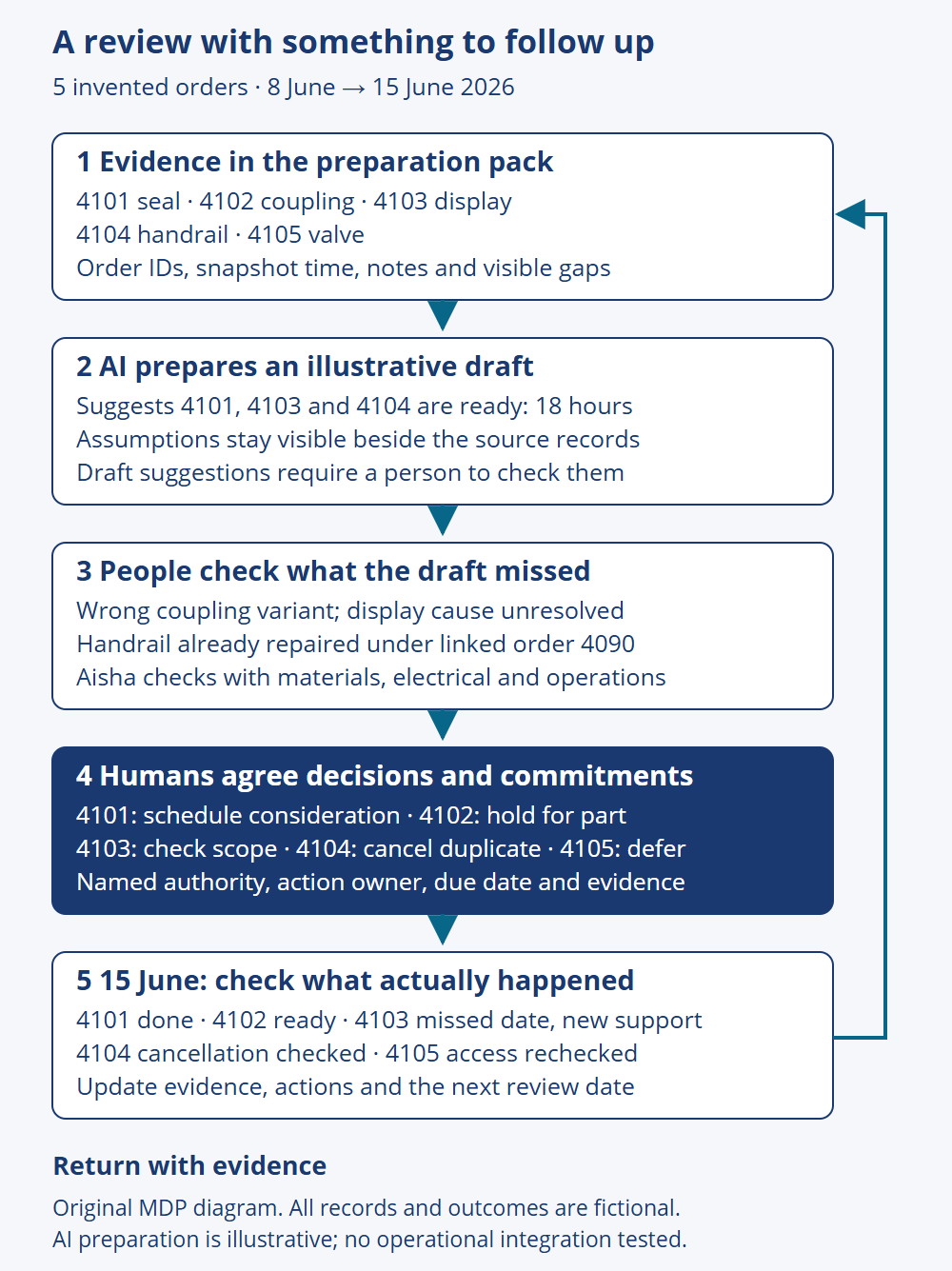
An original MDP diagram of this invented review. AI prepares suggestions; named people check the evidence, agree decisions within their authority and return with evidence of what happened.
What leaves the room
I'd finish by reading back the commitments. People should have a chance to correct what the meeting thinks they've agreed (especially if a date has appeared beside their name).
| Order | Human decision on 8 June | Follow-up owner and date | Evidence for the 15 June review |
|---|---|---|---|
| 4101 | Put forward for scheduling | Aisha, 9 June | Scheduling outcome and, if executed, completion record |
| 4102 | Hold for the correct coupling | Dana, 10 June | Corrected reservation, supplier update and receipt/identity check if delivered |
| 4103 | Rework scope; readiness unconfirmed | Erin, 9 June | Checked diagnostic scope, preparation needs and revised estimate |
| 4104 | Cancel duplicate; retain link to 4090 | Aisha, 9 June | Recorded cancellation and linked completion evidence |
| 4105 | Defer work pending access, with earlier escalation if conditions change | Ben, 12 June | Access confirmation and review of current restrictions and condition |
Colin owns checking the first 4 decisions at the next review. Ben owns the operational access decision for 4105. Aisha maintains the review record so each action stays attached to its order.
The arithmetic now has a clearer meaning. Once 4104's cancellation is recorded, the remaining 4 open orders carry 40 estimated hours. Only 4101's 8 hours has passed the readiness check for scheduling consideration. That leaves 32 hours outside the ready group: the coupling's 16, the display's unvalidated 4 and the valve's 12.
Those figures describe this selected list at that point. They don't measure the site's total backlog, the next week's capacity or a productivity improvement.
Come back to the promises
Move the invented example forward to Monday 15 June. I'd start with the previous commitments, keeping the 8 June extract available alongside the current records.
4101 was scheduled and completed on Thursday 11 June. Colin checks the signed completion record and acceptance evidence. It can leave the open-work list on that basis.
For 4102, Dana corrected the reservation and supplied the update by 10 June. The correct coupling arrived on 12 June, and Aisha checked its identity, reservation and the remaining preparation requirements. Colin now accepts the job for scheduling consideration. Its 16 hours becomes eligible for that discussion; the work is still outstanding.
Erin missed the 9 June commitment on 4103. The specialist she needed wasn't available. The review records the missed date and the continuing uncertainty. Colin agrees support from another competent person, and Erin owns the checked scope by Wednesday 17 June. The 4 hours stays unvalidated. There hasn't been a technical diagnosis just because the meeting has discussed it twice.
4104 shows the cancellation recorded on 9 June, with its link to 4090. Colin checks the link and closes the review action.
Ben reconfirmed 4105's candidate window on 12 June. On 15 June he checks the current condition and restrictions through the authorised process and retains the 22 June plan. He owns another access check on Friday 19 June, ahead of the next review on 22 June, with earlier escalation still applying.
There are now 3 open orders from the original selection: 4102, 4103 and 4105. Their estimates total 32 hours, of which 16 hours have passed the current readiness check. Eight hours left through completed work; 6 left through a duplicate cancellation. I'd keep those movements separate when explaining the change from 46 to 32.
Give the next review something to work with
This is the performance loop I want a report to support: see the position, examine the reason, agree an action and check what happened. It extends the metric, diagnosis and action sequence in my MDP framework with an explicit return to the evidence.
My unfinished handbook has a place for maintenance and reliability process-control meetings. The useful question in its discussion of productive meetings is who will do what by when. In this example, I'd add: what will the next meeting need to see?
A simple work-management review sheet could hold that together. I'd include the source order and extract date, supplied observations, missing context, AI suggestion, human correction, agreed decision, decision owner, action owner, due date and next-review evidence. Keep the suggestion visible beside the accepted decision. That makes a disagreement understandable later.
It's a proposed companion to this article. A small app could eventually carry approved actions into a reminder workflow, after the owner accepts them. That would need its own build and tests, including checks that a revised draft can't overwrite an agreed action. For a first version, I'd use a sheet and check whether people can follow the commitments into the next meeting.
Try it with 5 orders at your next review. Pick ones with different reasons for waiting. Ask the people closest to them to check what the records leave out, then agree the next step and the evidence you'll return to.
When the team meets again, open those commitments first. Find out what happened to the coupling, the scope check and the access window. Give the people responsible a chance to explain, and agree what needs to happen next.