“Seal replaced. Tested OK.”
Which seal? What did they find? What did “tested OK” involve? And did anyone work out why it failed?
If you opened that work order six months later, you'd probably have a few questions.
Let me use a made-up example.
A technician finds leakage around a pump shaft seal, replaces it and watches the pump run for 10 minutes. There's no visible leakage during that check. The cause of the failure is still unknown.
By the time they get to the terminal, someone else is waiting to use it. Another job needs attention. They type the note, close the work order and get on with the shift.
Now the person looking at the history has two lines to work with. Most of what the technician knew has stayed with the technician, locked in their head. Will they remember? Perhaps, or perhaps not. Will they be on shift the next time the seal needs changing? There's a chance, but then again they might not even be with the company anymore. This valuable history of what they found, what they learned and what they did to fix the issue is all but gone.
I'd want to have a conversation with the person who wrote that note. What did they think someone would need later? What made it difficult to put that into the record?
Glen Murphy's paper on manually captured engineering data gives me a useful way of thinking about those questions. He applies Icek Ajzen's theory of planned behaviour, which looks at what people value, what they think others expect, and how able they feel to do the thing being asked of them. Murphy's paper
The names get a bit academic. I find the questions underneath easier to work with.
Does the person see the point?
Imagine asking that technician who reads their completion notes.
What would they say?
If the answer is “no idea”, I'd start there. It's a fair question to ask of someone doing the work. They spend time entering information, and they should be able to see what happens to it.
A planner might use the note to prepare a repeat job. The next technician might want to know exactly what was checked. A reliability engineer might be trying to establish whether several seal replacements had anything in common.
Each person needs something slightly different. So it's worth being specific about what you're asking the technician to record.
“Improve your data quality” gives them quite a lot to figure out for themselves.
“I need to know what you saw during the test, because the next shift will use that to decide what to check” gives them a reason and a task they can recognise.
This is something I explored in my draft book on reliability culture. The person entering the information should get to see it being used. Otherwise, their experience of the whole process may amount to filling in a form and hearing about it when something's missing.
That doesn't sound particularly rewarding.
What does the team actually pay attention to?
Suppose the morning conversation is always about overdue work orders. How many are still open? How many can be closed today?
The technician hears that conversation every day. The quality of the history gets very little attention.
I'd expect that to influence where people put their effort.
Murphy calls this part of the picture “subjective norms”. Basically, what do the people around me appear to value? That could be the supervisor, the rest of the shift or the experienced technician everyone goes to for advice.
You can write a procedure explaining what good history looks like. I'd also listen to the questions people ask when they open a work order.
“Was it running at normal duty when you checked it?” tells the team that the detail matters. It might also reveal that the record leaves an important question unanswered.
I'd listen to what happens when someone writes “cause not established”, too.
If that gets challenged every time, someone may start picking the most plausible cause code just to finish the order. The field is filled in. The person analysing it later has no way of knowing how much confidence to put in the answer.
I'd rather have that uncertainty visible so someone can decide whether it needs investigating.
Can they do what's being asked?
Back to the pump.
The technician may understand exactly why a useful note matters. They may want to write one. There's still someone waiting behind them for the terminal.
A reminder about data quality won't make that queue any shorter.
This is where Murphy's discussion of control and time pressure helps. Someone's intention to record useful information can run into the conditions of the shift.
I'd ask the technician to show me how they enter the note. Where do they do it? How long does it take? Can they find the work order easily? What happens if they're unsure which code to select?
You could find several different problems in that one conversation.
Someone might need help understanding the failure codes. Someone else might know the codes perfectly well and struggle to get access to the system. Another might have been shown how to enter the information once, months ago, and be trying to remember which screen to use.
I'd want to understand which of those problems I was trying to solve before arranging another round of training.
 Open full-size image (opens in a new tab)
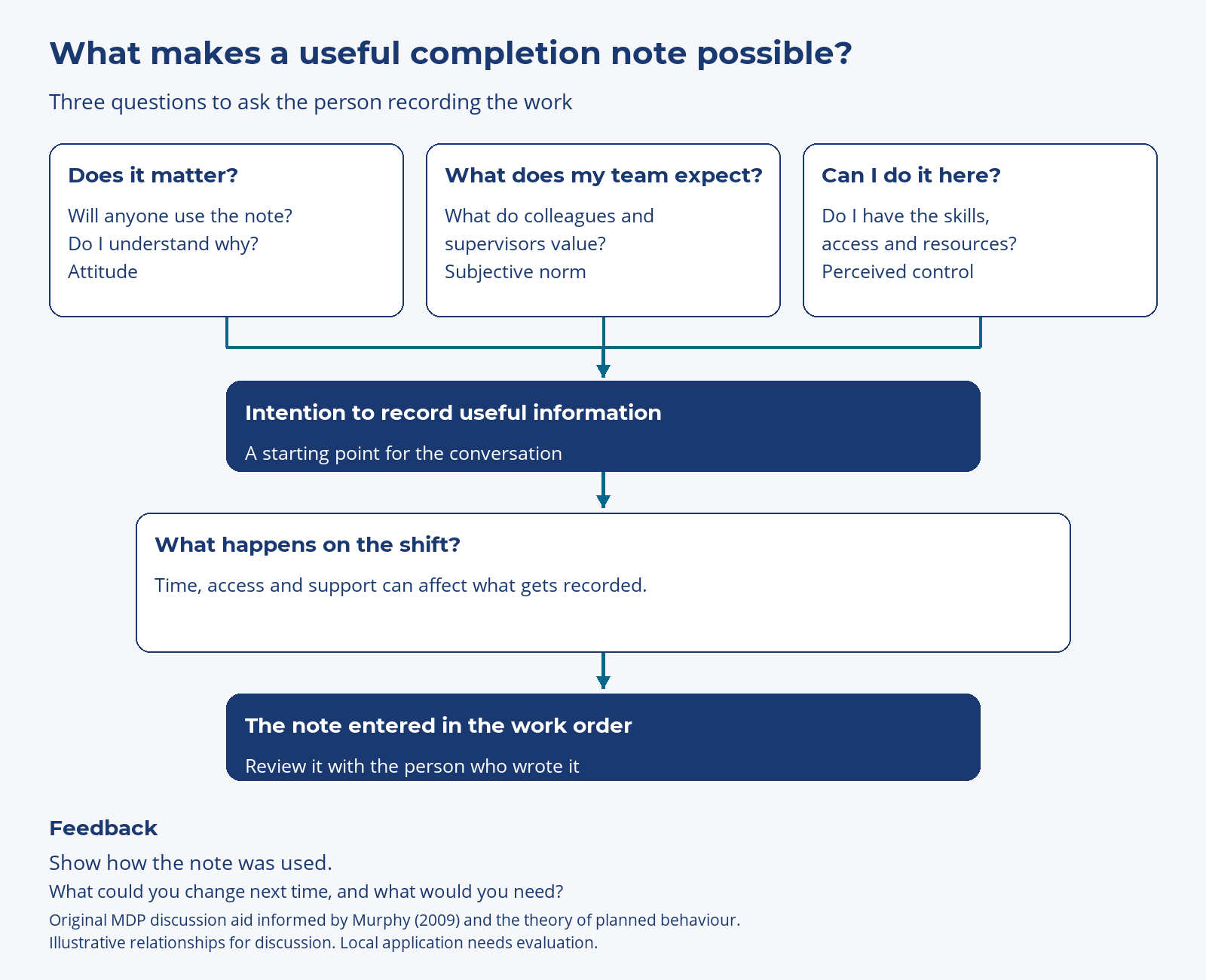
Three questions I'd use to discuss a close-out, drawing on Murphy's application of the theory of planned behaviour. The arrows suggest a conversation order. Any changes would need checking in the setting where people do the work.
Then there's the feedback.
“Insufficient detail. Please update.”
The technician opens the order again. Which detail? What did the reviewer need to know? And where are they supposed to find the time to go through it again?
Murphy raises a useful point here. He suggests feedback can do little good when the person feels they have no way to act on it.
I'd open the record with them and ask what “tested OK” meant. In this made-up job, the technician watched the pump for 10 minutes and saw no leakage from the seal.
That's useful information. It can go into the note.
Leakage observed around the pump shaft seal. Seal replaced. Pump run for 10 minutes after repair, with no visible leakage during that check. Cause of seal failure not established.
The next person can now see what the technician observed and what remains unknown. They can ask whether the check covered the conditions they're interested in. The site's requirements may call for other information or linked test results.
And when someone does use the note, tell the technician. Show them the follow-up question it helped answer or the job it helped prepare. Give them a chance to say what would make the next note easier to write.
My dissertation looked at maintenance information that existed across several systems. There was plenty being collected, and there were still gaps in what it could support, including difficulties linking information to the same equipment. I'd ask the same question of any report or dataset. Can someone use this to answer the question they actually have?
You can ask the same thing of one completion note.
Choose a type of job and sit down with someone who uses its history. Agree what they need to know. Then talk to a person who enters it and work through a recent example together.
Pick one change you can make and check. Perhaps it's clearer guidance on an uncertain cause, a useful example beside the form, or a better point in the job to record observations. Agree who'll make the change and when you'll look at the records again.
I'd want to know whether the next person could use the notes, and what it took to produce them. Both matter.
AI could help with some of that writing. In the pump example, a technician could supply the observed leak, seal replacement, 10-minute run with no visible leakage, and unresolved cause. An assistant could turn those observations into a draft note.
The technician would still need to read it, correct it and accept it. I'd want the cause left unresolved until there was evidence to say more. I'd also check whether the person had time to review the draft and could easily change it. Those are questions to work through before trying that approach.
For now, I'd start with the note that's already there.
Ask the person who wrote it what happened. Ask the next person what they needed. There's a good chance that conversation will tell you something useful about the work, the system and what to change next.