“Bearing changed. Run OK.”
The supervisor wants the work order closed. The planner wants to know what happened. The technician has already moved on to another job.
Someone says the team needs to take reliability more seriously.
I'd start by opening that work order with them. What did the technician observe? What did the run check cover? What does the next person need to know? And what happened during the shift that left so little of it in the record?
You can learn quite a lot about a workplace from the way that conversation goes.
Does the supervisor give someone time to explain? Does “cause not established” survive the discussion? Does the planner get the information they need? If someone agrees to sort out a problem with recording the history, does anybody ask about it again?
Those are the everyday choices I have in mind when I talk about a culture of reliability.
I'll use a made-up situation at the fictional Northbank site. The people, work order, conversations, trial and later review are all invented. They illustrate questions I'd ask, with no claim of a measured cultural change or improvement at a real site. The AI text later in the guide is also an authored illustration, rather than a response from a model experiment.
On Monday 16 November 2026, supervisor Ruth opens WO-2104 for motor M-410. Sam, the technician, entered “Bearing changed. Run OK.” The cause field says “Wear”. Planner Ellis is trying to understand what someone preparing a similar job could learn from the history.
There's a useful discussion waiting here. There are also several ways to make Sam wish he'd stayed at the work front.
Listen to what the morning review rewards
Imagine Ruth's first question is “Why is this still open?”
That's a reasonable question. Open work needs managing, and people need to understand where a job has reached. I'd listen to what comes after it.
If the rest of the conversation is about getting the number down before Friday, Sam has a fairly clear message about what matters. A closed order is visible. A useful piece of history might never get mentioned.
Now imagine Ruth asks Ellis what he was looking for in the note.
He wants to know which bearing was changed, what Sam found and the conditions of the check afterwards. He also wants to know whether “Wear” is a finding or someone's best guess. That could affect the questions he puts into the next job pack and whether a reliability engineer needs to look further.
The same order has given the meeting a different job. There is something specific to resolve, with a person who can explain why it matters.
I'd be careful about turning that into an interrogation of Sam in front of everyone. Ruth can identify the information gap in the review and arrange a short conversation with him afterwards. The whole meeting doesn't need to watch someone reconstruct a maintenance job from memory.
This is one of the themes in my unfinished handbook on reliability culture: leaders' expectations need to show up in what they ask, what they support and what they recognise. A message about useful history has rather more weight when the leader opens a record and uses it.
I'd ask a manager to listen to a few ordinary reviews. Which questions get repeated? Who gets praised? What happens when someone says a job isn't ready, a cause is uncertain or an agreed action hasn't happened?
You may hear sensible discussions about all of those things. You may also hear a constant push to close, accept or move on, with very little time spent checking what those words mean.
Write down the actual questions. “People need to change their mindset” gives you very little to work on. “I asked for every order to be closed by Friday and never asked whether the history was useful” gives you a choice to make at the next meeting.
A leader can change their own next question immediately. The team then needs to see that question followed by something useful.
Ask what made the record hard to write
Ruth sits down with Sam and opens WO-2104.
In this fictional conversation, he explains that he heard a rough noise at the motor's drive end, replaced the drive-end bearing and observed a 10-minute unloaded run afterwards. He didn't hear that noise during the check. He hasn't established why the bearing needed replacing.
Those are the observations supplied for the example. They don't establish performance at normal load, the cause of the original condition or how the motor will behave next week.
Sam also explains how he entered the record. He reached the shared terminal near the end of his shift. Someone else was using it. When he got access, another job was waiting for him, and he wrote the short note. He selected “Wear” because the form required a cause and he didn't know how to record an unresolved one.
Ruth now has several different things to deal with.
There's missing history. There's an uncertain cause represented as a definite answer. There's access to the terminal. There's Sam's understanding of what the form allows. Training might help with part of that. It won't create another terminal or decide how the shift makes time for the record.
I'd want Ruth to watch the entry process with him. What screen does he open? Where does he find the order? Which bits are repeated? What happens if he needs to stop halfway through? How would he record an observation while it is still fresh, using arrangements the site accepts?
Sam's account is useful evidence about this job. I'd check before assuming it describes every shift or every technician. Someone on nights might face a different problem. A contractor might have a different route into the system. The person reviewing the note might also have a queue of work that nobody has looked at.
You can ask people to show you those conditions without promising to rebuild the whole system.
Ruth can also be clear about the immediate expectation. Sam needs to check and complete the history. Ruth needs to help resolve how an unknown cause should be represented, through the site's accepted process, and retain the correction history. Ellis needs to identify the information he will actually use.
That gives everyone something to do. It also makes the leader's own part visible.
For the closer discussion of intention, time pressure and feedback, Why good intentions still produce poor maintenance data works through a completion note in detail. Here, I'm interested in what a leader chooses to do after hearing the explanation.
Does Sam leave with another reminder, or with a workable agreement about the record and the difficulty he has just described?
Give each person a part they can recognise
“Everyone owns reliability” sounds agreeable enough. I'd still want to know who is going to do what with WO-2104.
Sam can confirm what he observed and correct the account of his work. Ellis can explain what he needs for planning and show whether the record answers it. Noor, the reliability engineer, can decide what further technical evidence she needs to examine the bearing issue. Ruth can agree a small trial of the capture arrangements within her delegated authority.
Decisions about operating the motor, changing its maintenance requirements or authorising physical work remain with the site's designated people and procedures. This discussion doesn't give Ruth or the review group extra authority over those decisions.
I'd make that clear early. Asking someone for their contribution works better when they know what they can influence and what needs another decision owner.
Sam's revised history is checked with him on Tuesday 17 November:
WO-2104, motor M-410. Rough noise heard at the drive end. Drive-end bearing replaced. Motor observed during a 10-minute unloaded run afterwards; the noise wasn't heard during that check. Cause not established.
The correction is recorded through the accepted route, with the original retained and the cause field's earlier “Wear” entry identified as unconfirmed. This is an invented outcome of the conversation, using only Sam's supplied observations. It isn't a complete close-out specification for another site.
Ellis can now see which component was involved and what the check covered. He can also see a question that remains open. Noor hasn't diagnosed the failure simply because the record is clearer.
I'd want the conversation to include Sam's view of that wording. Does it say what he means? Has anyone added a claim he can't support? Can he see where Ellis will use it?
People can take responsibility for a useful contribution when the contribution is recognisable. “Be accountable for data quality” leaves a technician to imagine several other people's needs. “Record the component, what you observed and the conditions of the check, then leave the unresolved cause visible” gives them something they can discuss and try.
The reviewer needs an equally clear task. If Ruth accepts the record, what has she checked? If she needs more information, she should be able to explain what question it will answer and who needs it.
 Open full-size image (opens in a new tab)
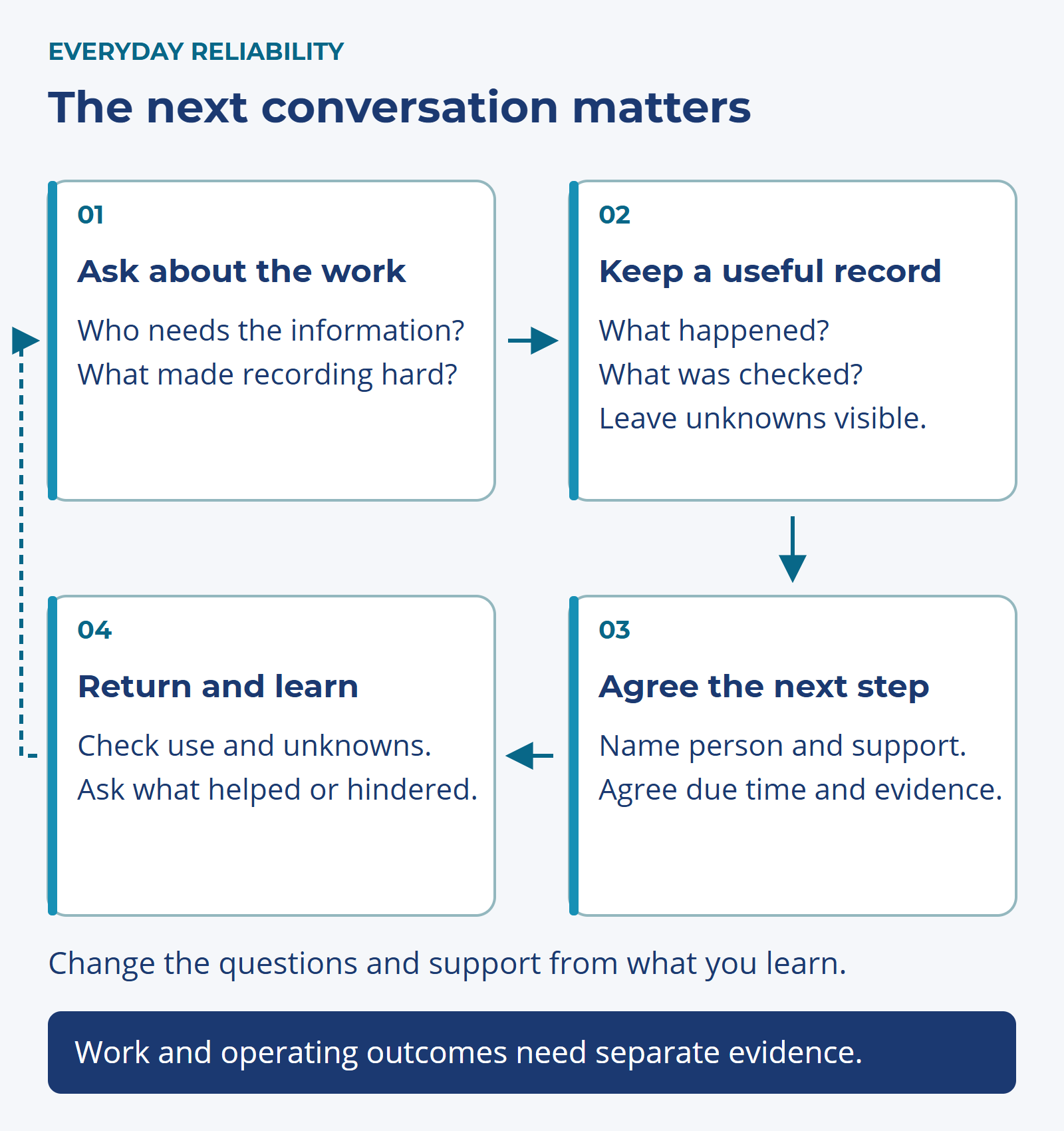
Original MDP conversation aid, developed from the handbook's leadership themes and the shared corporate Maintenance Model of Excellence V2. The arrows organise a review; they don't promise that a better note causes fewer failures. No source diagram is reproduced.
Look beyond the maintenance team
Sam has explained the queue at the terminal. Ruth can ask him to be more organised. She can also look at what would have to change for him to record the information at a better point in the shift.
That may involve operations, shift cover or the person responsible for system access. A maintenance instruction on its own can leave all of those arrangements exactly as they were.
The corporate maintenance model behind part of this guide connects the resources and information available to a team with work execution and operating results. It's shared organisational material, with contributions beyond my own. I've used that connection to develop the questions here, rather than reproduce its model or claim it as my individual work.
For WO-2104, the connection is quite ordinary. Someone needs time and access to record the observations. Someone else needs enough information to prepare or assess work. The maintenance and operating decisions that follow still need competent people, suitable resources and accepted checks.
I find that a useful way to discuss costs, too. A request for more time at close-out should explain what someone will use that time to produce. A request to reduce administration should consider what information would disappear and who would then have to recover it.
If Ellis has to find Sam on another shift to ask which bearing was changed, that is work as well. You'd need to observe or measure it before putting a saving against a proposed change. This example contains no such cost measurement.
Ruth brings Morgan from operations into the discussion about cover. They agree to try a short protected opportunity for recording after handover, fitted around the shift's accepted priorities. They don't prescribe the same number of minutes for every maintenance job. Sam helps choose a point that might work; Ruth owns arranging the trial and checking whether it actually happens.
That is a small example of cooperation across a boundary. Each person can see the practical request and its limits. Morgan gets to explain the demands on the shift before a promise is written against their name.
I'd want the same consideration for stores, procurement, engineering or IT when an action reaches them. Invite the person who can explain the constraint. Agree what they can provide. If the review group lacks authority or resources, identify who can make the next decision.
You don't need everyone in every meeting. You do need the relevant person's agreement before presenting their work as a commitment.
Make the commitment small enough to carry out
Ruth could leave the discussion with “improve completion notes” on the action list.
I'd expect that line to come back several times.
For the fictional trial, she and the people involved agree something more useful. By Wednesday 18 November, Ellis will draft a short prompt with Sam and Noor. It will ask for the component, observations, work done, check conditions and anything still unknown. Sam will try it during 19–26 November, using the agreed recording opportunity after handover.
Ruth will check that the opportunity is available and deal with interruptions. Ellis will review 4 selected comparable completion records with their writers before the next discussion. They will meet on Friday 27 November at 09:00 to examine what helped and what still needs changing.
The selection is deliberately small. It gives them examples to discuss. It won't establish the quality of every record or provide a reliable score for an individual.
Noor takes a separate question about the motor: what further bearing and operating evidence is needed, and who has authority to accept the technical assessment? That question stays open until the relevant evidence and decision are available. A tidy note won't close it.
I'd keep the action record brief enough that people use it. For each commitment, I want the work-order reference, the question being addressed, the agreed task, a person who has accepted it, a due time and what the next reviewer should expect to see.
“Ellis to improve notes” has an owner and still leaves most of the work undefined. “Ellis to bring 4 selected records and show which preparation questions they answer” gives the next conversation a purpose.
Ruth also has a commitment. She can't ask Sam to protect recording time while quietly expecting him to absorb it into an already full shift. The trial needs cover or a conscious choice about when the work happens. If she can't arrange that within her authority, she needs to take the constraint to someone who can decide.
I'd check that the task fits the person's workload before accepting their agreement. A nod at the end of an overrun meeting is a fairly thin basis for planning someone else's week.
The next review should have room for a difficulty as well as a completed task. People need to know where to raise it before the due date. Waiting until Friday to discover that the trial never had cover gives Ruth less chance to help.
Return to the evidence
Friday 27 November arrives. In the made-up review, Ellis brings the 4 selected records and discusses them with the people who wrote them.
All 4 identify the equipment and component. Three describe the conditions of the check afterwards. One still says only “tested”. Ellis could use the 3 fuller records to draft preparation questions for a similar job; he needs to go back to the writer of the fourth to understand its check.
That's what this small review establishes. The selection hasn't shown that failures fell or the site became more reliable. It has shown something about the usefulness of these records to this planner.
Sam says the agreed opportunity helped him record the details when it was available. He also identifies one busy shift when it wasn't protected. Ruth checks that account with Morgan and keeps the cover problem open. The trial hasn't removed the constraint just because the action sheet has a due date.
I'd ask Ruth to work through 3 different checks.
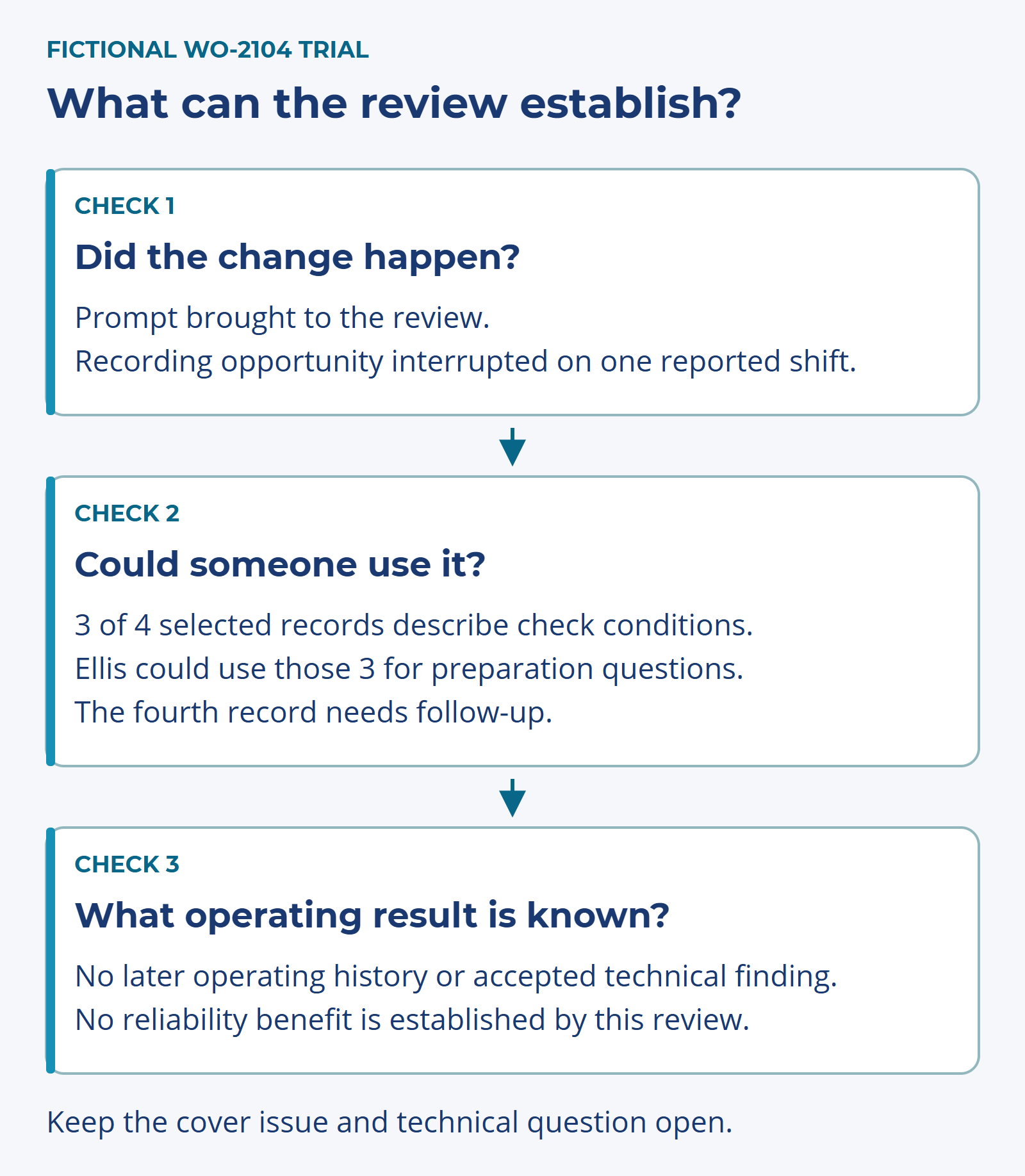
Did the agreed change happen? Ellis brought the prompt and records. The recording opportunity was interrupted on one reported shift. That gives Ruth a specific arrangement to revisit, rather than a reason to write “staff reminded”.
Could someone use what it produced? Ellis can point to the 3 records, the questions they answer and the further question left by the fourth. Sam can see the connection between what he entered and what another person needed.
What happened to the equipment or operating result? There is no later operating history or accepted technical finding in this example. Noor's evidence question remains open. The meeting can't reasonably claim improved motor reliability or a prevented failure.
That last question deserves its own time and evidence. A motor might run for a while without repeating the problem under different duty, or the observation period might simply be too short to learn much. You'd need the operating conditions, exposure and agreed assessment to interpret the result. I'm not supplying them here.
I'd also listen to the effort involved. Was the prompt useful at the terminal? Did it repeat something already entered elsewhere? Could a person on another shift use it? Did checking 4 records help Ellis, or leave him rewriting every note for everyone else?
Useful staff feedback can include “this part made the job harder”. Ask them to show where. Then decide whether to change the prompt, the timing or the expectation, with someone responsible for the choice.
In this example, Ruth continues the small trial while addressing cover, and Ellis follows up the unexplained check with its writer. The technical question remains separate. Those are fictional review decisions, with limited evidence behind them. They give the team a next step without pretending the work is finished.
 Open full-size image (opens in a new tab)
Original MDP review aid using the invented WO-2104 trial. Check implementation, use and operating outcomes separately. The partial result and open questions remain visible; this is no assessment of a real site.
For the fuller route from a measure to evidence, a decision and a later check, From maintenance data to decisions goes into the reporting work. The leadership choice here is to return and make time for that check.
Give credit for work that is easy to miss
A team dealing with an urgent breakdown deserves recognition for good work. I'd also listen for the quieter things that get noticed in the next review.
Does anyone mention that Sam left an uncertain cause visible? That Ellis showed which questions the history could support? That Sam raised the cover problem and Morgan helped Ruth check it?
Those contributions can disappear if the only story worth telling is how quickly someone got a machine running again.
I'd be specific with recognition. “Ellis could see what was checked and under what conditions in this note” tells the person which detail helped. A general thank-you for supporting reliability gives them much less to repeat.
The same care applies to a shortfall. The fourth record needs a better account of its check. Open it with the writer. Find out what they observed, what they understood the prompt to mean and what got in the way. Agree the correction and see whether the guidance needs changing.
You can keep that expectation while being fair about the conditions. The record still needs attention. Ruth's cover arrangement also needs attention. Each has a named owner, and the next review should ask about both.
I'd avoid converting these 4 records into a league table of technicians. The sample was chosen for discussion and is too limited to support that judgement. You would also lose the detail of the jobs and the conditions under which people wrote them.
A leader can instead recognise a useful correction, a clear unknown or an action brought back with evidence. It gives the rest of the team an example of what the leader wants to see.
And if Ruth promised support and didn't provide it, she needs to say so. “The agreed time wasn't available on that shift; I'm checking the cover” is something the team can follow up. Repeating the instruction to write better notes would leave her own action conveniently out of view.
Expect AI drafts to survive a conversation
Suppose an assistant is used to prepare this review.
I'd want the leader to ask what it received before reading its explanation aloud. Did it get the original work order, Sam's checked account, the agreed trial actions or the later review? Which versions? Did it receive any operating history?
For this illustration, the supplied pack contains WO-2104, Sam's confirmed observations, the trial commitments and Ellis's later review of the 4 selected records. It contains no established failure cause, later operating history or cost measurement. Ruth owns the review of the draft. Sam checks statements about his work; Ellis checks statements about use of the records; Noor owns the technical evidence question.
Here's a deliberately flawed sentence someone might put in the pack:
Poor technician discipline caused the bearing failure. The new recording process has resolved the reliability problem.
That's authored example text. No model was run to produce it.
Both claims go beyond the supplied observations. The record is thin; that doesn't establish what caused the bearing issue. Three notes could help the planner prepare questions; that doesn't establish a reliability improvement. A confident explanation would leave the team discussing a conclusion nobody has earned.
I'd expect Ruth to stop the explanation, check it with the relevant people and have it corrected before it enters accepted minutes. A replacement could say:
The cause of the condition reported on WO-2104 remains unestablished. In the small capture trial, Ellis could use 3 of 4 selected records to draft preparation questions. One check description needs follow-up, and an interruption to the agreed recording opportunity remains to be addressed. No later equipment result is supplied.
Every statement there can be traced to the fictional pack. It still needs the named people's check. An assistant's fluent wording doesn't remove that job.
If the earlier explanation has already been shared, I'd expect the correction to reach the people who received it. Leaving the old claim in a slide while quietly updating the source file gives the team 2 versions of what supposedly happened.
I'd also ask Sam what the arrangement feels like to use. Can he see and correct the description of his work? Is correction practical during the shift? Does he have time to check it? Can he challenge a misleading summary without having to argue against “the AI”?
Those questions belong in a leadership conversation about the working conditions. They give the person who has to accept the draft a chance to explain what help would look like.
Ruth still decides which review actions she can accept within her authority. Technical and operational decisions retain their designated owners. An AI-written recommendation doesn't become an instruction because it appears under an action heading.
AI in maintenance decision support covers the preparation and checking in more detail. Here, my expectation of the leader is that they make the inputs, uncertainty, corrections and human decisions visible, then listen to the staff who have to use the result.
Keep doing it when the week gets awkward
The difficult test comes when the meeting is running late and another problem is demanding attention.
Ruth could skip the trial review, ask for the action to be marked complete and move on. She could also acknowledge that the agreed check needs another slot, name when it will happen and keep the open issues visible. The team can tell the difference by what happens next.
I'd want urgent work handled through the site's priorities and authorised arrangements. I'd also want the leader to return to the commitment that was displaced. If a task is repeatedly pushed aside, discuss whether the team has the capacity, the authority or a sensible reason to keep it.
Sometimes the right decision will be to stop a trial. Perhaps the prompt duplicates information, the capture point doesn't work or the review effort brings little use. Record what was tried, what people found and why the decision owner stopped it. Tell the people who contributed.
That is useful learning, too. Staff shouldn't have to keep filling in an experimental form because nobody wants to admit it wasn't helpful.
If the trial continues, make the next commitment just as clear as the first. Who will resolve the cover question? What will Ellis check in the next records? Who will return with the technical evidence? Keep their different due dates and decision owners visible.
I'd look for continuity when shifts and supervisors change as well. Can the next person find the agreed question, the current evidence and the outstanding action? Or do they have to start again because the explanation lived in one person's memory?
In the handbook, day-to-day integration and communication sit alongside focused action and learning. I find that combination useful. You can ask a good question in a meeting once. Repeating it, providing the support and returning with evidence gives the team something dependable to work with.
There's no culture score hidden in WO-2104. There is a set of choices a leader can make, and records of what happened afterwards. That's enough to begin a practical conversation.
Take one work order into the next review
I'd choose a recent order whose history someone wants to use. Ask that person what they need to know, then invite the writer to explain the work and the conditions around recording it.
Agree one change the people involved can actually try. Name who will provide the support, who will use the result and when you'll look at it together. Keep technical questions and operating decisions with their authorised owners.
I've included a leadership conversation and review sheet to help record that discussion. It has a worked version of this fictional situation and a blank version. It's a static aid for a conversation; a person still needs to agree the action and accept what the returned evidence establishes.
At the next review, open the record again. Ask the writer whether the change was workable. Ask the user what it helped them do. Check the leader's own commitment alongside everyone else's.
Sam supplied information. Ellis checked what it could support. Ruth arranged support and came back to check what happened. Some questions remained open.
I'd be interested in a workplace where that sort of discussion became ordinary.
Related reading
- Why good intentions still produce poor maintenance data examines the conditions around entering a useful note.
- From maintenance data to decisions follows evidence through a review and into an agreed action.
- AI in maintenance decision support examines what an assistant receives, what people check and who decides.
Two planned short companions have narrower jobs: “Why I care about what happens after the meeting” will focus on my interest in follow-through, and “Helping people see the value of a good work-order note” will focus on feedback to the person entering information. Their examples and final text are still to be written.