An order is Complete on Tuesday, Reopened on Wednesday and Complete again on Thursday.
On Friday you open the backlog report as of 17:00 on Tuesday. Should that order be there?
I'd include that question in a system-change test. Here's the invented case I'd use. I haven't run it in a CMMS or reporting system, and no maintenance process owner has accepted it for operational use.
First, I'd sit down with that process owner and agree what the statuses mean for this measure. In this example, Open and Reopened count in the backlog. Complete doesn't. Reopened means some of the original scope remains. I'm leaving the reason unstated.
This measures status-based backlog. It says nothing about schedule attainment or physical-completion performance. If your site uses these statuses differently, you'd need to agree a different test before running it.
I'd keep the population small: 1 invented order, WO-T015, with no other orders or filters to complicate the count.
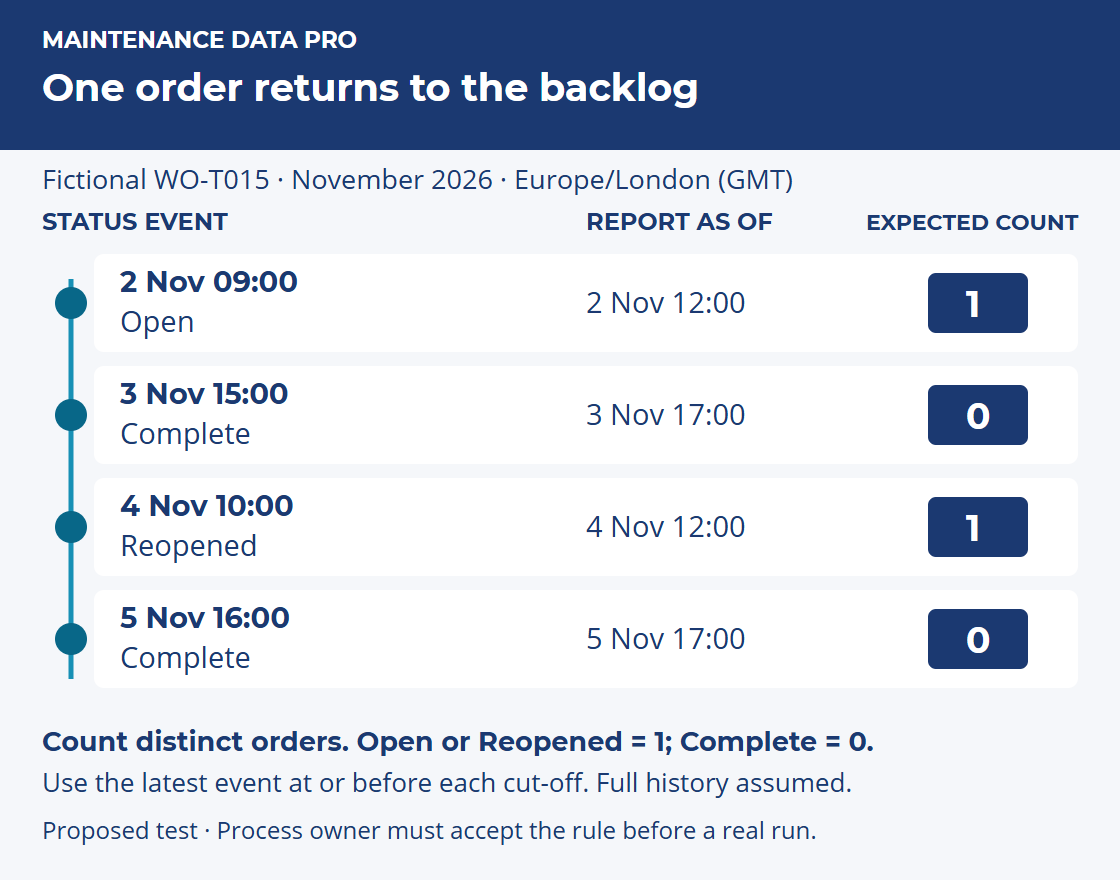
The order opens on 2 November 2026 at 09:00. It changes to Complete on 3 November at 15:00, Reopened on 4 November at 10:00, then Complete again on 5 November at 16:00. All times are Europe/London, GMT on these dates.
For this test, those 4 events are the complete history. Each change takes effect as soon as it's entered. There are no backdated entries, later corrections, deleted events or matching timestamps to resolve (those deserve their own cases).
At each cut-off, use the latest event effective at or before that instant. Count the distinct order once if its applicable status is Open or Reopened, otherwise count 0. A change applies from its effective instant, including a cut-off at exactly that time.
I'd write down these expected results before looking at any report:
| Cut-off in November 2026, GMT | Applicable status | Expected backlog count |
|---|---|---|
| 2 November, 12:00 | Open | 1 |
| 3 November, 17:00 | Complete | 0 |
| 4 November, 12:00 | Reopened | 1 |
| 5 November, 17:00 | Complete | 0 |
 Open full-size image (opens in a new tab)
Expected contribution of WO-T015 to the isolated status-based backlog at 4 cut-offs. Invented history; no system output or physical-completion KPI.
The process owner would need to accept the meaning and those expectations before a real run. The analyst checks the arithmetic and how the report gets back to the events. The tester records what actually appears.
I'd want more than 4 matching numbers. When the count is 1, WO-T015 should appear once. The detail should identify the event that applies to each cut-off. After the final completion, I'd run the earlier cut-offs again and expect the same results. Finishing the order on Thursday shouldn't erase Wednesday's reopened state from this history.
A wrong count, a duplicate order or detail pointing to the wrong event would fail this test.
Now give the analyst a much thinner export.
Imagine extracting it on 6 November at 09:00. There's 1 row: WO-T015, created 2 November at 09:00, current status Complete, latest completion 5 November at 16:00.
That's everything in this invented export. It contains no first completion, reopening event or earlier status history.
It supports a current backlog contribution of 0 at extraction. You can't establish all 4 historical results from that row alone. Using the latest completion date to keep the order open until Thursday would miss Tuesday's completion. Applying today's Complete status to every earlier date would miss Monday's open state and Wednesday's reopening.
If that's the only input available, I'd record the historical test as not demonstrated. Then I'd ask what evidence the reporting design can retain or retrieve. I wouldn't fill the missing history with a plausible story.
AI could help draft checks from the supplied events, counting rule and export fields, or flag that the export lacks the history the test needs. An analyst would still check each suggested result against those inputs. The process owner accepts the status meanings.
I've covered the wider definition questions in Defining a maintenance KPI people can defend, and the path through data, report and follow-up in Building a maintenance reporting system people can use.
For this one case, I'd start with the worked test card. Agree the expectations, record the available history, then leave space beside each expected result for the observed output and its evidence. That gives you something specific to check when an order comes back.