“Valve checked. Working OK.”
The next shift opens the work order. Was it checked with flow through the line? That's the condition they're interested in. The note doesn't say.
Here's a fictional handover.
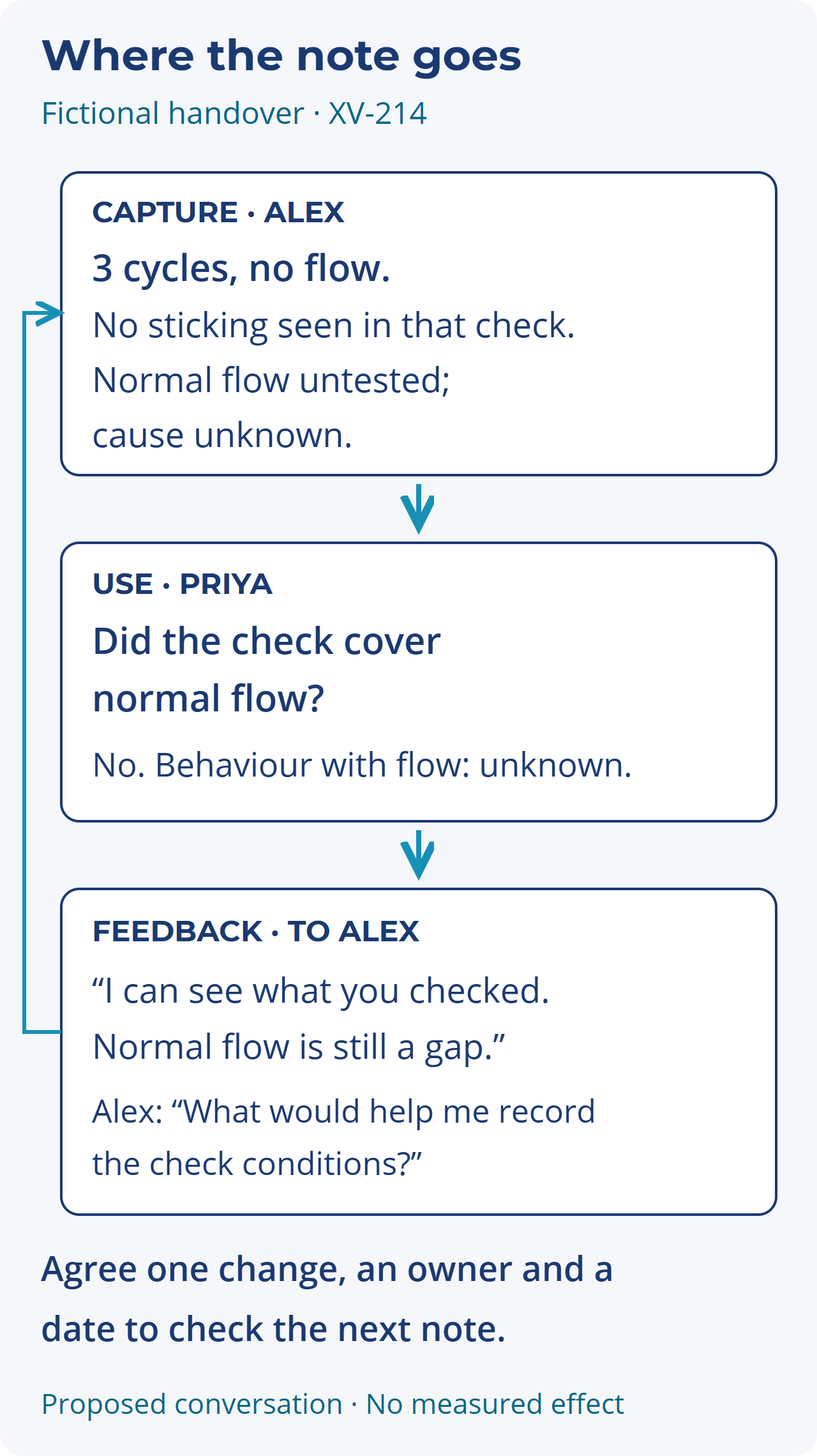
Alex, a technician, has investigated a report of intermittent sticking on valve XV-214. With no flow through the line, Alex observes 3 open-close cycles without sticking. There hasn't been a check under normal flow, and the cause of the reported problem remains unknown.
It's near the end of the shift. Another handover is waiting. Alex enters that short note and moves on.
Priya, the incoming shift supervisor, reads it while reviewing the outstanding issue. She needs to know whether the check covered normal flow before she can identify what still needs following up through the site's authorised process.
“Working OK” leaves her guessing about the conditions of the check.
I'd put those 2 people beside the same record.
Show the question the note has to answer
Priya could say: “I needed to know whether it was checked under normal flow. If you tell me there was no flow during the check, I can see that the operating condition I'm interested in still hasn't been covered.”
Alex already has that information. It just hasn't made it into the work order.
XV-214: 3 open-close cycles observed with no flow through the line; no sticking observed during that check. Not checked under normal flow. Cause of reported sticking not established.
Now Priya can answer one question: was normal flow covered? No. Whether the valve sticks under that condition remains unknown. She still needs to decide the appropriate follow-up with the authorised site roles. The note gives her a clearer starting point.
Alex also gets to see precisely why those few words about flow matter. That's more useful feedback than “please provide more detail” (which leaves quite a lot for someone to work out).
This is something I explored in the “Data Attitude” section of my draft reliability-culture handbook: can the person collecting information see how someone else uses it?
Glen Murphy's paper on manually captured data considers this too. He proposes that feedback about how data is used can influence whether people value collecting it. He also argues that feedback may achieve little when the person feels unable to act on it.
That last bit matters. Alex might understand Priya's question perfectly and still struggle to get a note entered before handover. Murphy discusses time pressure as something that can get between intending to record useful information and actually doing it. His paper offers a conceptual argument and suggested actions; it doesn't establish that this conversation will improve notes at your site.
 Open full-size image (opens in a new tab)
An original MDP conversation aid. The arrows show a proposed exchange, drawing on the handbook and Murphy's discussion of feedback and time pressure. They don't show a measured improvement.
Give the feedback somewhere to go
I'd try a short conversation around one record. The feedback conversation card keeps 4 prompts together:
- The reader: “I used this note to answer…”
- Together: “It told us this. This part is still unknown.”
- The person entering it: “What made that detail difficult to record?”
- Together: “What will each of us change, and when will we check another note?”
If Alex says the terminal is hard to get to before handover, Priya needs to take that constraint to whoever owns the shift arrangements or system access. A request for longer notes won't resolve it. Agree who'll address the obstacle and when they'll report back.
Then look at another note together. Could Priya answer the relevant question? Could Alex enter the information within the available time? Record what helped and what still got in the way. That gives you something to review; it doesn't prove the conversation changed anyone's behaviour.
AI could help prepare a draft. For this fictional job, you'd supply the valve identifier, reported sticking, 3 cycles with no flow and no sticking observed, the absence of a normal-flow check, and the unresolved cause. Ask it to arrange those observations and flag missing information. If a draft leaves out the supplied check conditions, asking “What conditions were checked?” would surface that omission. It mustn't invent an answer about an operating condition that wasn't checked.
That's a proposed use, with no model run behind this example. Alex would verify every statement and accept the record. Priya would check whether it answered her question.
For a fuller discussion, use the approved close-out conversation sheet, alongside the close-out article. Why good intentions still produce poor maintenance data explores the wider psychology.
For this week, I'd start small. Show one person where their note went, the question it answered, and the question you still need help with. Then give them time to tell you what would make that easier.