You're preparing a job to clean a cooling-water strainer. You need to know which gasket to put in the pack, so you open the last work order.
“Strainer cleaned. Back in service.”
That gives you another question for the technician (assuming you can find them).
Here's a fictional job behind that note.
The technician works on cooling-water strainer ST-204. Before cleaning, the differential-pressure indicator reads 0.8 bar. They open the strainer and find brown debris covering part of the basket. They remove the debris, clean and refit the basket, and use 1 cover gasket. The work takes 2 technician-hours.
After return to service, the indicator reads 0.2 bar. The technician sees no leakage at the cover during a 10-minute check. Flow isn't recorded. Nobody has established where the debris came from.
There's also a useful bit of feedback: the replacement cover gasket wasn't included in the job pack.
The short note leaves the planner to find most of that out again.
I'd want the next person to have something like this:
ST-204 cooling-water strainer. Differential-pressure indicator read 0.8 bar before cleaning. Brown debris covered part of the basket. Debris removed; basket cleaned and refitted. Used 1 cover gasket. Work took 2 technician-hours. After return to service, indicator read 0.2 bar. No visible cover leakage during a 10-minute check. Flow not recorded. Source of debris not established. Preparation feedback: replacement cover gasket was missing from the job pack.
It's longer, yes. Each detail gives someone something to work with.
The planner has a starting point for the next job.
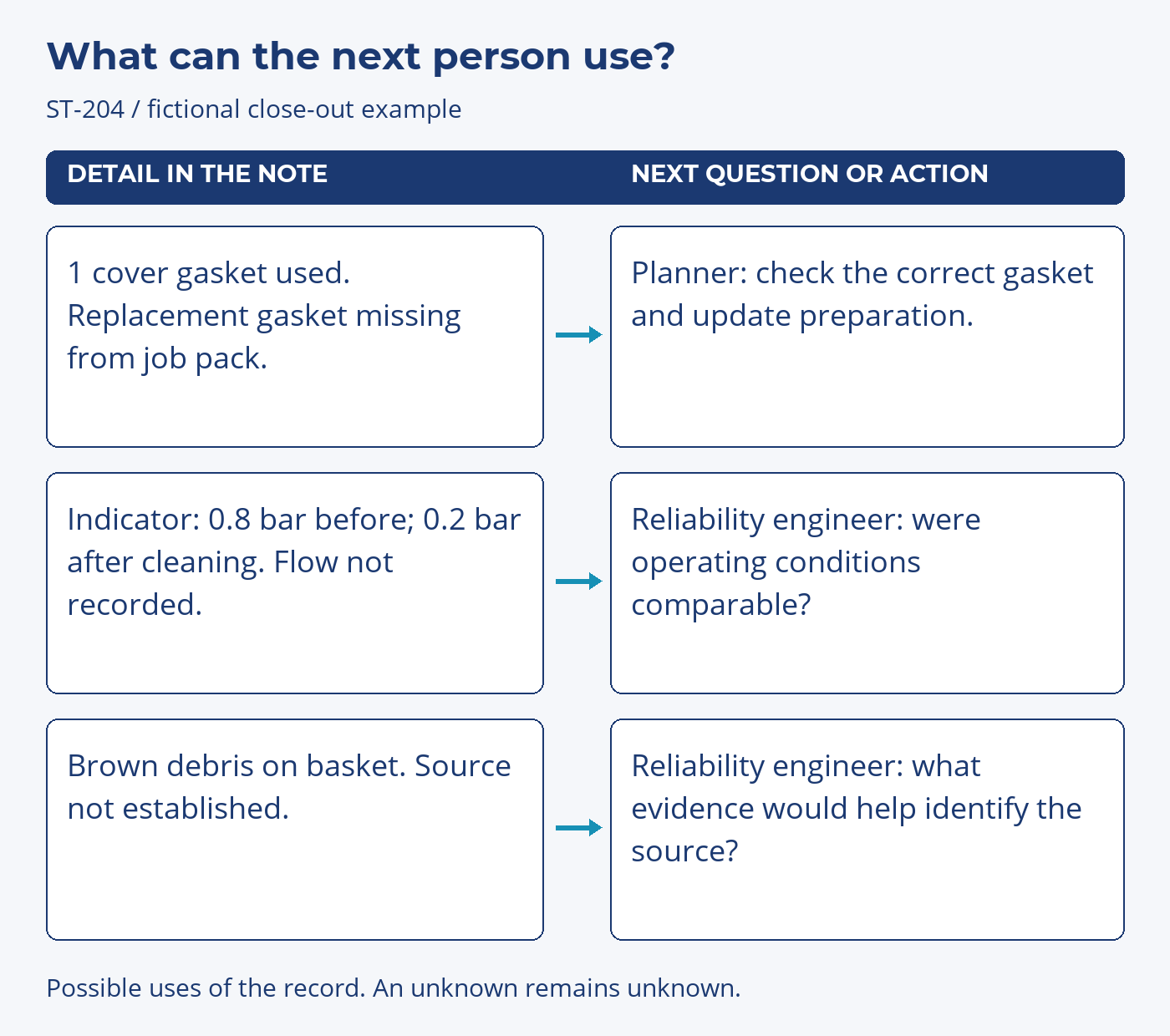
They can see that a gasket was used and that the previous job pack missed it. They can check the correct part against the equipment information and update the preparation. The 2 technician-hours give them a previous actual to consider alongside the scope and conditions of the next job.
I'd use those 2 technician-hours as a reference for labour. If I needed to know how long to book the equipment out for, I'd still have to ask. One completed job tells you what happened on that occasion. The next job may need different access, people or support.
The feedback still needs to reach someone who can change the pack. I'd agree who'll check it and where they'll record the update. Leaving the comment buried in the history gives the next planner another thing to stumble across.
The reliability engineer can see both the observation and its limits.
The recorded pressure drop was lower after cleaning. That's useful. Without the flow, they can't assume the 2 readings were taken under comparable operating conditions.
And “brown debris” gives them a description of what the technician saw. Calling it corrosion would add a conclusion the example hasn't established. They might want a sample or a photograph next time, depending on what they're trying to investigate.
I'd keep “source of debris not established” in the note. It leaves the next question visible: is this a repeat problem, and what evidence would help explain where the material comes from?
 Open full-size image (opens in a new tab)
A useful note gives the next person a starting point and shows where they still need evidence. Fictional example showing possible uses of the record.
In my draft handbook on reliability culture, I describe close-out as recording the work history and then having a supervisor or peer review it. That includes equipment condition, resources used and feedback for future preparation and reliability work.
For this job, I'd ask the reviewer to check the note against what the technician actually observed. Does it identify the equipment? Can you follow what was found, what was done and what was checked afterwards? Are the unknowns still clear?
I'd also check that the hours and materials agree with the relevant work-order entries. This example note covers part of a close-out; the site's required records and acceptance checks still need completing.
A small handover sheet could help that conversation. I'd try 5 prompts: equipment, findings, work done and resources used, checks afterwards, and the question or preparation change being handed on. Give the follow-up an owner and a place to find it again.
Try it with a planner and a technician on one completed job. Ask the planner what they could prepare from the record, and what they'd still have to go and ask someone. That's where I'd start improving the next note.