There's enough work on the improvement list to keep everyone busy until next Christmas.
The planner wants to sort out the materials information that keeps coming back with questions. The reliability engineer wants equipment references checked so she can investigate repeat repairs. Someone would also quite like to stop copying figures into the weekly review pack.
All reasonable requests. Who has time to do them?
I'd start by putting that question beside the list, before giving every idea a score.
In my draft reliability handbook, I use effort and value to help compare improvement actions. The shared corporate Maintenance Model of Excellence also connects an opportunity finder to agreed improvement plans and review. My 2017 MSc dissertation prioritised recommendations for a particular company using estimated contribution and effort. Those were recommendations and modelled possibilities; they weren't evidence of benefits achieved by implementing them.
For a new team, I'd want fresh estimates grounded in the work they can see. Here's a made-up example. Every person, record and figure below is fictional.
Find the time people can actually give
Ben, a planner, can offer 10 hours over the next 4 weeks. Asha, a reliability engineer, has 8. Erin, the maintenance supervisor and decision owner for this small improvement allocation, has 6.
That's 24 person-hours across the team. If all 3 attend a 1-hour meeting, they've used 3 of them.
Erin agrees to hold back 2 hours of each person's allowance for interruptions. That leaves 18 hours they can plan against: Ben 8, Asha 6 and Erin 4. These hours are additional to their normal duties, with no overtime or extra staff assumed. Required safety work and urgent defects follow the site's authorised arrangements; they don't wait for a good position on this list.
Now there's a constraint worth discussing. “A few hours when you get a chance” would leave everyone making a different assumption.
The team puts 3 candidates on the table. Each scope includes preparation, trying the change with its users, checking the result and leaving usable instructions. The estimates cover the whole team's effort, including those users, within the allowances above. They assume existing tools and access, with no purchase or system configuration change.
Give each idea something solid to stand on
A: Improve one materials-status handover.
In the previous 4 weeks, the fictional team logged 24 eligible handovers within the job family proposed for the trial. Those handovers generated 12 clarification requests. Eight concerned missing materials-status information; 4 concerned other matters. Their diary records 20 person-minutes of combined staff effort for each request.
Ben proposes agreeing what the next person needs to know about materials status, trying that handover on one job family, then reviewing the records with Erin and Asha. It would leave the site's purchasing, stock and work-release controls in place.
They estimate 12–16 hours: Ben 5–7, Asha 4–5 and Erin 3–4. The upper estimate fits every person's available allowance.
The hoped-for benefit is avoiding 6–8 of the 8 materials questions in another 4-week period with 24 comparable handovers and a similar job mix. At 20 minutes each, that's 120–160 minutes, or 2 hours to 2 hours 40 minutes, before subtracting any extra handover effort. The other 4 requests stay outside the claim.
I'd ask why they expect to avoid so many. In this example, Ben has checked the 8 requests and found that each asked for information already available to the person handing over the job. That makes the idea worth trying. It still doesn't establish that people will record it consistently, that the reader will understand it or that next month's work will look similar.
B: Reconcile equipment references for a repeat-repair review.
Asha has 5 repair records that she can't confidently connect to the equipment entries in another report. She wants to check the links before using them to select an investigation.
An initial estimate for resolving the wider reference problem is 24–36 hours: Ben 6–8, Asha 14–20 and Erin 4–8. Even its lower end exceeds the 18-hour allowance. Asha's time alone is a problem.
She could instead spend 6 team hours checking those 5 records: Ben 2, Asha 3 and Erin 1. The output would be confirmed links, unresolved cases and a better-defined follow-on proposal. Nobody can yet defend an estimate of failures prevented or production recovered. The check could establish that the records concern different equipment.
I'd keep “value not yet estimated” visible. Giving an enabling task a zero because its benefit is uncertain would make it very easy to keep postponing the information needed for a better decision.
C: Reduce manual preparation of the weekly review pack.
Ben's diary shows 60 minutes a week spent copying figures and checking the pack. He proposes using an existing export to reduce the copying while retaining checks against the source totals.
The team estimates 10–14 hours: Ben 8–10, Asha 1–2 and Erin 1–2. The total fits inside 18. The upper estimate for Ben exceeds his 8 available hours.
They estimate removing 30–45 minutes of work a week, leaving 15–30 minutes for preparation and checks. Over 4 weeks, that would release 120–180 minutes, or 2–3 hours. Those diary entries cover pack preparation only; they exclude the clarification work in A.
The proposal needs a trial showing that the export preserves the agreed population and totals. A quicker pack with missing orders would give the team another problem to sort out.
 Open full-size image (opens in a new tab)
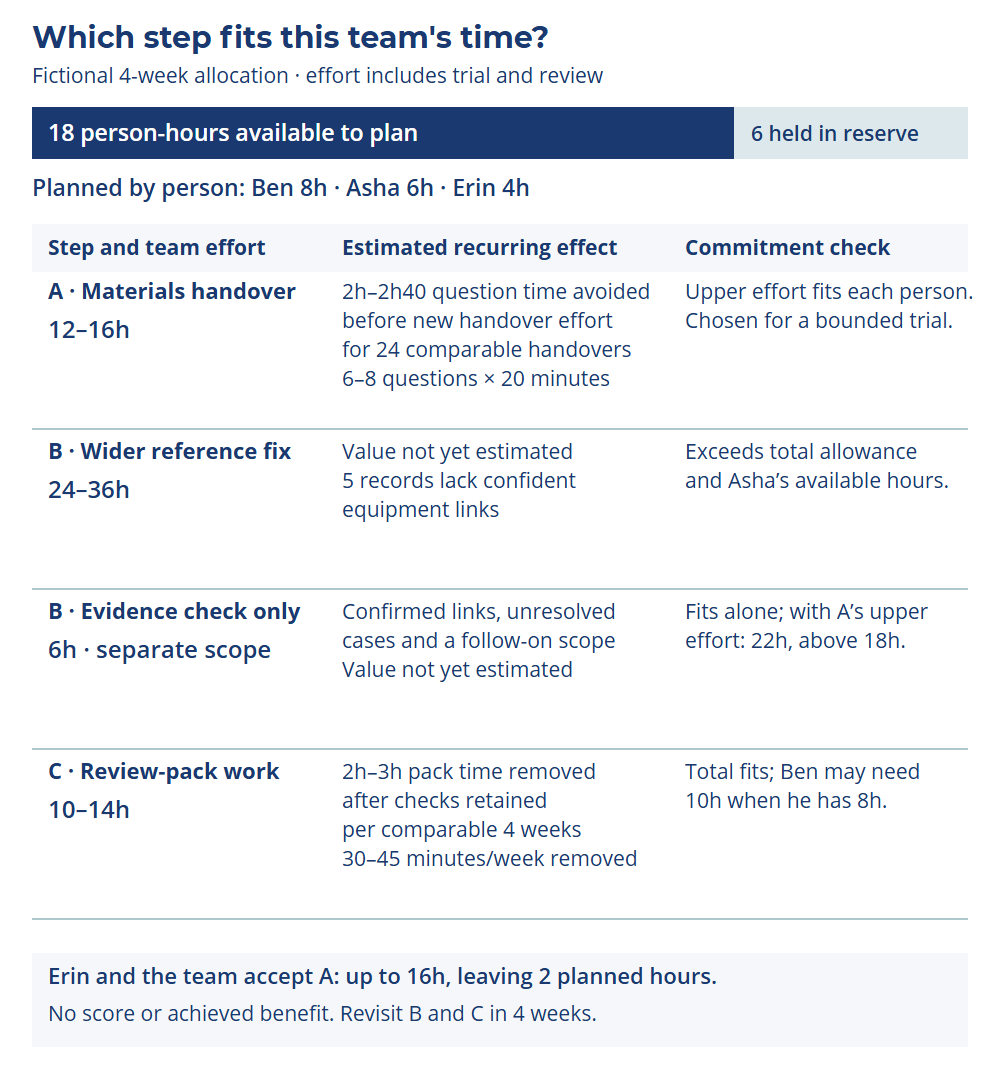
An original fictional comparison. A's question time avoided is before new handover effort and assumes another 24 eligible handovers in 4 weeks. C's estimate allows for retained pack checks. B's 6-hour check is a separate alternative scope. Implementation effort includes introduction and review.
Let the comparison start the conversation
A and C have overlapping estimates of recurring time avoided, with A's extra handover time still to subtract. C may take less effort overall. A fits within each person's allowance at the upper end of the estimate. B could help the team ask a better reliability question, with its operational value still unresolved.
I wouldn't turn that into a league table with decimal places.
There's no weighted score here. If a team uses one, it needs to agree what each criterion means, why one gets more weight and what would make them override the result. Multiplying an uncertain “value 4” by an agreed weight won't establish how many hours a change will release. A score can help people expose disagreements; the accountable team still accepts the trade-offs.
These time estimates describe staff capacity. The employees remain employed and their salaries continue. No payment reduction is claimed. The team would have to decide what useful work any released time could support and check whether that happened.
If they later attach money to an opportunity, I'd use the separate checks in What a maintenance saving leaves out: which payments change, what happens to total expenditure, and what value is being modelled. Equipment records that might support an investigation don't yet establish a production benefit.
I'd also ask about dependencies. Will the proposed change work with the existing handover? Does someone else have to change a report first? Has another proposal already claimed the same minutes? Put those conditions beside the estimate while people can still challenge it.
Choose the next step and say what waits
Erin and the team choose A for this 4-week window. In the fictional discussion, their immediate aim is to reduce materials-status questions during job preparation. Ben and Erin can try the handover together, and the upper estimate fits without using the reserved hours.
They accept that C might release more time. Proceeding with its current scope could require Ben to take time from another duty or consume his reserve. They could narrow it, transfer some work or reconsider the allocation; nobody has agreed a workable version of those changes today. It stays on the list for the next review.
B stays visible too. Its 6-hour check would fit on its own. Adding it to A's upper estimate would require 22 hours, which exceeds the 18 planned hours, and would overbook all 3 people. Calling it “just a quick check” won't create the missing time.
That choice has a consequence: the repeat-repair review remains limited by those unresolved equipment links. Erin records that limitation and brings the decision back in 4 weeks. If new evidence shows an urgent equipment concern, it goes through the site's existing escalation route sooner. This allocation doesn't authorise operating with an unresolved risk.
Ben owns preparing A's handover example. Asha checks the comparison records. Erin makes sure Ben has time to record the materials status, accepts the trial arrangements and returns with the team to decide whether to continue. They reserve up to 16 of the 18 planned hours for A, leaving 2 unallocated within the planned allowance as well as the separate 6-hour reserve.
Decide what you'd need to see afterwards
The team records the next 4 weeks' eligible handovers in the chosen job family, the materials questions raised, the time spent answering them and the time taken to add and review the information. Ben also keeps the original request records and the effort diary.
At the review, Asha checks the workload and job mix before comparing periods. Fewer questions during a quiet month would need some explanation. Extra recording time comes out of any claimed release of time, and the team asks the receiving person whether the handover was useful. They make no claim about schedule performance or equipment reliability from this small trial.
Erin can continue, change or stop it. The returned evidence might show that the prompt duplicates something already recorded, or that the estimates were optimistic. That's a reason to revise the choice. Building a culture of reliability through everyday work looks more closely at providing support and returning to commitments like these.
I've included an opportunity and assumptions worksheet with this worked comparison and blank prompts. It keeps the evidence, estimates, scarce people's time, dependencies and accepted next step together. It's a static discussion sheet, ready for a team to adapt.
An AI assistant could help organise candidate ideas or test what happens if A takes longer. Give it the recorded counts, time allowances, effort ranges and stated assumptions. Ask it to preserve “unknown” where B has no defensible benefit estimate, and to show any arithmetic it adds. Ben would check the records and calculations; each person would accept their effort estimate, and Erin and the team would own the choice. This is a proposed use, with no model trial or live workflow behind it.
For the next review, bring a short list and the people who'd have to do the work. Put their available time beside the estimates. Agree one step they can complete and check, then write down why the other ideas will wait.
I'd want everyone leaving that conversation to recognise the commitment they've just made.