“You've marked that job ready. Who's putting the scaffold up?”
“The scaffold requirement's in the work pack.”
“That's not what I asked.”
You can imagine how the rest of that meeting goes.
Let me use a made-up example. A maintenance team needs to replace an elevated valve. The planner has worked through the scope with the people involved. The parts are available, the craft hours are estimated, and the scaffold requirement has been assessed with the scaffold team. The work pack describes the access needed, the estimated effort and the sequence: erect the scaffold before the valve work, then remove it afterwards.
The planner marks the job “ready to schedule”.
The scheduler opens it and asks whether the scaffold team can support it next week. Nobody has checked their availability for that week.
The planner thinks they've handed over a prepared job. The scheduler thinks they've received another job with something missing.
Both have a reason for their answer.
I'd ask them to leave the status field alone for a minute and explain what they expect the next person to do.
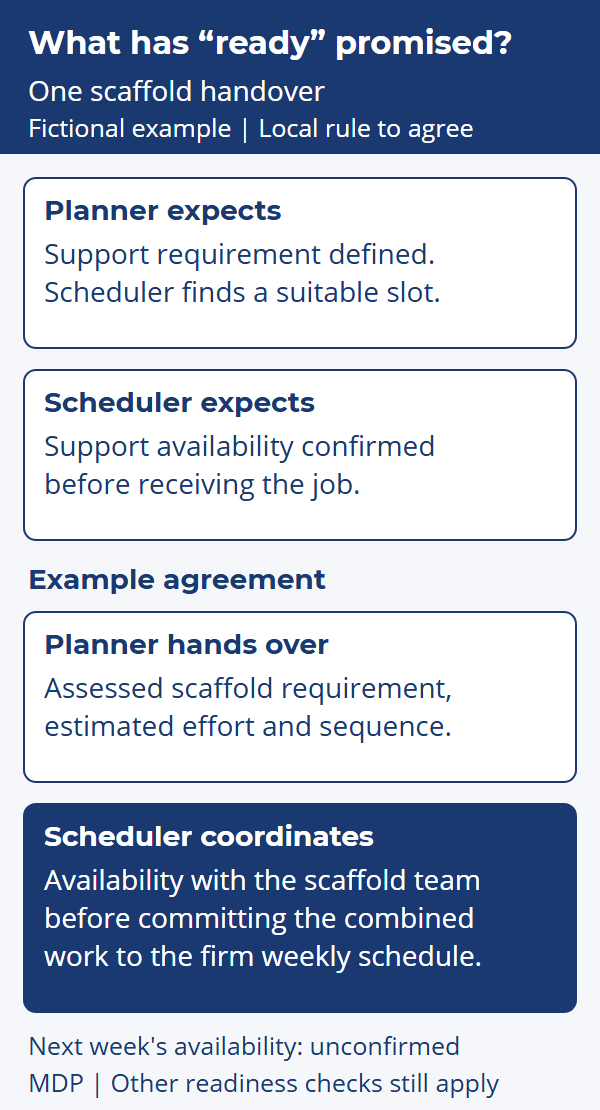
The planner expects the scheduler to find a week when the valve work and scaffold activities can fit together. The scheduler expects support-service availability to have been confirmed before the order reaches them.
There's the disagreement. Who establishes availability, and at which point?
In my draft handbook on reliability culture, preparation includes identifying the support services, activities and dependencies a job needs. Scheduling matches that workload to the craft capacity and operating constraints available at the site. That gives me somewhere to start the conversation. Your site's handover still needs an agreed boundary.
For this fictional job, I'd bring the planning and scheduling teams together with the scaffold representative. Open the work pack. Can the scaffold team understand what's required and estimate the work from it? Does the scheduler have enough information to compare that demand with the other work competing for their time?
If the access requirement still needs assessing, there's preparation to finish. In this example, that assessment is already done. The unanswered question is whether the team can fit the assessed work into a particular week.
Suppose they agree that the scheduler will coordinate that availability when considering a slot. The planner will hand over the assessed requirement, effort and dependencies. The scheduler will seek confirmation from the scaffold representative before committing the combined work to the firm weekly schedule.
Now they can write down what “ready” means for that handover.
Prepared for scheduling: the work pack defines the scaffold requirement, estimated effort and sequence. The scheduler coordinates availability with the scaffold representative before the job enters the firm weekly schedule.
That's an example agreement for this one disputed condition. Other readiness checks still apply. Permission to start work follows the site's own controls.
 Open full-size image (opens in a new tab)
One disputed condition, made explicit. This example agreement is a discussion aid; your site may put the boundary elsewhere.
I'd also keep “scaffold availability for next week: unconfirmed” visible against the order. Otherwise, someone reading “ready” could assume that conversation has already happened (and discover the gap on Monday morning).
You could put this agreement on a small definition sheet. Give it space for the decision the status supports, what each team currently assumes, the evidence to hand over, and who confirms anything still outstanding. Record who accepts the agreement and when you'll review it.
Then try it on a few actual orders with both teams. Give them the same work pack and ask each person whether it meets the agreed definition. Where their answers differ, open the detail together.
I'd want to hear the scaffold representative's answer too. They've got to deliver the support everyone else is discussing.
Start with the condition that keeps causing an argument. Agree what the person handing over must establish, what the person receiving must decide, and where the remaining uncertainty will be shown.
Then check whether both teams give the same answer next time.