“That job was approved 3 weeks ago. Why isn't it on next week's schedule?”
The planner opens the order. There's a purchase order for the replacement valve. The description says “replace passing valve”. Operations know about it.
It looks as though someone should be able to give it a date.
Then the questions start. Has the valve arrived? Which section of plant needs to be available? Does the job need access equipment? How long will the equipment be out of service?
Someone has approved the work. There's still quite a lot to establish before anyone can make a useful commitment to carry it out.
Let me use a made-up example. The arrangements are there to make the handover visible, rather than describe how every site should work.
What did the approval actually settle?
Order 64128 is to replace a passing cooling-water isolation valve, CW-V-17.
For this example, approval means the reviewer has accepted that the work is needed, checked the equipment and defect information, and assigned a priority using the site's process. The team has agreed to prepare the job.
It hasn't yet established the replacement specification, the access arrangements or the plant conditions needed to do it.
Your approval might cover more than that. It might include a funding decision or a more developed scope. I'd want to know what the person approving the order believes they've agreed, and what the next person expects to receive.
Otherwise, “approved” can carry several different promises around the same meeting table.
In my draft handbook on reliability culture, I separated screening and prioritisation, preparation, and scheduling. The practical reason for keeping those steps visible is that each leaves the next person with something different to work with.
The reviewer establishes whether the work is valid and how important it is. Preparation establishes the activities, resources and constraints. Scheduling brings that prepared work together with the capacity and operating conditions available.
A missing valve specification will need attention somewhere in that sequence. Giving the order a date won't answer it.
Follow the job far enough to find the missing information
Suppose the planner speaks with the technician and operations representative about 64128. They confirm the valve tag and the symptom. The valve needs replacing, and the job will require a planned interruption to that section of cooling water.
The planner develops the task sequence and estimates 2 mechanical technicians for 4 hours. That's an estimate for this fictional scope; another valve job could need something quite different.
Access has been checked. The replacement and associated consumables have been specified. Operations have identified the plant conditions and preparation needed for the job. The site's permit and isolation arrangements will still govern whether the work can start.
Now look at the material record.
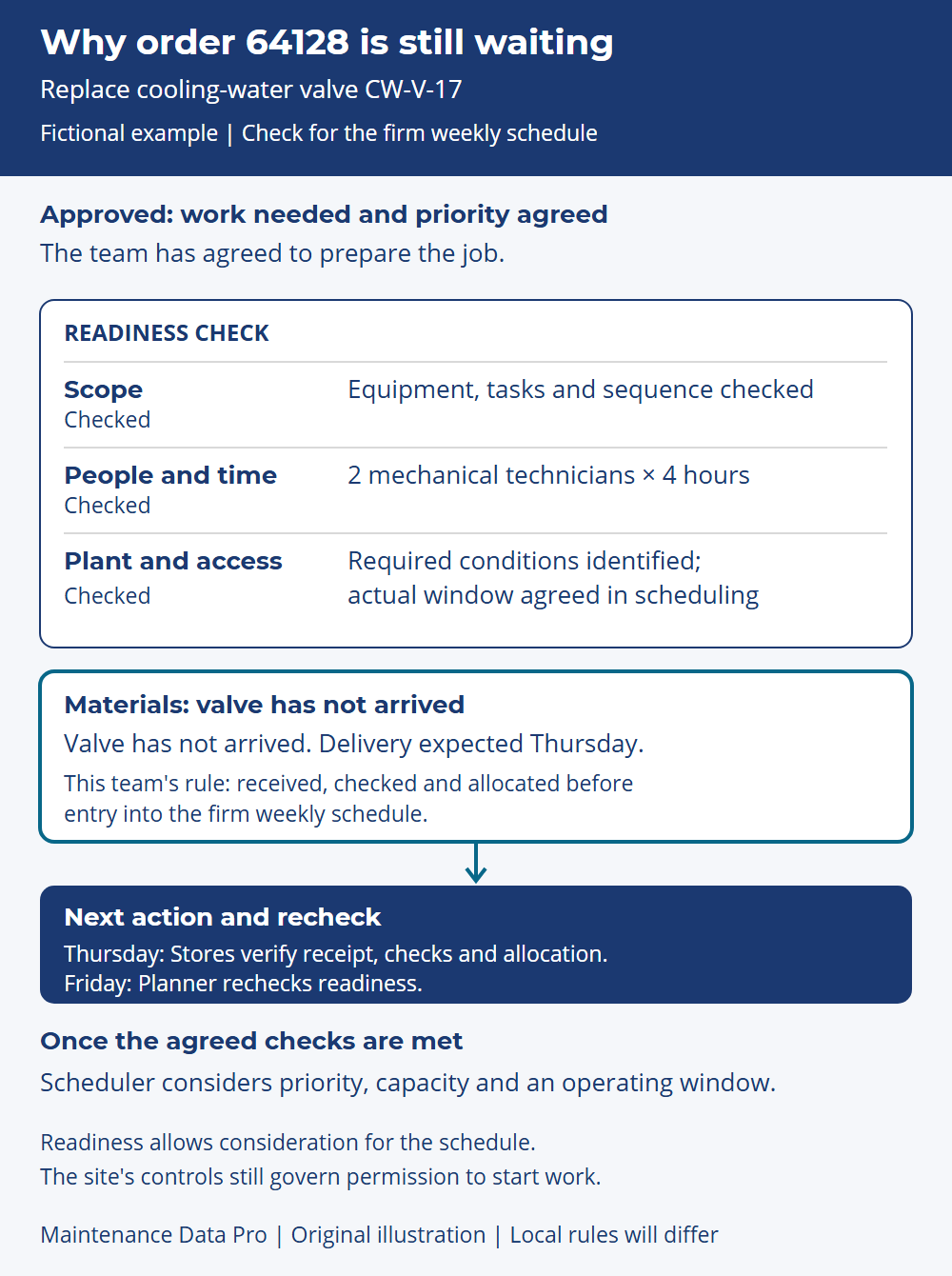
The purchase order exists. The supplier expects delivery on Thursday. Stores haven't received the valve.
Would you call that job ready for a firm commitment next week?
For this example, the team has agreed that required materials must be received, checked and allocated to the order before it enters the firm weekly schedule. A supplier's expected delivery date doesn't satisfy that check.
The planner records the outstanding condition: stores to check on Thursday whether the valve has arrived, passed its checks and been allocated, then the planner to recheck readiness on Friday.
That's a much more useful conversation than “it's still with planning”. Someone can see what's missing, who can resolve it and when to look again.
There's no suggestion that the planner should personally make the delivery happen. The action belongs with the person who can confirm it. The planner needs the answer to complete the handover.
Agree what you're checking before colouring the box
I'd be careful with a field called “Ready”. Ready for which decision?
In this example, the readiness check supports selection into a firm weekly schedule. It asks whether the scope and resource requirements are sufficiently prepared, materials are available, and the operating constraints are understood. The scheduler then has enough information to seek a workable slot.
The exact date, crew allocation and operating window still need agreeing during scheduling. Permission to start work comes through the site's own controls at the appropriate time.
A longer-range lookahead can include jobs awaiting delivery, provided that uncertainty is visible. You might provisionally coordinate the valve replacement with a possible plant window while chasing the material. I'd want everyone to understand that the slot depends on a condition that hasn't yet been met.
That's a different commitment from putting the job into the firm schedule as though the valve were already on the shelf.
Your site may accept a confirmed delivery against a particular cut-off. Another may require materials physically available much earlier. Agree the rule for the decision you're making, including who can accept an exception and how it will be recorded.
“That's how I thought it worked” is a fairly expensive thing to discover once people have turned up to do the job.
 Open full-size image (opens in a new tab)
A worked readiness check using the fictional site's rule for its firm weekly schedule. The delivery forecast remains visible without treating it as confirmed availability. Readiness allows the scheduler to consider the job; it doesn't authorise work to start.
Two approved orders can need different conversations
Take another fictional order, 64145, to replace a damaged local pressure gauge on a separate utility line.
Its scope and task sequence are prepared. The correct gauge and consumables are available and allocated. The planner has identified the craft requirement and duration, and operations have confirmed the relevant plant constraints. It meets this team's readiness checks.
There's still no suitable instrument technician capacity in the proposed week.
Both orders could appear on a report headed “Approved, not scheduled”. Yet the next action differs.
For 64128, confirm the material availability and recheck the job. For 64145, the scheduling discussion needs to consider capacity and competing work. Someone with the appropriate authority may need to decide which work takes precedence.
Sending both back to the planner with “please progress” gives them very little to act on (and another message to answer).
I'd want the report to show the reason each job is waiting, alongside the person responsible for its next action. Where the answer is unknown, show that too. “Material availability not checked” and “material confirmed unavailable” lead to different tasks.
Keep the information small enough that people will maintain it. An order reference, an outstanding condition, an action owner and a review date can be a useful starting point. The supporting detail can remain in the work pack and linked records.
Keep priority in the conversation
A prepared gauge job might be easier to place than a more important valve job that's waiting for a part.
I'd still want the person accountable for the valve's risk to know about the wait. The team may need to expedite delivery, reconsider the proposed solution or review how the defect is being managed until the work can happen.
Those decisions need the site's risk and work-management processes. A readiness check alone can't settle them.
Equally, the oldest approval date doesn't tell you which work should go first. An order can be old because it's awaiting a planned outage, because someone hasn't resolved a preparation gap, or because no one has checked it recently. You need to open the record and talk to the people involved.
For 64128, I'd keep the material action visible alongside its agreed priority and required timing. That gives the reviewer a chance to ask whether Friday's recheck is soon enough. If the situation changes before then, someone needs to revisit the decision.
A readiness checklist for the next conversation
I'd start with a few approved orders that people expected to see on the schedule. Sit with the planner and the person who builds or agrees that schedule. Bring in operations, stores or a craft representative where their answer is needed.
Use these questions to agree what the next person needs:
- Scope: Are the equipment and defect details clear? Are the tasks, sequence and relevant dependencies defined?
- People and time: Are the crafts, support services, special tools and estimated durations identified well enough to build the schedule?
- Materials: What does availability mean for this scheduling decision? What evidence shows the required parts and consumables meet that rule?
- Operating conditions: Are access needs, plant conditions and coordination requirements understood? Which arrangements must be confirmed when choosing the slot?
- Outstanding conditions: What's unresolved or unchecked? Who will act, by when, and who will recheck readiness?
- Handover: Does the scheduler have enough information to consider the job? Has the appropriate person accepted that handover under the site's process?
Record “unknown” where it belongs. Use “not applicable” only when someone can explain why. Six tidy ticks won't help the technician if a required tool hasn't been considered.
A small readiness worksheet could hold those answers and the follow-up actions. I'd try it on a few jobs before asking anyone to maintain another system field. The people receiving the handover can tell you whether the answers actually helped them choose and prepare the week's work.
Start with the approved order that keeps coming back to the meeting. Find the condition that's holding it up, agree who can resolve it, and give the next person a clear point at which to check again.
Then, when someone asks why it still hasn't been scheduled, there's an answer they can use.